




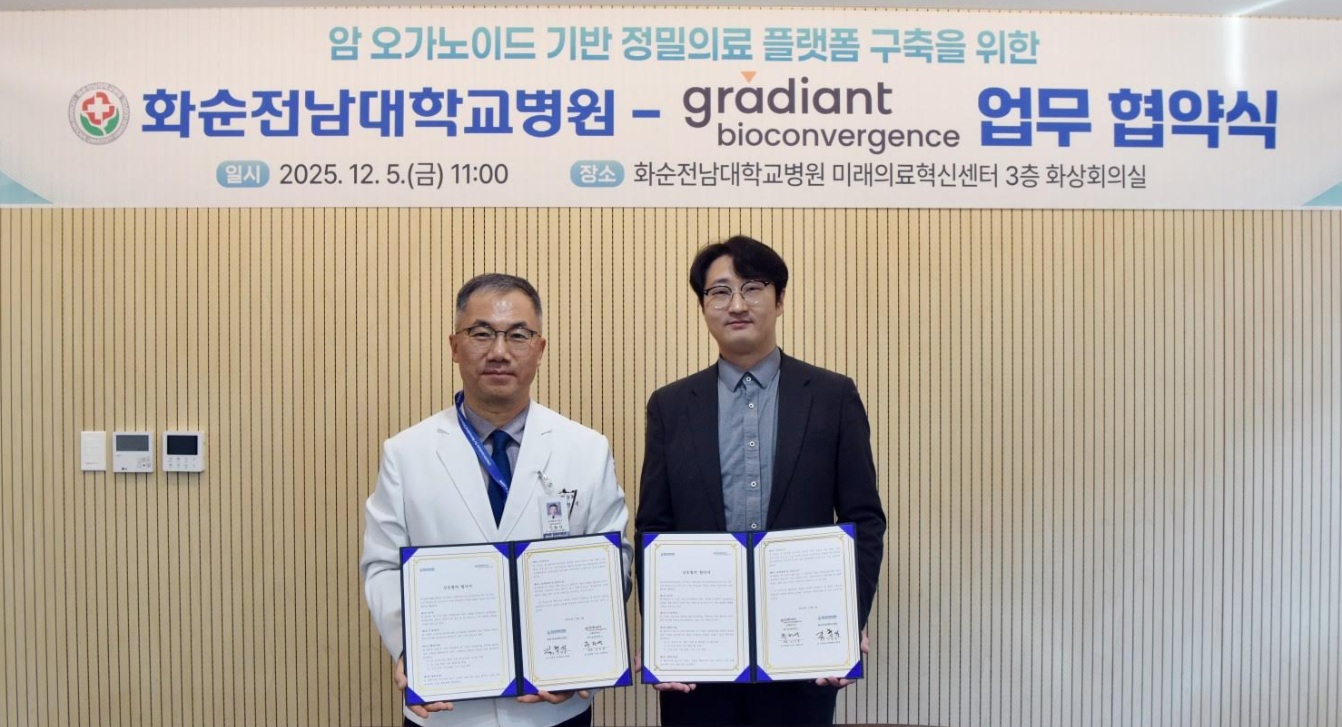
그래디언트의 자회사 그래디언트 바이오컨버전스(대표이사 남인봉)는 화순전남대학교병원(병원장 민정준)과 정밀의학 연구 역량 강화를 위해 업무협약을 체결했다고 8일 밝혔다.
이번 협력은 환자 기반 임상 정보와 오가노이드 분석 데이터를 통합해 항암제 반응 예측 정확도를 높이고, 초기 연구 단계의 실행력을 강화하는 것을 목표로 한다. 양 기관은 화순전남대학교병원의 임상 기반 연구 자원과 그래디언트 바이오컨버전스의 오가노이드 및 AI 기반 분석 기술을 연계해 암 오가노이드 뱅크 구축, 항암 타깃 발굴 등 정밀의학 연구를 공동 추진할 계획이다.
협약에 따라 화순전남대학교병원은 암환자 조직·임상 정보 제공과 연구 참여 동의 절차 등 임상 기반 인프라를 제공하며, 그래디언트 바이오컨버전스는 환자 유래 오가노이드(PDO) 생산 및 분석과 AI 기반 바이오마커 발굴 역량을 활용해 비임상 연구를 수행한다. 이를 통해 임상–비임상 연계 중심의 상호 보완적 연구 협력 구조가 마련된다.
양 기관은 주요 암종별 PDO 구축, 표준운영절차(SOP) 정립, 차세대 치료제 반응성 검증 모델 개발 등 단계적 공동 연구도 이어갈 예정이다.
남인봉 대표는 “임상 데이터 자원과 AI 기반 오가노이드 기술의 결합은 정밀의료 혁신의 핵심 요소”라며 “이번 협력이 암 정밀의학 연구의 깊이와 적용 범위 확장에 기여할 것”이라고 말했다. 김형석 화순전남대학교병원 의생명연구원장은 “협약이 정밀의료 연구 경쟁력 강화와 산학연 협력을 통한 혁신 의료기술 개발 촉진에 도움이 될 것”이라고 밝혔다.
- 관련 기사 더 보기
Gradient Bioconvergence Signs MOU with Hwasun Chonnam National University Hospital
Gradient Bioconvergence (CEO Nam In-bong), a subsidiary of Gradient, announced on the 8th that it signed a business agreement with Hwasun Chonnam National University Hospital (Director Min Jeong-jun) to strengthen precision medicine research capabilities.
This collaboration aims to integrate patient-based clinical information with organoid analysis data to improve the accuracy of predicting anticancer drug response and enhance the execution capabilities of early-stage research. The two organizations plan to jointly pursue precision medicine research, including the establishment of a cancer organoid bank and the identification of anticancer targets, by linking Chonnam National University Hwasun Hospital's clinical research resources with Gradient Bioconvergence's organoid and AI-based analysis technologies.
Under the agreement, Chonnam National University Hwasun Hospital will provide clinical infrastructure, including the provision of cancer patient tissue and clinical information and the consent process for research participation. Gradient Bioconvergence will conduct non-clinical studies, leveraging its capabilities in patient-derived organoid (PDO) production and analysis and AI-based biomarker discovery. This will establish a complementary research collaboration structure centered on clinical-nonclinical linkages.
The two organizations also plan to continue joint research in stages, including establishing PDOs for each major cancer type, establishing standard operating procedures (SOPs), and developing a verification model for next-generation treatment response.
"The combination of clinical data resources and AI-based organoid technology is a key element of precision medicine innovation," said Nam In-bong, CEO. "This collaboration will contribute to expanding the depth and scope of precision cancer medicine research." Kim Hyung-seok, Director of the Biomedical Research Institute at Chonnam National University Hwasun Hospital, stated, "This agreement will help strengthen the competitiveness of precision medicine research and promote the development of innovative medical technologies through industry-academia-research collaboration."
- See more related articles
グラデーションバイオコンバージェンス、華順全南大病院と業務協定締結
グラディエントの子会社グラディアントバイオコンバージェンス(代表取締役南人峰)は、華順全南大学病院(病院長ミン・ジョンジュン)と精密医学研究力量強化のために業務協約を締結したと8日明らかにした。
今回の協力は、患者ベースの臨床情報とオルガノイド分析データを統合して抗がん剤反応予測精度を高め、初期研究段階の実行力を強化することを目指す。両機関は、華順全南大学病院の臨床ベースの研究資源とグラデーションバイオコンバージェンスのオルガノイドおよびAIベースの分析技術を連携し、がんオルガノイドバンクの構築、抗がんターゲットの発掘など精密医学研究を共同推進する計画だ。
協約により、華順全南大学病院はがん患者組織・臨床情報提供と研究参加同意手続きなど臨床基盤インフラを提供し、グラデーションバイオコンバージェンスは患者由来オルガノイド(PDO)の生産および分析とAIベースのバイオマーカー発掘能力を活用して非臨床研究を行う。これにより、臨床 – 非臨床連携中心の相互補完的な研究協力構造が確立される。
両機関は主要癌種別PDO構築、標準運用手続き(SOP)の確立、次世代治療剤反応性検証モデルの開発など、段階的共同研究も続ける予定だ。
ナム・インボン代表は「臨床データ資源とAIベースのオルガノイド技術の結合は精密医療革新の核心要素」とし「今回の協力ががん精密医学研究の深さと適用範囲の拡大に寄与する」と述べた。キム・ヒョンソク華順全南大学病院医生命研究院長は「協約が精密医療研究競争力強化と産学研協力による革新医療技術開発促進に役立つだろう」と明らかにした。
- 関連記事をもっと見る
Gradient Bioconvergence与和顺全南国立大学医院签署合作备忘录
Gradient 的子公司Gradient Bioconvergence (CEO 南仁峰)于 8 日宣布,已与和顺全南国立大学医院(院长闵正俊)签署商业协议,以加强精准医疗研究能力。
此次合作旨在将基于患者的临床信息与类器官分析数据相结合,以提高预测抗癌药物反应的准确性,并增强早期研究的执行能力。双方计划将全南国立大学和顺医院的临床研究资源与Gradient Bioconvergence的类器官和人工智能分析技术相结合,共同开展精准医疗研究,包括建立癌症类器官库和识别抗癌靶点。
根据协议,全南国立大学和顺医院将提供临床基础设施,包括提供癌症患者组织和临床信息,以及研究参与的知情同意流程。Gradient Bioconvergence公司将利用其在患者来源类器官(PDO)的制备和分析以及基于人工智能的生物标志物发现方面的能力,开展非临床研究。这将建立一个以临床与非临床联系为核心的互补型研究合作结构。
这两个组织还计划分阶段继续开展联合研究,包括为每种主要癌症类型建立 PDO,建立标准操作程序 (SOP),以及开发下一代治疗反应的验证模型。
“临床数据资源与基于人工智能的类器官技术的结合是精准医疗创新的关键要素,”首席执行官南仁峰表示,“此次合作将有助于拓展精准癌症医学研究的深度和广度。”全南大学和顺医院生物医学研究所所长金亨锡表示:“这项协议将有助于增强精准医疗研究的竞争力,并通过产学研合作促进创新医疗技术的发展。”
- 查看更多相关文章
Protocole d'entente sur les signes de bioconvergence par gradient avec l'hôpital universitaire national de Hwasun Chonnam
Gradient Bioconvergence (PDG Nam In-bong), une filiale de Gradient, a annoncé le 8 avoir signé un accord commercial avec l'hôpital universitaire national de Hwasun Chonnam (directeur Min Jeong-jun) pour renforcer ses capacités de recherche en médecine de précision.
Cette collaboration vise à intégrer les données cliniques des patients aux données d'analyse d'organoïdes afin d'améliorer la précision des prédictions de réponse aux médicaments anticancéreux et de renforcer les capacités de mise en œuvre de la recherche en phase précoce. Les deux organisations prévoient de mener conjointement des recherches en médecine de précision, notamment la création d'une banque d'organoïdes cancéreux et l'identification de cibles thérapeutiques, en associant les ressources de recherche clinique de l'hôpital universitaire national de Chonnam à Hwasun aux technologies d'analyse d'organoïdes et d'intelligence artificielle de Gradient Bioconvergence.
Aux termes de cet accord, l'hôpital universitaire national de Chonnam à Hwasun fournira l'infrastructure clinique, notamment les tissus et les informations cliniques des patients atteints de cancer, ainsi que la procédure de consentement pour la participation à la recherche. Gradient Bioconvergence mènera des études non cliniques, en s'appuyant sur son expertise en matière de production et d'analyse d'organoïdes dérivés de patients (ODP) et de découverte de biomarqueurs par intelligence artificielle. Ceci permettra d'établir une structure de collaboration de recherche complémentaire, axée sur les liens entre les aspects cliniques et non cliniques.
Les deux organisations prévoient également de poursuivre leurs recherches conjointes par étapes, notamment en établissant des organisations de développement de produits (ODP) pour chaque grand type de cancer, en établissant des procédures opérationnelles standard (POS) et en développant un modèle de vérification de la réponse au traitement de nouvelle génération.
« L’association des données cliniques et de la technologie des organoïdes basée sur l’IA est un élément clé de l’innovation en médecine de précision », a déclaré Nam In-bong, PDG. « Cette collaboration contribuera à approfondir et à élargir la portée de la recherche en médecine de précision contre le cancer. » Kim Hyung-seok, directeur de l’Institut de recherche biomédicale de l’hôpital universitaire national de Chonnam à Hwasun, a affirmé : « Cet accord contribuera à renforcer la compétitivité de la recherche en médecine de précision et à promouvoir le développement de technologies médicales innovantes grâce à une collaboration entre l’industrie, le monde universitaire et la recherche. »
- Voir plus d'articles connexes
You must be logged in to post a comment.