




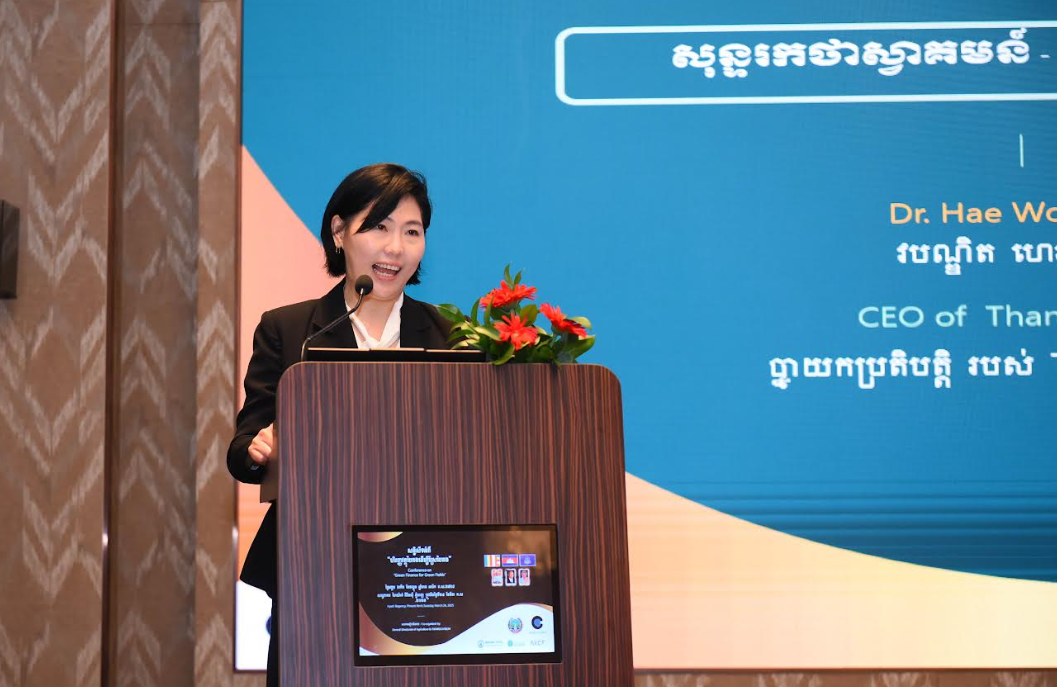
기후테크 스타트업 땡스카본은 24일 캄보디아 하얏트 리젠시 프놈펜에서 캄보디아 농림수산부 농업총국(GDA)과 글로벌녹색성장연구소(GGGI) 캄보디아와 함께 ‘탄소배출권을 통한 지속가능한 농업 전환(Green Finance for Green Field)’을 주제로 컨퍼런스를 개최했다고 31일 밝혔다.
이번 컨퍼런스는 농업 부문에서 기후변화로 인한 생산량 감소와 온실가스 배출 문제를 탄소배출권과 기술혁신으로 극복할 수 있는 방안을 논의하는 자리로 마련됐다. 땡스카본 김해원 대표와 캄보디아 농림수산부 차관보 키코잘, 농림수산부 농업총국 부국장인 욘트리 박사, 글로벌녹색성장연구소(GGGI) 캄보디아의 김소미 소장 등이 참석한 가운데 진행됐다.
농림수산부 차관보 키코살(Khy Kosal)은 캄보디아 정부가 농업인들을 북돋우고, 기후회복력을 강화할 수 있는 새로운 자본조달 솔루션으로서 탄소배출권을 도입할 것이라고 밝혔다. GGGI의 선임프로그램 책임자인 아난타(Anantaa Pande)는 한-아세안 협력기금의 메탄저감 프로젝트에 대해 설명하며, 벼농사 메탄 배출의 심각성과 중요성을 강조했다.
본격적인 사례발표 세션에서는 캄보디아 바탐방에서 진행된 땡스카본의 논물관리(Alternate Wetting & Drying, AWD) 시범사업 결과를 중심으로 발표가 진행되었다. 캄보디아 농업총국 부국장 욘트리 박사와 왕립농업대학(RUA)의 소픽 연구원의 연구 결과, 논물관리(AWD) 방법을 적용한 벼농사 지역에서는 메탄 배출 감소 뿐 아니라 수확량 증가, 병해충 감소, 비료 사용 절감 등의 효과가 나타났다.
땡스카본의 기술총책임을 맡고 있는 이승호 이사는 AI기반의 위성분석 기술을 통해 농업인들의 논물관리 이행을 정확하게 측정하고 관리하는 MRV기술(측정.보고.검증)을 소개했다. 이 혁신적 기술로 고품질 탄소배출권을 만들어낼 수 있어, 농업인들의 소득 향상 및 캄보디아와 우리나라의 국가 온실가스 감축 목표(NDC)에 크게 기여할 수 있음이 강조됐다.
땡스카본의 공동창업자 박두병 이사는 캄보디아에서 2030년까지 50만 헥타르 이상의 벼농사 지역을 지속가능한 농업으로 전환해 나갈 수 있는 구체적인 확장 계획을 발표했다.
이어지는 패널 토론에서는 GGGI와 땡스카본 뿐 아니라 캄보디아 농업농촌개발은행과 캄보디아 쌀 협회 등 다양한 분야의 전문가들이 등장해 탄소배출권 및 녹색금융이 어떻게 농업의 회복력을 구축할 수 있는지 의견을 나눴다.
땡스카본 김해원 대표는 “급변하는 기후환경 속에서 농업의 지속가능성을 확보하기 위해 벼농사 메탄 감축 프로젝트의 성공 사례를 중심으로 전문가들의 다양한 의견을 교환하는 뜻깊은 자리였다”며 “기후변화에 대응하며 지속가능한 성장을 이루기 위해서는 정부와 금융기관, 기업, 농민 등 모든 이해관계자들의 적극적인 협력이 필요하며, 땡스카본은 혁신적 기술을 통해 탄소배출권 시장을 활성화시키는 기간 사업자 역할을 할 것”이라고 말했다.
- 관련 기사 더보기
Thanks Carbon, 'Sustainable Agriculture Transition through Carbon Emissions' Conference Held
Climate tech startup ThanksCarbon announced on the 31st that it held a conference on the topic of 'Sustainable Agricultural Transition through Carbon Credits (Green Finance for Green Field)' with the Cambodian Ministry of Agriculture, Forestry and Fisheries' General Directorate (GDA) and the Global Green Growth Institute (GGGI) Cambodia on the 24th at the Hyatt Regency Phnom Penh, Cambodia.
This conference was organized to discuss ways to overcome the problems of decreased production and greenhouse gas emissions due to climate change in the agricultural sector through carbon emissions rights and technological innovation. It was attended by Kim Hae-won, CEO of ThanksCarbon, Kikozal, Deputy Minister of Agriculture, Forestry and Fisheries of Cambodia, Dr. Yontri, Deputy Director of the General Directorate of Agriculture of the Ministry of Agriculture, Forestry and Fisheries, and Kim So-mi, Director of the Global Green Growth Institute (GGGI) Cambodia.
Khy Kosal, Deputy Minister of Agriculture, Forestry and Fisheries, said the Cambodian government will introduce carbon credits as a new financing solution to support farmers and strengthen climate resilience. Anantaa Pande, Senior Program Officer at GGGI, explained the Korea-ASEAN Cooperation Fund’s methane reduction project, emphasizing the severity and importance of methane emissions from rice farming.
The full-scale case presentation session focused on the results of the Alternate Wetting & Drying (AWD) pilot project of Thankskabon in Battambang, Cambodia. According to the research results of Dr. Yontri, Deputy Director General of the General Department of Agriculture of Cambodia, and Researcher Sopic of the Royal University of Agriculture (RUA), rice farming areas that applied the AWD method showed not only reduced methane emissions, but also increased yields, reduced pests and diseases, and reduced fertilizer use.
Director Seungho Lee, who is in charge of the technology of ThanksCarbon, introduced MRV technology (Measurement, Reporting, Verification) that accurately measures and manages farmers’ implementation of rice paddy management through AI-based satellite analysis technology. It was emphasized that this innovative technology can produce high-quality carbon credits, which can greatly contribute to increasing farmers’ income and achieving the national greenhouse gas reduction targets (NDC) of Cambodia and Korea.
ThanksKabone co-founder and director Park Du-byung has outlined a concrete expansion plan to transform more than 500,000 hectares of rice-growing areas in Cambodia into sustainable agriculture by 2030.
The panel discussion that followed brought together experts from GGGI, ThanksCarbon, the Cambodia Bank for Agriculture and Rural Development, and the Cambodia Rice Association to discuss how carbon credits and green finance can build agricultural resilience.
ThanksCarbon CEO Kim Hae-won said, “It was a meaningful opportunity to exchange diverse opinions with experts centered on the successful case of the rice farming methane reduction project to secure the sustainability of agriculture in a rapidly changing climate environment.” He continued, “In order to respond to climate change and achieve sustainable growth, active cooperation from all stakeholders including the government, financial institutions, companies, and farmers is necessary, and ThanksCarbon will play the role of a key operator that activates the carbon emissions market through innovative technologies.”
- See more related articles
サンスカーボン、「炭素排出権による持続可能な農業転換」カンファレンス開催
24日、カンボジアハイアットリージェンシープノンペンでカンボジア農林水産部農業総局(GDA)とグローバルグリーン成長研究所(GGGI)カンボジアと一緒に「炭素排出権を通じた持続可能な農業」したと31日明らかにした。
今回のカンファレンスは、農業部門で気候変動による生産量減少と温室効果ガス排出問題を炭素排出権と技術革新で克服できる方案を議論する場として設けられた。キム・ヘウォン代表とカンボジア農林水産部次官補キコザル、農林水産部農業総局副局長であるヨントリ博士、グローバルグリーン成長研究所(GGGI)カンボジアのキム・ソミ所長などが参加した中で行われた。
農林水産部次官補キコサル(Khy Kosal)は、カンボジア政府が農業人を盛り上げ、気候回復力を強化できる新しい資本調達ソリューションとして炭素排出権を導入すると明らかにした。 GGGIの上級プログラム責任者であるAnantaa Pandeは、ASEAN協力基金のメタン削減プロジェクトについて説明し、稲作メタン排出の深刻性と重要性を強調した。
本格的な事例発表セッションでは、カンボジアバタンバンで行われたサンスカーボンの論物管理(Alternate Wetting & Drying、AWD)の試験事業結果を中心に発表が行われた。カンボジア農業総局副局長ヨントリー博士と王立農業大学(RUA)のソフィック研究員の研究結果、物資管理(AWD)方法を適用した稲作地域ではメタン排出の減少だけでなく、収量の増加、病害虫の減少、肥料の使用削減などの効果が現れた。
サンスカーボンの技術総責任を担っているイ・スンホ理事は、AI基盤の衛星分析技術を通じて農業人らの物資管理履行を正確に測定して管理するMRV技術(測定・報告・検証)を紹介した。この革新的な技術で高品質の炭素排出権を生み出すことができ、農業人の所得向上とカンボジアと韓国の国家温室効果ガス削減目標(NDC)に大きく貢献できることが強調された。
サンスカーボンの共同創業者であるパク・ドゥビョン理事は、カンボジアで2030年までに50万ヘクタール以上の稲作地域を持続可能な農業に転換できる具体的な拡張計画を発表した。
続くパネル討論では、GGGIとサンスカーボンだけでなく、カンボジア農業農村開発銀行とカンボジア米協会など多様な分野の専門家が登場し、炭素排出権および緑金融がどのように農業の回復力を構築できるか意見を交わした。
キム・ヘウォン代表は「急変する気候環境の中で農業の持続可能性を確保するために、稲作メタン削減プロジェクトの成功事例を中心に専門家たちの多様な意見を交換する重要な席だった」とし「気候変動に対応し、持続可能な成長を成し遂げるためには政府と金融機関、企業、敵技術を通じて炭素排出権市場を活性化させる期間事業者の役割を果たすだろう」と話した。
- 関連記事をもっと見る
感谢碳,“通过碳排放实现农业可持续转型”会议召开
气候科技初创公司ThanksCarbon 31 日宣布,它与柬埔寨农业、林业和渔业部总局(GDA)以及全球绿色增长研究所(GGGI)柬埔寨于 24 日在柬埔寨金边凯悦酒店举办了以“通过碳信用实现可持续农业转型(绿地绿色金融)”为主题的会议。
此次会议旨在探讨如何通过碳排放权和技术创新克服气候变化导致的农业产量下降和温室气体排放问题。 ThanksKaboon首席执行官金海源 (Kim Hae-won)、柬埔寨农林渔业部副部长Kikozal、农林渔业部农业总局副局长Yontri博士、柬埔寨全球绿色增长研究所(GGGI)所长金素美 (Kim So-mi) 出席了此次活动。
柬埔寨农业、林业和渔业部副部长 Khy Kosal 表示,柬埔寨政府将引入碳信用作为新的融资解决方案,以支持农民并增强气候适应能力。 GGGI高级项目官员Anantaa Pande介绍了东盟-韩国合作基金的甲烷减排项目,强调了水稻种植甲烷排放的严重性和重要性。
全面的案例展示环节集中讨论了 Thankskabon 在柬埔寨马德望开展的交替润湿与干燥 (AWD) 试点项目的成果。柬埔寨农业总局副局长永特里博士和皇家农业大学研究员索皮克的研究发现,采用AWD(空气水排放)方式的水稻种植区不仅减少了甲烷排放量,而且产量增加、病虫害减少、化肥使用量减少。
Thankscabon技术负责人Seungho Lee主任介绍了MRV技术(测量、报告、验证),该技术通过基于AI的卫星分析技术,准确测量和管理农户对稻田管理的实施情况。强调指出,这项创新技术可以产生高质量的碳信用额,对增加农民收入和实现柬埔寨和我国的国家温室气体减排目标(NDC)有显著贡献。
感谢Kabone联合创始人兼董事Park Du-byung制定了具体的扩张计划,到2030年将柬埔寨50多万公顷的水稻种植区改造成可持续农业。
随后的小组讨论汇集了 GGGI、ThanksCarbon、柬埔寨农业和农村发展银行以及柬埔寨水稻协会的专家,探讨碳信用和绿色金融如何增强农业复原力。
ThanksCarbon首席执行官金海源表示:“这是一个很有意义的机会,能够围绕水稻种植甲烷减排项目的成功案例与专家们交换不同的意见,以确保在快速变化的气候环境下农业的可持续性。”他继续说道:“为了应对气候变化并实现可持续增长,需要政府、金融机构、企业和农民等所有利益相关者的积极合作,而ThanksCarbon将扮演通过创新技术激活碳排放市场的关键运营商的角色。”
- 查看更多相关文章
Grâce à Carbon, la conférence « Transition vers une agriculture durable grâce aux émissions de carbone » a eu lieu
La startup de technologie climatique ThanksCarbon a annoncé le 31 qu'elle organisait une conférence sur le thème de la « Transition agricole durable grâce aux crédits carbone (finance verte pour les champs verts) » avec la Direction générale du ministère cambodgien de l'Agriculture, des Forêts et de la Pêche (GDA) et le Global Green Growth Institute (GGGI) Cambodge le 24 au Hyatt Regency Phnom Penh, au Cambodge.
Cette conférence a été conçue pour discuter des moyens de surmonter les problèmes de diminution de la production et des émissions de gaz à effet de serre dans le secteur agricole en raison du changement climatique grâce aux droits d’émission de carbone et à l’innovation technologique. L'événement a été suivi par Kim Hae-won, PDG de ThanksKaboon, Kikozal, vice-ministre de l'Agriculture, des Forêts et de la Pêche du Cambodge, le Dr Yontri, directeur adjoint de la Direction générale de l'agriculture du ministère de l'Agriculture, des Forêts et de la Pêche, et Kim So-mi, directrice du Global Green Growth Institute (GGGI) Cambodge.
Le gouvernement cambodgien va introduire des crédits carbone comme nouvelle solution de financement pour soutenir les agriculteurs et renforcer la résilience climatique, a déclaré Khy Kosal, vice-ministre de l’Agriculture, des Forêts et de la Pêche. Anantaa Pande, responsable principal du programme au GGGI, a expliqué le projet de réduction du méthane du Fonds de coopération ASEAN-ROK, en soulignant la gravité et l’importance des émissions de méthane provenant de la riziculture.
La séance de présentation de cas à grande échelle s'est concentrée sur les résultats du projet pilote de mouillage et de séchage alternés (AWD) de Thankskabon mené à Battambang, au Cambodge. Une étude menée par le Dr Yontri, directeur général adjoint du Département général de l’agriculture du Cambodge, et Sopic, chercheur à l’Université royale d’agriculture (RUA), a révélé que les zones rizicoles qui appliquaient les méthodes AWD (Air Water Discharge) ont non seulement vu leurs émissions de méthane réduites, mais ont également vu leurs rendements augmenter, moins de parasites et de maladies, et moins d’utilisation d’engrais.
Le directeur Seungho Lee, responsable de la technologie chez Thankscabon, a présenté la technologie MRV (mesure, rapport, vérification) qui mesure et gère avec précision la mise en œuvre de la gestion des rizières par les agriculteurs grâce à une technologie d'analyse par satellite basée sur l'IA. Il a été souligné que cette technologie innovante peut produire des crédits carbone de haute qualité, qui peuvent contribuer de manière significative à augmenter les revenus des agriculteurs et à atteindre les objectifs nationaux de réduction des gaz à effet de serre (CDN) du Cambodge et de notre pays.
Park Du-byung, cofondateur et directeur de ThanksKabone, a présenté un plan d'expansion concret visant à transformer plus de 500 000 hectares de rizières au Cambodge en agriculture durable d'ici 2030.
La table ronde qui a suivi a réuni des experts du GGGI, de ThanksCarbon, de la Banque cambodgienne pour l'agriculture et le développement rural et de l'Association cambodgienne du riz pour discuter de la manière dont les crédits carbone et la finance verte peuvent renforcer la résilience agricole.
Kim Hae-won, PDG de ThanksCarbon, a déclaré : « Ce fut une occasion significative d'échanger des opinions diverses avec des experts centrées sur le cas réussi du projet de réduction du méthane de la riziculture pour garantir la durabilité de l'agriculture dans un environnement climatique en évolution rapide. » Il a poursuivi : « Afin de répondre au changement climatique et de parvenir à une croissance durable, une coopération active de toutes les parties prenantes, y compris le gouvernement, les institutions financières, les entreprises et les agriculteurs, est nécessaire, et ThanksCarbon jouera le rôle d'un opérateur clé qui active le marché des émissions de carbone grâce à des technologies innovantes. »
- Voir plus d'articles connexes
You must be logged in to post a comment.