




– EGFR 저해제 반응성 바이오마커를 오가노이드 모델로 정밀 검증
– 양사, 정밀의료 실현 위한 기술 융합으로 기존 치료 한계 돌파 기대
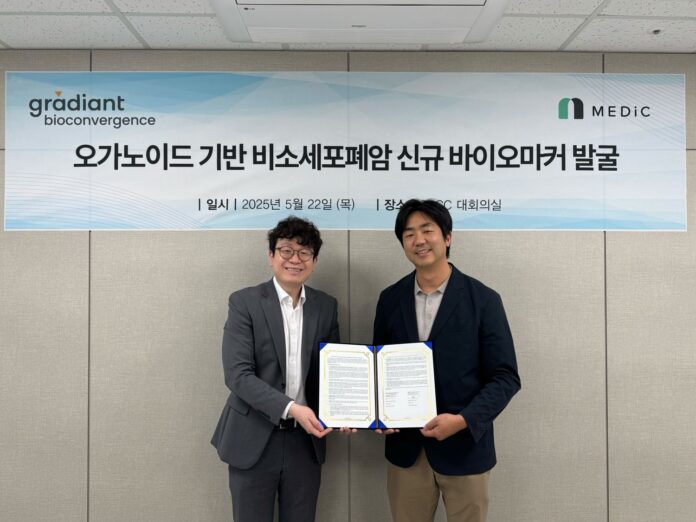
그래디언트 바이오컨버전스(대표이사 이진근)는 미국 실리콘밸리의 바이오 기업인 메딕 라이프 사이언스(MEDiC Life Sciences, 대표이사 한규호)와 EGFR 유전자 음성(wild-type) 비소세포폐암(NSCLC) 환자를 대상으로 EGFR 저해제의 치료 적용 가능성을 탐색하기 위한 바이오마커 공동 검증 및 연구 업무협약을 체결했다고 23일 밝혔다.
이번 협약은 지난 미국암연구학회 연례학술대회(AACR 2025)에서 양사가 논의한 협력 방안을 공식화한 것으로, 양사는 각사의 플랫폼을 활용한 바이오마커 검증 및 데이터 비교에 긴밀히 협력할 예정이다.
먼저 양사는 메딕 라이프 사이언스가 발굴한 바이오마커 후보가 기존의 3D 세포배양 모델에서 보인 반응을 그래디언트 바이오컨버전스의 환자유래 오가노이드(Patient-Derived Organoid, PDO) 모델에서도 일관되게 재현할 수 있는지를 검증하는 공동 프로젝트에 착수한다. 이후 비소세포폐암 PDO의 유전체 및 전사체 데이터를 활용해 환자군을 특정 바이오마커 기반으로 군집화하고, 다양한 EGFR 저해제에 대한 민감도를 비교 분석함으로써 바이오마커의 유효성을 검증할 계획이다.
그래디언트 바이오컨버전스는 오가노이드와 유전체 분석 데이터를 기반으로 한 AI 기술을 활용해 신약 타깃 발굴 및 약물 반응 평가 플랫폼을 개발 중이다. 최근에는 1~3세대 EGFR 저해제를 포함한 주요 항암 표적 치료제에 대한 오가노이드 약물 평가를 완료했다. 메딕 라이프 사이언스는 CRISPR 기반 유전체 스크리닝과 3D 종양 모델을 활용한 MCAT™ 플랫폼을 통해 EGFR 저해제를 비롯한 항암제 바이오마커 및 신약 타깃을 발굴하고 있다.
그래디언트 바이오컨버전스 이진근 대표는 “양사 간 협업을 통해 각사의 플랫폼이 가진 강점을 결합하고, EGFR 억제제의 새로운 적용 가능성에 대한 실마리를 확보하고자 한다”며, “기존 치료의 한계를 넘어서는 혁신적인 치료 전략을 제시할 수 있도록 노력할 것“이라고 전했다.
메딕 라이프 사이언스 한규호 대표는 “EGFR 치료제는 현재 EGFR 변이가 있는 환자에게만 사용이 권고되고 있으나, 변이가 없는 일부 환자에게도 반응 사례가 보고되고 있다“며, “이번 공동연구를 통해 이러한 환자군을 선별할 수 있는 새로운 바이오마커를 발굴하고, EGFR 억제제의 적용 범위를 확장할 것”이라고 말했다.
Gradient Bioconvergence, US Medic Life Sciences Sign MOU for Non-Small Cell Lung Cancer Biomarker Discovery
– Precise validation of EGFR inhibitor responsiveness biomarkers using organoid models
– The two companies expect to overcome the limitations of existing treatments through technological convergence to realize precision medicine.
Gradient Bioconvergence (CEO Jin-Geun Lee) and MEDiC Life Sciences (CEO Kyu-Ho Han), a bio company in Silicon Valley, USA, are conducting joint biomarker validation and research to explore the therapeutic applicability of EGFR inhibitors for patients with EGFR gene-negative (wild-type) non-small cell lung cancer (NSCLC). On the 23rd, it was announced that a business agreement had been signed.
This agreement formalizes the collaboration plan discussed by both companies at the American Association for Cancer Research (AACR 2025) Annual Meeting, and the two companies plan to closely cooperate on biomarker validation and data comparison using each company's platform.
First, the two companies will embark on a joint project to verify whether the biomarker candidates discovered by Medic Life Science can consistently reproduce the responses shown in existing 3D cell culture models in Gradient Bioconvergence’s patient-derived organoid (PDO) model. Afterwards, they plan to verify the validity of the biomarkers by clustering patient groups based on specific biomarkers using genomic and transcriptomic data of non-small cell lung cancer PDO and comparing and analyzing the sensitivity to various EGFR inhibitors.
Gradient Bioconvergence is developing a platform for discovering new drug targets and evaluating drug responses using AI technology based on organoids and genome analysis data. Recently, it completed organoid drug evaluations for major anticancer target treatments, including 1st to 3rd generation EGFR inhibitors. Medic Life Science is discovering anticancer biomarkers and new drug targets, including EGFR inhibitors, through the MCAT™ platform utilizing CRISPR-based genome screening and 3D tumor models.
“Through collaboration between our two companies, we aim to combine the strengths of each company’s platforms and gain insight into the new applicability of EGFR inhibitors,” said Jin-Geun Lee, CEO of Gradient Bioconvergence. “We will strive to present an innovative treatment strategy that overcomes the limitations of existing treatments.”
“EGFR treatments are currently only recommended for patients with EGFR mutations, but there have been reports of responses in some patients without mutations,” said Han Kyu-ho, CEO of Medic Life Science. “Through this joint research, we will discover new biomarkers that can screen for this patient population and expand the scope of application of EGFR inhibitors.”
グラデーションバイオコンバージェンス、米メディックライフサイエンスと非小細胞肺がんバイオマーカー発掘 MOU締結
– EGFR阻害剤反応性バイオマーカーをオルガノイドモデルで精密検証
–両社、精密医療実現のための技術融合で既存治療限界突破期待
グラデーションバイオコンバージェンス(代表取締役イ・ジングン)は、米国シリコンバレーのバイオ企業であるメディックライフサイエンス(MEDiC Life Sciences、代表取締役ハン・ギュホ)とEGFR遺伝子陰性非小細胞肺がん(NSCLC)患者を対象にEGFR阻害剤の治療適用可能性を探索する 業務協約を締結したと23日明らかにした。
今回の協約は、昨年の米国がん研究学会年次学術大会(AACR 2025)で両社が議論した協力案を公式化したもので、両社は各社のプラットフォームを活用したバイオマーカー検証およびデータ比較に緊密に協力する予定だ。
まず、両社は、メディックライフサイエンスが発掘したバイオマーカー候補が既存の3D細胞培養モデルで見られた反応を、グラデーションバイオコンバージェンスの患者由来オルガノイド(Patient-Derived Organoid, PDO)モデルでも一貫して再現できるかどうかを検証する共同プロジェクトに着手する。以後、非小細胞肺がんPDOの遺伝体および転写物データを活用して患者群を特定のバイオマーカーベースで群集化し、様々なEGFR阻害剤に対する感度を比較分析することでバイオマーカーの有効性を検証する計画だ。
グラデーションバイオコンバージェンスは、オルガノイドと誘電体分析データに基づいたAI技術を活用して、新薬ターゲットの発掘と薬物反応評価プラットフォームを開発中です。最近、第1〜第3世代のEGFR阻害剤を含む主要な抗がん標的治療薬のオルガノイド薬物評価が完了しました。メディックライフサイエンスは、CRISPRベースの誘電体スクリーニングと3D腫瘍モデルを活用したMCAT™プラットフォームを通じて、EGFR阻害剤を含む抗がん剤バイオマーカーや新薬ターゲットを発掘している。
グラデーションバイオコンバージェンスのイ・ジングン代表は「両社間のコラボレーションを通じて各社のプラットフォームが持つ強みを結合し、EGFR阻害剤の新たな適用可能性に対する糸口を確保しよう」とし、「既存治療の限界を超えた革新的な治療戦略を提示できるように努力する」と伝えた。
メディックライフサイエンスハン・ギュホ代表は「EGFR治療剤は現在、EGFR変異がある患者にのみ使用が推奨されているが、変異がない一部の患者にも反応事例が報告されている」とし、「今回の共同研究を通じてこれらの患者群を選別できる新しいバイオマーカーを発掘し、EGFR阻害剤の適用範囲を拡大した。
Gradient Bioconvergence与US Medic Life Sciences签署非小细胞肺癌生物标志物研发谅解备忘录
–使用类器官模型精确验证 EGFR抑制剂反应性生物标志物
–两家公司希望通过技术融合克服现有治疗的局限性,实现精准医疗。
Gradient Bioconvergence(代表:李镇根)与美国硅谷生物公司MEDiC Life Sciences(代表:韩圭镐)正在联合进行生物标志物验证和研究,探索EGFR抑制剂对EGFR基因阴性(野生型)非小细胞肺癌(NSCLC)患者的治疗适用性。 23日,宣布签署商业协议。
该协议正式确立了两家公司在美国癌症研究协会(AACR 2025)年会上讨论的合作计划,两家公司计划利用各自公司的平台在生物标志物验证和数据比较方面进行密切合作。
首先,两家公司将开展一个联合项目,以验证 Medic Life Sciences 发现的候选生物标志物是否能够在 Gradient Bioconvergence 的患者来源类器官 (PDO) 模型中一致地重现现有 3D 细胞培养模型中显示的反应。随后,我们计划利用非小细胞肺癌PDO的基因组和转录组数据,根据特定的生物标志物对患者群体进行聚类,并通过比较和分析对各种EGFR抑制剂的敏感性来验证生物标志物的有效性。
Gradient Bioconvergence 正在开发一个平台,利用基于类器官和基因组分析数据的人工智能技术来发现新的药物靶点并评估药物反应。最近,我们完成了主要抗癌靶向疗法的类器官药物评估,包括第一代至第三代 EGFR 抑制剂。 Medic Life Sciences 正在通过其 MCAT™ 平台利用基于 CRISPR 的基因组筛选和 3D 肿瘤模型发现抗癌生物标志物和新药物靶点,包括 EGFR 抑制剂。
Gradient Bioconvergence 首席执行官 Jin-Geun Lee 表示:“通过两家公司的合作,我们旨在结合各自平台的优势,深入了解 EGFR 抑制剂的新适用性。” “我们将努力提出一种创新的治疗策略,克服现有治疗的局限性。”
Medic Life Science 首席执行官 Han Kyu-ho 表示:“EGFR 治疗目前仅推荐用于 EGFR 突变患者,但有报道称部分未发生突变的患者也有反应。” “通过此次联合研究,我们将发现可以筛查该患者群体的新的生物标志物,扩大EGFR抑制剂的应用范围。”
Gradient Bioconvergence et US Medic Life Sciences signent un protocole d'accord pour la découverte de biomarqueurs du cancer du poumon non à petites cellules
– Validation précise des biomarqueurs de réactivité aux inhibiteurs de l’EGFR à l’aide de modèles organoïdes
– Les deux sociétés espèrent surmonter les limites des traitements existants grâce à la convergence technologique pour réaliser une médecine de précision.
Gradient Bioconvergence (PDG Jin-Geun Lee) et MEDiC Life Sciences (PDG Kyu-Ho Han), une société de biotechnologie de la Silicon Valley, aux États-Unis, mènent conjointement une validation et des recherches sur les biomarqueurs afin d'explorer l'applicabilité thérapeutique des inhibiteurs de l'EGFR pour les patients atteints d'un cancer du poumon non à petites cellules (CPNPC) négatif au gène EGFR (de type sauvage). Le 23, il a été annoncé qu'un accord commercial avait été signé.
Cet accord officialise le plan de collaboration discuté par les deux sociétés lors de la réunion annuelle de l'American Association for Cancer Research (AACR 2025), et les deux sociétés prévoient de coopérer étroitement sur la validation des biomarqueurs et la comparaison des données en utilisant la plateforme de chaque société.
Dans un premier temps, les deux sociétés se lanceront dans un projet commun visant à vérifier si les candidats biomarqueurs découverts par Medic Life Sciences peuvent reproduire de manière cohérente les réponses présentées dans les modèles de culture cellulaire 3D existants dans le modèle d’organoïde dérivé du patient (PDO) de Gradient Bioconvergence. Par la suite, nous prévoyons de regrouper des groupes de patients en fonction de biomarqueurs spécifiques en utilisant les données génomiques et transcriptomiques du cancer du poumon non à petites cellules PDO, et de vérifier la validité des biomarqueurs en comparant et en analysant la sensibilité à divers inhibiteurs de l'EGFR.
Gradient Bioconvergence développe une plateforme permettant de découvrir de nouvelles cibles médicamenteuses et d'évaluer les réponses médicamenteuses à l'aide d'une technologie d'IA basée sur des données d'analyse d'organoïdes et de génomes. Récemment, nous avons terminé les évaluations de médicaments organoïdes des principales thérapies anticancéreuses ciblées, y compris les inhibiteurs de l’EGFR de première à troisième génération. Medic Life Sciences découvre des biomarqueurs anticancéreux et de nouvelles cibles médicamenteuses, notamment des inhibiteurs de l'EGFR, grâce à sa plateforme MCAT™ utilisant le criblage génomique basé sur CRISPR et des modèles tumoraux 3D.
« Grâce à la collaboration entre nos deux sociétés, nous souhaitons combiner les atouts des plateformes de chaque société et mieux comprendre la nouvelle applicabilité des inhibiteurs de l'EGFR », a déclaré Jin-Geun Lee, PDG de Gradient Bioconvergence. « Nous nous efforcerons de présenter une stratégie de traitement innovante qui surmonte les limites des traitements existants. »
« Les traitements EGFR ne sont actuellement recommandés que pour les patients présentant des mutations EGFR, mais des réponses ont été signalées chez certains patients sans mutations », a déclaré Han Kyu-ho, PDG de Medic Life Science. « Grâce à cette recherche conjointe, nous découvrirons de nouveaux biomarqueurs permettant de dépister cette population de patients et d’élargir le champ d’application des inhibiteurs de l’EGFR. »
You must be logged in to post a comment.