




– 글로벌 검색 벤치마크 RTEB에서 매개변수 10억 개 이하 모델 세계 2위 기록
– 다국어 항공우주 도메인 특화 검색 벤치마크 ‘스텔라’ 자체 구축
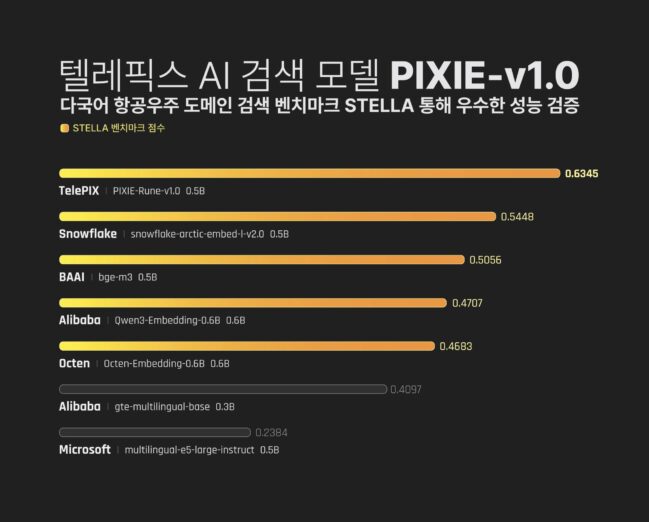
우주 AI 종합 솔루션 기업 텔레픽스(TelePIX, 대표 조성익)는 항공우주 전문 기술 문서를 정확하게 검색하는 자사 AI(인공지능) 모델 ‘픽시1.0(PIXIE-v1.0)’이 글로벌 성능 평가에서 상위권에 올랐다고 3일 밝혔다.
픽시1.0은 항공우주·위성·국방 등 고도의 전문 기술 문서를 대상으로 의미 기반 검색을 할 수 있도록 설계된 항공우주 도메인 특화 정보 검색 모델이다. 위성 설계 문서, 기술 규격서, 운용 매뉴얼 등 방대한 항공우주 기술 문서를 자연어 질의로 보다 수월하게 검색할 수 있도록 설계됐다. 위성용 에이전트 AI 솔루션 샛챗(SatCHAT)의 성능 고도화를 위해 개발됐으며, 앞서 공개한 픽시 프리뷰(PIXIE-Preview)에 이어 이번 1.0에서는 도메인 특화 검색 성능을 정량적으로 검증하는 데 중점을 뒀다.
이 모델은 최근 허깅페이스(Hugging Face) 플랫폼을 통해 공개된 글로벌 검색 벤치마크 RTEB(Retrieval Embedding Benchmark, 검색 임베딩 성능 평가 지표)의 매개변수 10억(1B)개 이하 모델 부문에서 세계 2위를 기록했다. 해당 부문에는 글로벌 빅테크와 연구기관이 공개한 다수의 임베딩 모델이 포함돼 있다.
RTEB는 기존 임베딩 모델 평가 표준으로 활용돼 온 MTEB(Massive Text Embedding Benchmark, 대량 텍스트 임베딩 벤치마크 리더보드)를 확장한 차세대 검색 벤치마크로, 테스트 데이터 위주의 점수 경쟁이 아닌 실제 산업 환경에서의 AI 모델 정보 검색 성능을 평가하는 데 초점을 맞췄다. 법률·금융·의료·코드 등 고난도 도메인을 기반으로 모델의 실질적인 산업 활용 가능성을 검증할 수 있다.
해당 부문의 1위 모델을 포함해 대부분은 법률·금융·의료·코드 등 여러 도메인을 포괄하는 범용 모델인 반면, 텔레픽스의 픽시1.0은 항공우주 도메인과 한·영 기술 문서에 집중했음에도 글로벌 상위권 성과를 냈다.
회사 측은 이번 결과가 모델 규모 확장이 아닌 도메인 특화 데이터 정제와 학습 품질 개선만으로도 높은 검색 성능을 달성할 수 있음을 보여준 사례라고 평가했다. 특히 전문 용어와 약어가 복잡하게 얽힌 항공우주 문서 환경에서도 의미 기반 검색이 안정적으로 작동해 산업 현장 적용 가능성을 확인했다는 설명이다.
또한 텔레픽스는 RTEB에서 직접적으로 다루지 않는 한국어를 포함한 다국어 항공우주 도메인 검색 성능을 검증하기 위해 자체 구축한 검색 벤치마크 ‘스텔라(STELLA)’를 활용한 추가 평가를 진행했다. 그 결과 픽시1.0은 파라미터 규모 대비 우수한 검색 정확도를 보였으며, 언어·도메인 특화 검색 역량을 안정적으로 확보한 것으로 확인됐다. 스텔라는 항공우주 전문 문서를 기반으로 구성된 다국어 정보 검색 벤치마크로, 항공우주 도메인에 특화된 공개 검색 평가 기준이 거의 없는 현실적 한계를 보완하기 위해 설계됐다.
텔레픽스는 픽시1.0을 오픈소스로 공개했으며, RAG(Retrieval-Augmented Generation) 기반 AI 시스템에서 전문 기술 문서 검색을 위한 핵심 모델로 활용될 수 있을 것으로 기대하고 있다.
텔레픽스 권다롱새 데이터사이언스 부문장은 “이번에 공개한 픽시1.0은 프리뷰 단계에서 제시한 방향성을 유지하되, 항공우주 도메인 검색 성능을 보다 안정적으로 고도화하는 데 집중해 성능 평가에서 우수한 성적을 냈다. 픽시와 스텔라가 향후 도메인 특화 정보 검색 연구와 실제 응용을 위한 기초 자료로 활용되기를 기대한다”며 “텔레픽스는 우주 도메인에 특화된 AI 하드웨어·소프트웨어 통합 솔루션 기업으로, 실제 위성 산업에서 유용하게 활용 가능한 AI 모델과 솔루션 고도화에 집중할 계획”이라고 말했다.
Telepix ranks second globally in AI performance evaluations for its aerospace domain search model.
– Ranked 2nd globally for models with less than 1 billion parameters in the global search benchmark RTEB
– Developed our own multilingual aerospace domain -specific search benchmark, ' Stella '
TelePIX (CEO Seongik Cho), a comprehensive space AI solution company, announced on the 3rd that its AI (artificial intelligence) model 'PIXIE-v1.0', which accurately searches aerospace technical documents, ranked high in a global performance evaluation.
PIXIE 1.0 is an aerospace domain-specific information retrieval model designed to enable semantic-based searches of highly specialized technical documents in areas such as aerospace, satellite, and defense. It is designed to facilitate natural language query searching of vast aerospace technical documents, including satellite design documents, technical specifications, and operation manuals. Developed to enhance the performance of SatCHAT, an agent AI solution for satellites, PIXIE 1.0, following the previously released PIXIE-Preview, focuses on quantitatively verifying domain-specific search performance.
This model recently ranked second globally in the Retrieval Embedding Benchmark (RTEB), a global search benchmark released through the Hugging Face platform, in the model category with fewer than 1 billion parameters. This category includes numerous embedding models released by global big tech companies and research institutes.
RTEB is a next-generation search benchmark that extends the Massive Text Embedding Benchmark (MTEB), the existing standard for evaluating embedding models. Rather than focusing on test data-driven score competition, it focuses on evaluating AI model information retrieval performance in real-world industrial environments. It can verify the practical industrial applicability of models based on high-difficulty domains such as law, finance, medicine, and code.
While most models, including the top model in the sector, are general-purpose models that cover multiple domains such as law, finance, medicine, and code, Telefix's Pixie 1.0 achieved top global performance despite focusing on the aerospace domain and Korean-English technical documents.
The company stated that these results demonstrate that high search performance can be achieved simply through domain-specific data refinement and improved learning quality, rather than simply expanding the model's scale. In particular, the company explained that semantic-based search performed reliably even in aerospace document environments rife with technical terminology and abbreviations, confirming its potential for industrial application.
Furthermore, Telepix conducted an additional evaluation using its own search benchmark, "STELLA," to verify the search performance of multilingual aerospace domains, including Korean, which are not directly covered by RTEB. The results confirmed that Pixie 1.0 demonstrated excellent search accuracy relative to its parameter scale and had stably secured language- and domain-specific search capabilities. STELLA is a multilingual information retrieval benchmark built on specialized aerospace documents, and was designed to complement the practical limitations of the almost complete absence of public search evaluation criteria specific to the aerospace domain.
Telepix has released Pixie 1.0 as open source and expects it to be utilized as a core model for specialized technical document retrieval in AI systems based on Retrieval-Augmented Generation (RAG).
Telepix Kwon Darong-sae, Head of Data Science, said, “Pixie 1.0, which was released this time, maintained the direction presented in the preview stage, but focused on more stably improving the aerospace domain search performance, and achieved excellent results in the performance evaluation. We expect that Pixie and Stella will be used as basic data for future domain-specific information retrieval research and actual applications.” He added, “As an AI hardware and software integrated solution company specialized in the space domain, Telepix plans to focus on improving AI models and solutions that can be usefully utilized in the actual satellite industry.”
テレフィックス、航空宇宙ドメイン検索モデルでAI性能評価書世界2位
–グローバル検索ベンチマークRTEBでパラメータ10億個以下モデル世界2位記録
–多言語航空宇宙ドメイン特化検索ベンチマーク「ステラ」自体構築
宇宙AI総合ソリューション企業テレフィックス(TelePIX、代表チョ・ソンイク)は、航空宇宙専門技術文書を正確に検索する自社AI(人工知能)モデル「ピクシー1.0(PIXIE-v1.0)」がグローバル性能評価で上位圏に上がったと3日明らかにした。
ピクシー1.0は、航空宇宙・衛星・防衛など高度な専門技術文書を対象に意味ベース検索ができるように設計された航空宇宙ドメイン特化情報検索モデルである。衛星設計文書、技術規格書、運用マニュアルなど膨大な航空宇宙技術文書を自然言語の質疑でより簡単に検索できるように設計された。衛星用エージェントAIソリューションSatCHATの性能高度化のために開発され、先に公開したピクシープレビュー(PIXIE-Preview)に続き、今回の1.0ではドメイン特化検索性能を定量的に検証することに重点を置いた。
このモデルは最近、ハギングフェイス(Hugging Face)プラットフォームを通じて公開されたグローバル検索ベンチマークRTEB(Retrieval Embedding Benchmark、検索埋め込み性能評価指標)のパラメータ10億(1B)個以下のモデル部門で世界2位を記録した。該当部門にはグローバルビッグテックと研究機関が公開した多数の埋め込みモデルが含まれている。
RTEBは既存の埋め込みモデル評価基準として活用されてきたMTEB(Massive Text Embedding Benchmark、大量テキスト埋め込みベンチマークリーダーボード)を拡張した次世代検索ベンチマークで、テストデータ中心のスコア競争ではなく、実際の産業環境でのAIモデル情報検索性能の評価に焦点を当てた。法律・金融・医療・コードなど高難度ドメインを基にモデルの実質的な産業活用可能性を検証できる。
該当部門の1位モデルを含め、大部分は法律・金融・医療・コードなど様々なドメインを包括する汎用モデルである一方、テレフィックスのピクシー1.0は航空宇宙ドメインと韓・英技術文書に集中したにもかかわらずグローバル上位圏成果を出した。
同社側は、今回の結果がモデル規模の拡張ではなく、ドメイン特化データの精製と学習品質の改善だけでも高い検索性能を達成できることを示した事例だと評価した。特に専門用語と略語が複雑に絡み合った航空宇宙文書環境でも意味ベース検索が安定的に動作して産業現場適用可能性を確認したという説明だ。
また、テレフィックスは、RTEBで直接扱わない韓国語を含む多言語航空宇宙ドメイン検索性能を検証するため、自社構築した検索ベンチマーク「STELLA」を活用した追加評価を行った。その結果、ピクシー1.0はパラメータ規模に比べて優れた検索精度を示し、言語・ドメイン特化検索能力を安定的に確保したことが確認された。ステラは航空宇宙専門文書に基づいて構成された多言語情報検索ベンチマークで、航空宇宙ドメインに特化した公開検索評価基準がほとんどない現実的な限界を補完するように設計された。
テレフィックスはピクシー1.0をオープンソースで公開し、RAG(Retrieval-Augmented Generation)ベースのAIシステムで専門技術文書検索のためのコアモデルとして活用できると期待している。
テレフィックス・クォンダロン新データサイエンス部門長は「今回公開したピクシー1.0はプレビュー段階で提示した方向性を維持するが、航空宇宙ドメイン検索性能をより安定的に高度化することに集中して性能評価で優れた成績を出した。ピクシーとステラが今後のドメイン特化情報検索研究と実際宇宙ドメインに特化したAIハードウェア・ソフトウェア統合ソリューション企業で、実際の衛星産業で有用に活用可能なAIモデルとソリューションの高度化に集中する計画だ」と述べた。
Telepix 的航空航天领域搜索模型在全球人工智能性能评估中排名第二。
–在全球搜索基准测试RTEB中,参数少于10亿的模型排名全球第二
–开发了我们自己的多语言航空航天领域特定搜索基准“ Stella ”。
综合空间人工智能解决方案公司 TelePIX(CEO 赵成益)于 3 日宣布,其能够准确搜索航空航天技术文档的人工智能模型“PIXIE-v1.0”在全球性能评估中名列前茅。
PIXIE 1.0 是一款专为航空航天领域设计的检索模型,旨在支持对航空航天、卫星和国防等领域高度专业化的技术文档进行基于语义的检索。它旨在简化对海量航空航天技术文档(包括卫星设计文档、技术规范和操作手册)的自然语言查询检索。PIXIE 1.0 的开发是为了提升卫星智能体 AI 解决方案 SatCHAT 的性能,在之前发布的 PIXIE-Preview 的基础上,重点在于对特定领域的检索性能进行定量验证。
该模型最近在 Hugging Face 平台发布的全球搜索基准测试——检索嵌入基准测试 (RTEB) 中排名全球第二,位列参数量少于 10 亿的模型类别中。该类别涵盖了众多由全球大型科技公司和研究机构发布的嵌入模型。
RTEB 是新一代搜索基准测试,它扩展了现有的文本嵌入模型评估标准——大规模文本嵌入基准测试 (MTEB)。与专注于测试数据驱动的分数竞争不同,RTEB 侧重于评估人工智能模型在真实工业环境中的信息检索性能。它可以验证基于法律、金融、医疗和代码等高难度领域的模型的实际工业应用性。
虽然大多数模型(包括该领域的顶级模型)都是涵盖法律、金融、医学和代码等多个领域的通用模型,但 Telefix 的 Pixie 1.0 尽管专注于航空航天领域和韩英技术文档,却取得了全球顶尖的性能。
该公司表示,这些结果表明,无需简单地扩大模型规模,只需通过特定领域的数据优化和提升学习质量,即可实现高搜索性能。该公司特别解释说,即使在充斥着技术术语和缩写的航空航天文档环境中,基于语义的搜索也能可靠地运行,这证实了其在工业应用方面的潜力。
此外,Telepix 还使用其自主研发的搜索基准“STELLA”进行了额外评估,以验证 Pixie 1.0 在包括韩语在内的多语言航空航天领域的搜索性能,这些领域并未被 RTEB 直接覆盖。结果证实,Pixie 1.0 在其参数范围内展现出卓越的搜索准确率,并稳定具备特定语言和领域的搜索能力。STELLA 是一个基于专业航空航天文档构建的多语言信息检索基准,旨在弥补航空航天领域公开搜索评估标准几乎完全缺失的实际不足。
Telepix 已将 Pixie 1.0 开源,并期望它能作为基于检索增强生成 (RAG) 的 AI 系统中专门技术文档检索的核心模型。
Telepix 数据科学主管权达荣赛 (Kwon Darong-sae) 表示:“此次发布的 Pixie 1.0 延续了预览阶段的发展方向,但更加注重稳定地提升航空航天领域的搜索性能,并在性能评估中取得了优异的成绩。我们期望 Pixie 和 Stella 能为未来特定领域的信息检索研究和实际应用提供基础数据。” 他补充道:“作为一家专注于航天领域的 AI 软硬件一体化解决方案公司,Telepix 计划致力于改进可在实际卫星行业中有效应用的 AI 模型和解决方案。”
Telepix se classe deuxième au niveau mondial en matière d'évaluation des performances de l'IA pour son modèle de recherche dans le domaine aérospatial.
– Classé 2e mondial pour les modèles comportant moins d' un milliard de paramètres dans le benchmark de recherche mondial RTEB
– Nous avons développé notre propre banc d'essai de recherche multilingue spécifique au domaine aérospatial , « Stella ».
TelePIX (PDG Seongik Cho), une société de solutions complètes d'IA spatiale, a annoncé le 3 que son modèle d'IA (intelligence artificielle) « PIXIE-v1.0 », qui recherche avec précision des documents techniques aérospatiaux, s'est classé parmi les meilleurs dans une évaluation mondiale des performances.
PIXIE 1.0 est un modèle de recherche d'informations dédié au domaine aérospatial. Il permet d'effectuer des recherches sémantiques dans des documents techniques hautement spécialisés, notamment dans les secteurs de l'aérospatiale, des satellites et de la défense. Conçu pour faciliter la recherche en langage naturel dans de vastes quantités de documents techniques aérospatiaux, tels que les documents de conception de satellites, les spécifications techniques et les manuels d'utilisation, PIXIE 1.0 a été développé pour optimiser les performances de SatCHAT, une solution d'IA pour satellites. Faisant suite à la version préliminaire PIXIE-Preview, PIXIE 1.0 se concentre sur la vérification quantitative des performances de recherche dans ce domaine.
Ce modèle s'est récemment classé deuxième au niveau mondial dans le Retrieval Embedding Benchmark (RTEB), un benchmark de recherche global publié par la plateforme Hugging Face, dans la catégorie des modèles comportant moins d'un milliard de paramètres. Cette catégorie inclut de nombreux modèles d'intégration publiés par de grandes entreprises technologiques et des instituts de recherche internationaux.
RTEB est un banc d'essai de recherche de nouvelle génération qui étend le Massive Text Embedding Benchmark (MTEB), la norme existante pour l'évaluation des modèles d'intégration de textes. Plutôt que de se concentrer sur la compétition de scores basée sur des données de test, il vise à évaluer les performances de recherche d'informations des modèles d'IA dans des environnements industriels réels. Il permet de vérifier l'applicabilité industrielle pratique des modèles dans des domaines complexes tels que le droit, la finance, la médecine et le développement informatique.
Alors que la plupart des modèles, y compris le modèle phare du secteur, sont des modèles à usage général qui couvrent de multiples domaines tels que le droit, la finance, la médecine et le code, le Pixie 1.0 de Telefix a atteint les meilleures performances mondiales malgré sa spécialisation dans le domaine aérospatial et les documents techniques coréens-anglais.
L'entreprise a déclaré que ces résultats démontrent qu'il est possible d'obtenir des performances de recherche élevées grâce à un affinement des données spécifique au domaine et à une meilleure qualité d'apprentissage, plutôt qu'en augmentant simplement la taille du modèle. Elle a notamment expliqué que la recherche sémantique s'est avérée fiable même dans des environnements documentaires aérospatiaux riches en terminologie technique et en abréviations, confirmant ainsi son potentiel pour les applications industrielles.
Par ailleurs, Telepix a mené une évaluation complémentaire à l'aide de son propre référentiel de recherche, « STELLA », afin de vérifier les performances de recherche dans les domaines aérospatiaux multilingues, notamment en coréen, qui ne sont pas directement couverts par le RTEB. Les résultats ont confirmé que Pixie 1.0 a démontré une excellente précision de recherche par rapport à son échelle de paramètres et a maintenu des capacités de recherche stables, tant linguistiques que spécifiques au domaine. STELLA est un référentiel de recherche d'informations multilingue, construit à partir de documents spécialisés en aérospatiale, et conçu pour pallier les limitations pratiques liées à l'absence quasi totale de critères d'évaluation de la recherche publics spécifiques au domaine aérospatial.
Telepix a publié Pixie 1.0 en tant que logiciel libre et prévoit qu'il sera utilisé comme modèle de base pour la recherche de documents techniques spécialisés dans les systèmes d'IA basés sur la génération augmentée par la recherche (RAG).
Kwon Darong-sae, responsable de la science des données chez Telepix, a déclaré : « Pixie 1.0, dont la sortie a eu lieu cette fois-ci, a conservé l’orientation présentée lors de la phase de prévisualisation, tout en se concentrant sur l’amélioration durable des performances de recherche dans le domaine aérospatial. Les résultats obtenus lors de l’évaluation des performances sont excellents. Nous prévoyons que Pixie et Stella serviront de base de données pour les futures recherches et applications concrètes en matière de recherche d’informations spécifiques au domaine. » Il a ajouté : « En tant qu’entreprise spécialisée dans les solutions matérielles et logicielles intégrées d’IA pour le secteur spatial, Telepix entend se concentrer sur l’amélioration des modèles et solutions d’IA afin qu’ils puissent être utilisés concrètement dans l’industrie satellitaire. »
You must be logged in to post a comment.