




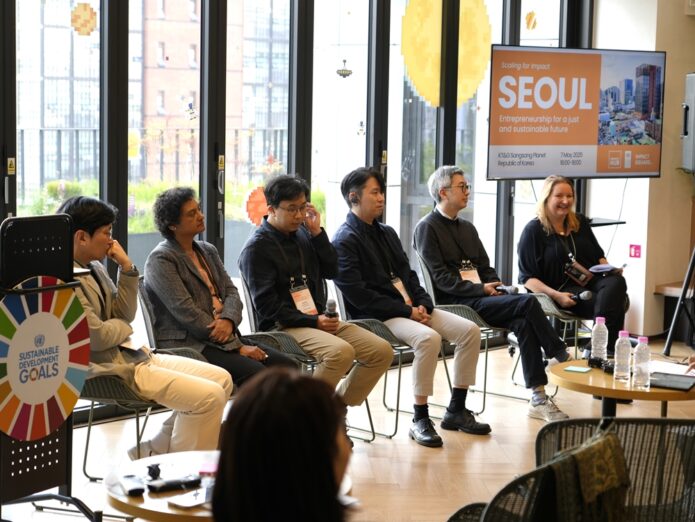
임팩트스퀘어, Impact Hub Network, 유엔개발계획(UNDP) 서울정책센터가 공동 주최한 글로벌 행사 ‘Scaling for Impact(스케일링 포 임팩트)’가 지난 7일 서울 성동구 KT&G 상상플래닛에서 개최됐다. ‘정의롭고 지속 가능한 미래를 위한 기업가 정신’을 주제로 한 이번 행사에서는 한국 청년 사회적기업가 생태계 현황 보고서 발표와 함께 국내외 전문가들이 패널로 참여해 임팩트 창출을 위한 혁신과 글로벌 협력 방안을 모색했다.
이번 행사는 전 세계 최대 규모의 사회 혁신가 네트워크인 임팩트허브와 성수 소셜벤처 클러스터 형성의 초기부터 함께해 온 주요 기관들이 한자리에 모여, 한국 임팩트 생태계의 현재와 가능성에 대해 심도 있게 논의한 자리로 의미를 더했다. 특히, 글로벌 연사들과 참가자들이 함께한 패널 토의 및 참여형 대화 세션에서는 다양한 지역적 시각에서 한국 임팩트 생태계의 향후 방향성과 국제 협력 가능성에 대한 활발한 논의가 이뤄졌다.
1부에서는 UNDP의 아태지역 연구 시리즈 중 하나로 발간할 예정인 ‘대한민국 청년 사회적기업가 생태계 현황(State of the Ecosystem for Youth Social Entrepreneurship in the Republic of Korea)’ 보고서를 통해 현재 한국의 임팩트 생태계의 현황과 합의점을 도출했다.
UNDP 서울정책센터의 이주리 담당관은 “UNDP는 빈곤 종식과 불평등 감소를 지원하는 국제개발기구”라고 소개하며, UNDP는 민간 부문, 그중에서도 청년 창업가와 임팩트 스타트업이 지속가능발전목표에 기여할 수 있는 가능성에 주목하고 있음을 밝혔다. 그러면서 한국을 포함한 개도국의 구조적인 임팩트 생태계 정책 개선에 기여하고자 본 보고서를 발간하게 된 목적을 설명했다.
강재원 연구위원은 “한국의 소셜벤처 정책은 벤처기업 정책의 연장선에서 출발했으며, 초기에는 정부 주도로 소셜벤처의 개념을 정립하고 기반을 조성하는데 중점을 두었다”면서 중소벤처기업부의 2023년 기준 한국 소셜벤처 실태조사를 인용해 “20대 청년 창업자의 비율은 아직 낮지만, 영업이익 전환 속도가 빠르고, 남녀 간 창업 격차가 작다는 점은 매우 고무적”이라고 평가했다.
이어 “한편으로 정부 정책에 대한 의존도가 높다는 점은 동시에 해결해야 할 과제”라고 지적하며 “청년 창업가들은 경험이 부족하고 자본이 취약한 상황에서 도전하고 있으며, 이들의 성장을 위해서는 맞춤형 지원, 사회적 자본 축적, 지속 가능한 생태계 설계가 필수”라고 강조했다.
2부 패널토의에서는 Tatiana Glad(Impact Hub Network 최고책임자)의 진행 아래, 강재원 연구위원(중소기업벤처연구원), 강봉수 대표(딥비전스), Pamla Gopaul(African Union Development Agency NEPAD), 허재형 대표(루트임팩트), 김민수 이사(임팩트 스퀘어)가 패널로 참여해 ‘공정하고 지속가능한 미래를 위한 기업가 정신과 협업’을 주제로 열띤 논의를 펼쳤다. 이번 토의에서는 임팩트 생태계의 지속가능성을 위해 성수동 소셜벤처 클러스터와 임팩트허브 네트워크와 같은 커뮤니티의 중요성이 강조됐으며, 신뢰를 기반으로 한 국제 협업의 방향성에 대한 의견이 오갔다.
한국의 임팩트 생태계의 방향성과 청년 창업가들의 성장을 위한 논의 중 김민수 이사(임팩트스퀘어)는 “한국은 정부 주도형 생태계 아래에서 임팩트 시장을 확장해 왔지만 이제는 정책 의존을 넘어서 시장 기반의 생존 역량을 강화해야 할 시점”이라며 “청년들이 도전할 수 있도록 더 많은 기회와 멋진 롤모델이 필요하다”고 강조했다.
강재원 연구위원은 “선의를 갖고 창업을 하는 사람들, 선의를 믿고 투자하는 등의 우리 사회의 신뢰 자본이 필요하다”고 설명했다.
글로벌 협업 방안과 관련해 Pamla Gopaul(African Union Development Agency NEPAD)은 아프리카의 사례를 공유하며 “지속가능한 창업 생태계에는 정부, 시민사회, 국제기구가 함께 장기적 관점을 설계해야 하며, 국제 협력도 각 지역의 현실에 맞춘 맞춤형 전략이 중요하다”고 조언했다.
강봉수 대표(딥비전스)는 글로벌 협업을 위한 접근 방식으로 현지의 필요와 맥락에 맞춘 지역화가 필요하다고 설명했고, 허재형 대표(루트임팩트)는 각자가 실질적으로 연결될 수 있는 지점을 먼저 찾는 데서 글로벌 협업을 시작할 수 있다고 제언했다.
토의를 마무리하며 Tatiana Glad(Impact Hub Network)는 지속가능한 생태계 구축을 위한 네트워크와 신뢰를 기반으로 하는 협업의 중요성을 다시금 강조했다. 이후 이어진 그룹 토크 세션에서는 참가자들이 소규모로 나뉘어 임팩트 생태계의 현안, 국제 협력의 가능성, 청년 창업 생태계의 변화 방안 등에 대해 자유롭게 의견을 교환하며 현장의 열기를 이어갔다.
윤남희 임팩트스퀘어 연구 부문 이사는 이번 행사의 함의에 대해 “오늘의 대화는 단지 청년 창업에 대한 논의가 아니라, 미래 세대를 위한 생태계 설계에 관한 깊은 성찰이었다”며 “글로벌 협업은 이상향이 아닌 생존을 위한 전략이 되어야 하고, 단순한 연결을 넘어, 신뢰 기반의 실질적 연대로 나아가야 한다”고 말했다.
- 관련 기사 더 보기
'Scaling for Impact' held, discussing the future of the youth impact ecosystem
The global event 'Scaling for Impact', co-hosted by Impact Square, Impact Hub Network, and the United Nations Development Programme (UNDP) Seoul Policy Center, was held on the 7th at KT&G Sangsang Planet in Seongdong-gu, Seoul. Under the theme of 'Entrepreneurship for a Just and Sustainable Future', the event presented a report on the current status of the Korean youth social entrepreneur ecosystem, and domestic and international experts participated as panelists to explore innovation and global cooperation for impact creation.
This event was more meaningful as it brought together Impact Hub, the world’s largest network of social innovators, and key organizations that have been involved since the early days of the Seongsu Social Venture Cluster to discuss in-depth the current status and potential of the Korean impact ecosystem. In particular, panel discussions and participatory dialogue sessions with global speakers and participants included active discussions on the future direction of the Korean impact ecosystem and the potential for international cooperation from various regional perspectives.
In Part 1, we looked at the current status of Korea's impact ecosystem and drew consensus through the report, 'State of the Ecosystem for Youth Social Entrepreneurship in the Republic of Korea', which is scheduled to be published as part of UNDP's Asia-Pacific regional research series.
Lee Ju-ri, a UNDP Seoul Policy Center officer, introduced the report by saying, “UNDP is an international development organization that supports the eradication of poverty and reduction of inequality,” and said that UNDP is paying attention to the potential of the private sector, especially young entrepreneurs and impact startups, to contribute to the sustainable development goals. She explained the purpose of publishing this report to contribute to improving the structural impact ecosystem policies in developing countries, including Korea.
Research Fellow Kang Jae-won said, “Korea’s social venture policy started as an extension of the venture company policy, and initially focused on establishing the concept of social ventures and laying the foundation under the leadership of the government.” Citing the Ministry of SMEs and Startups’ 2023 survey on the status of social ventures in Korea, he evaluated, “Although the proportion of young entrepreneurs in their 20s is still low, the speed of conversion to operating profit is fast and the gap in entrepreneurship between men and women is small, which is very encouraging.”
He continued, “On the other hand, the high dependence on government policies is also a challenge that needs to be addressed,” and emphasized, “Young entrepreneurs are taking on the challenge with a lack of experience and weak capital, and customized support, social capital accumulation, and sustainable ecosystem design are essential for their growth.”
In the second panel discussion, moderated by Tatiana Glad (Chief Executive Officer of Impact Hub Network), panelists including Research Fellow Kang Jae-won (SME Venture Research Institute), CEO Kang Bong-soo (Deep Visions), Pamla Gopaul (African Union Development Agency NEPAD), CEO Heo Jae-hyung (Root Impact), and Director Kim Min-soo (Impact Square) had a heated discussion on the topic of ‘Entrepreneurship and Collaboration for a Fair and Sustainable Future.’ The discussion emphasized the importance of communities such as the Seongsu-dong Social Venture Cluster and the Impact Hub Network for the sustainability of the impact ecosystem, and opinions were exchanged on the direction of international collaboration based on trust.
During the discussion on the direction of Korea’s impact ecosystem and the growth of young entrepreneurs, Director Kim Min-soo (Impact Square) emphasized, “Korea has expanded the impact market under a government-led ecosystem, but now is the time to go beyond policy dependence and strengthen market-based survival capabilities.” He added, “We need more opportunities and great role models for young people to take on challenges.”
Research Fellow Kang Jae-won explained, “We need trust capital in our society, such as people who start businesses with good intentions and people who invest with good intentions.”
Regarding global collaboration, Pamla Gopaul (NEPAD, African Union Development Agency) shared African cases and advised, “A sustainable startup ecosystem requires a long-term perspective from governments, civil society, and international organizations, and international cooperation also requires customized strategies tailored to the realities of each region.”
CEO Kang Bong-soo (Deep Visions) explained that localization tailored to local needs and context is necessary as an approach for global collaboration, and CEO Heo Jae-hyung (Root Impact) suggested that global collaboration can begin by first finding a point where each person can practically connect.
In closing the discussion, Tatiana Glad (Impact Hub Network) reiterated the importance of collaboration based on networks and trust to build a sustainable ecosystem. In the group talk session that followed, participants divided into small groups and freely exchanged opinions on current issues in the impact ecosystem, possibilities for international cooperation, and ways to change the youth entrepreneurship ecosystem, continuing the excitement of the event.
“Today’s conversation was not just about youth entrepreneurship, but also a deep reflection on designing an ecosystem for future generations,” said Namhee Yoon, Director of Research at Impact Square, about the implications of this event. “Global collaboration should be a strategy for survival, not a utopia, and it should move beyond simple connections to real solidarity based on trust.”
- See more related articles
「スケーリングフォーインパクト」開催、青年インパクトエコシステムの未来議論
インパクトスクエア、Impact Hub Network、国連開発計画(UNDP)ソウル政策センターが共同主催したグローバルイベント「Scaling for Impact(スケーリングフォーインパクト)」が去る7日、ソウル城東区KT&G想像プラネットで開催された。 「正義で持続可能な未来のための起業家精神」をテーマにした今回のイベントでは、韓国青年社会的企業家生態系現況報告発表とともに、国内外の専門家らがパネルとして参加し、インパクト創出のための革新とグローバル協力方案を模索した。
今回のイベントは、全世界最大規模の社会イノベーションがネットワークであるインパクトハブと聖水ソーシャルベンチャークラスター形成の初期から共にしてきた主要機関が一堂に会し、韓国インパクト生態系の現在と可能性について深く議論した場として意味を加えた。特に、グローバル講演者と参加者が一緒にしたパネル討議及び参加型対話セッションでは、様々な地域的視点で韓国インパクト生態系の今後の方向性と国際協力の可能性について活発な議論がなされた。
第1部では、UNDPのアジア太平洋地域の研究シリーズの1つとして発刊する予定の「大韓民国青年社会的企業家生態系現況(State of the Ecosystem for Youth Social Entrepreneurship in the Republic of Korea)」報告書を通じて現在、韓国のインパクト生態系の現況と合意点を導出した。
UNDPソウル政策センターのイ・ジュリ担当官は「UNDPは貧困終息と不平等減少を支援する国際開発機構」と紹介し、UNDPは民間部門、中でも青年創業家とインパクトスタートアップが持続可能な発展目標に寄与できる可能性に注目していることを明らかにした。それとともに、韓国を含む開発途上国の構造的なインパクト生態系政策の改善に寄与しようとした本報告書を発刊することになった目的を説明した。
カン・ジェウォン研究委員は「韓国のソーシャルベンチャー政策はベンチャー企業政策の延長線から出発し、初期には政府主導でソーシャルベンチャーの概念を確立し基盤を造成することに重点を置いた」とし、中小ベンチャー企業部の2023年基準韓国ソーシャルベンチャー実態調査を引用して「20代青年創業早く、男女間の創業格差が小さいという点は非常に促す」と評価した。
続いて「一方で政府政策への依存度が高いという点は同時に解決すべき課題」と指摘し、「青年創業者は経験が不足して資本が脆弱な状況で挑戦しており、これらの成長にはカスタマイズ支援、社会的資本蓄積、持続可能な生態系設計が必須」と強調した。
2部パネル討議では、Tatiana Glad(Impact Hub Network最高責任者)の進行のもと、カン・ジェウォン研究委員(中小企業ベンチャー研究院)、カン・ボンス代表(ディープビジョンズ)、Pamla Gopaul(African Union Development Agency NEPAD)、ホ・ジェヒョン代表(ルートインファクト)、キム「公正で持続可能な未来のための起業家精神とコラボレーション」をテーマに熱い議論を繰り広げた。今回の議論では、インパクトエコシステムの持続可能性のために、聖水洞ソーシャルベンチャークラスタやインパクトハブネットワークなどのコミュニティの重要性が強調され、信頼に基づく国際コラボレーションの方向性についての意見が上がった。
韓国のインパクトエコシステムの方向性と青年創業者の成長のための議論の中で、キム・ミンス理事(インパクトスクエア)は「韓国は政府主導型エコシステムの下でインパクト市場を拡大してきたが、今は政策依存を超えて市場基盤の生存能力を強化しなければならない」
カン・ジェウォン研究委員は「善意を持って創業をする人々、善意を信じて投資するなどの韓国社会の信頼資本が必要だ」と説明した。
グローバルコラボレーション案と関連して、Pamla Gopaul(African Union Development Agency NEPAD)はアフリカの事例を共有し、「持続可能な創業生態系には政府、市民社会、国際機関が共に長期的な視点を設計しなければならず、国際協力も各地域の現実に合わせたカスタマイズ戦略が重要だ」と述べた。
カン・ボンス代表(ディープビジョンズ)は、グローバルコラボレーションのためのアプローチとして、現地のニーズとコンテキストに合わせたローカライゼーションが必要だと説明した。
議論を終え、Tatiana Glad(Impact Hub Network)は、持続可能な生態系を構築するためのネットワークと信頼に基づくコラボレーションの重要性を再び強調しました。その後のグループトークセッションでは、参加者が小規模に分かれ、インパクト生態系の懸案、国際協力の可能性、青年創業生態系の変化案などについて自由に意見を交換し、現場の熱気を続けた。
ユン・ナムヒインパクトスクエア研究部門理事は今回の行事の含意について「今日の対話は単に青年創業についての議論ではなく、未来世代のための生態系設計に関する深い省察だった」とし「グローバルコラボレーションは理想郷ではなく生存のための戦略にならなければ、単純なつながりを超えている。
- 関連記事をもっと見る
“扩大影响力”会议举行,探讨青年影响力生态系统的未来
由Impact Square、Impact Hub Network、联合国开发计划署(UNDP)首尔政策中心共同主办的全球活动“Scaling for Impact”于7日在首尔市城东区KT&G想象星球举行。此次活动的主题是“为了公正和可持续的未来而创业”,报告介绍了韩国青年社会企业家生态系统的现状,来自韩国和国外的小组成员参加了此次活动,探讨了创新和全球合作产生影响的方式。
此次活动意义非凡,因为它汇集了全球最大的社会创新者网络 Impact Hub 和自圣水社会风险投资集群成立初期就参与其中的关键组织,深入探讨了韩国影响力生态系统的现状和潜力。特别是,与全球演讲者和参与者的小组讨论和参与式对话会就韩国影响生态系统的未来方向以及从各个区域角度进行国际合作的可能性进行了积极的讨论。
在第 1 部分中,我们研究了韩国影响力生态系统的现状,并通过《韩国青年社会创业生态系统状况》报告达成共识,该报告计划作为联合国开发计划署亚太区域研究系列的一部分发布。
联合国开发计划署首尔政策中心官员李周里表示:“联合国开发计划署是一个支持消除贫困和减少不平等的国际发展组织。”他补充说,联合国开发计划署正在关注私营部门,特别是年轻企业家和有影响力的初创企业,为实现可持续发展目标做出贡献的潜力。他随后解释了发布这份报告的目的,即为改善包括韩国在内的发展中国家的结构性影响生态系统政策做出贡献。
姜在元研究员表示,“韩国的社会风险投资政策是从风险投资公司政策的延伸开始的,最初是在政府主导下,致力于确立社会风险投资的概念并奠定基础”。他援引了中小企业部2023年韩国社会企业现状调查报告,评价道,“虽然20多岁的年轻创业者比例仍然很低,但转化为营业利润的速度很快,而且男女创业差距很小,这非常令人鼓舞。”
他继续说道,“另一方面,对政府政策的高度依赖也是需要解决的挑战”,并强调,“年轻创业者在经验不足、资金薄弱的情况下面临挑战,定制化支持、社会资本积累、可持续的生态系统设计对他们的成长至关重要。”
第二场小组讨论由Impact Hub Network首席执行官Tatiana Glad主持,中小企业风险投资研究所研究员Kang Jae-won、Deep Visions首席执行官Kang Bong-soo、非洲联盟发展机构NEPAD Pamla Gopaul、Root Impact首席执行官Heo Jae-hyung、Impact Square理事Kim Min-soo等就“为了公平可持续的未来,开展创业与合作”这一主题展开了热烈的讨论。讨论中,大家强调了圣水洞社会风险投资集群和Impact Hub Network等社区对于影响生态系统可持续性的重要性,并就基于信任的国际合作方向交换了意见。
在讨论韩国影响力生态系统的发展方向和年轻企业家的成长时,Impact Square 理事金敏洙强调,“韩国在政府主导的生态系统下扩大了影响力市场,但现在是超越政策依赖、加强基于市场的生存能力的时候了。”他补充道:“我们需要为年轻人提供更多机会和优秀榜样来应对挑战。”
姜在元研究员表示,“我们的社会需要信任资本,比如怀着良好意愿创业的人、怀着良好意愿投资的人”。
关于全球合作,Pamla Gopaul(非洲联盟发展署,NEPAD)分享了非洲的案例,并建议:“可持续的创业生态系统需要政府、民间社会和国际组织的长远眼光,国际合作也需要根据每个地区的实际情况制定定制战略。”
首席执行官 Kang Bong-soo(Deep Visions)解释说,根据当地需求和情况进行本地化是全球合作的必要方法,而首席执行官 Heo Jae-hyung(Root Impact)则建议,全球合作可以从首先找到每个人可以实际联系的点开始。
在讨论结束时,Tatiana Glad(Impact Hub Network)重申了基于网络和信任的合作对于构建可持续生态系统的重要性。在随后的小组讨论环节中,与会人员分成小组,就影响力生态系统的现状课题、国际合作的可能性、如何改变青年创业生态系统等自由交换意见,延续了活动的热闹气氛。
Impact Square 研究总监 Namhee Yoon 在谈到此次活动的意义时表示:“今天的对话不仅涉及青年创业,还对为子孙后代设计生态系统进行了深入思考。” “全球合作应该是一种生存策略,而不是乌托邦,它应该超越简单的联系,走向基于信任的真正团结。”
- 查看更多相关文章
« Scaling for Impact » a eu lieu pour discuter de l'avenir de l'écosystème d'impact des jeunes
L'événement mondial « Scaling for Impact », co-organisé par Impact Square, Impact Hub Network et le Seoul Policy Center du Programme des Nations Unies pour le développement (PNUD), s'est tenu le 7 au KT&G Sangsang Planet à Seongdong-gu, Séoul. L'événement, sur le thème « L'entrepreneuriat pour un avenir juste et durable », a présenté un rapport sur l'état actuel de l'écosystème des jeunes entrepreneurs sociaux coréens, et des panélistes de Corée et de l'étranger ont participé pour explorer les moyens par lesquels l'innovation et la coopération mondiale peuvent créer un impact.
Cet événement a été d'autant plus significatif qu'il a réuni Impact Hub, le plus grand réseau mondial d'innovateurs sociaux, et des organisations clés impliquées depuis les débuts du Seongsu Social Venture Cluster pour discuter en profondeur de l'état actuel et du potentiel de l'écosystème d'impact coréen. En particulier, des tables rondes et des séances de dialogue participatif avec des intervenants et des participants du monde entier ont permis des discussions actives sur l’orientation future de l’écosystème d’impact coréen et les possibilités de coopération internationale à partir de diverses perspectives régionales.
Dans la première partie, nous avons examiné l’état actuel de l’écosystème d’impact de la Corée et avons dégagé un consensus à travers le rapport « État de l’écosystème de l’entrepreneuriat social des jeunes en République de Corée », qui devrait être publié dans le cadre de la série de recherches régionales Asie-Pacifique du PNUD.
« Le PNUD est une organisation internationale de développement qui soutient l’éradication de la pauvreté et la réduction des inégalités », a déclaré Lee Ju-ri, responsable du Centre de politique du PNUD à Séoul, ajoutant que le PNUD prête attention au potentiel du secteur privé, en particulier des jeunes entrepreneurs et des startups d’impact, pour contribuer aux Objectifs de développement durable. Il a ensuite expliqué l’objectif de la publication de ce rapport, qui est de contribuer à améliorer l’impact structurel des politiques écosystémiques des pays en développement, dont la Corée.
Kang Jae-won, chercheur associé, a déclaré : « La politique coréenne en matière d’entreprise sociale a commencé comme une extension de la politique des entreprises à capital-risque et s’est initialement concentrée sur l’établissement du concept d’entreprise sociale et sur la pose des fondations sous la direction du gouvernement. » Citant l'enquête 2023 du ministère des PME et des startups sur le statut des entreprises sociales en Corée, il a évalué : « Bien que la proportion de jeunes entrepreneurs dans la vingtaine soit encore faible, la vitesse de conversion au bénéfice d'exploitation est rapide et l'écart en matière d'entrepreneuriat entre les hommes et les femmes est faible, ce qui est très encourageant. »
Il a poursuivi : « D’autre part, la forte dépendance aux politiques gouvernementales est également un défi qui doit être relevé », et a souligné : « Les jeunes entrepreneurs relèvent le défi avec un manque d’expérience et un capital faible, et un soutien personnalisé, une accumulation de capital social et une conception d’écosystème durable sont essentiels à leur croissance. »
Français Lors de la deuxième table ronde, modérée par Tatiana Glad (PDG d'Impact Hub Network), les panélistes, dont le chercheur Kang Jae-won (SME Venture Research Institute), le PDG Kang Bong-soo (Deep Visions), Pamla Gopaul (Agence de développement de l'Union africaine NEPAD), le PDG Heo Jae-hyung (Root Impact) et le directeur Kim Min-soo (Impact Square), ont engagé une discussion animée sur le thème « Entrepreneuriat et collaboration pour un avenir juste et durable ». Cette discussion a souligné l'importance de communautés telles que le Seongsu-dong Social Venture Cluster et l'Impact Hub Network pour la durabilité de l'écosystème d'impact, et des opinions ont été échangées sur l'orientation de la collaboration internationale basée sur la confiance.
Lors de la discussion sur l'orientation de l'écosystème d'impact de la Corée et la croissance des jeunes entrepreneurs, le directeur Kim Min-soo (Impact Square) a souligné : « La Corée a élargi le marché d'impact dans le cadre d'un écosystème dirigé par le gouvernement, mais il est maintenant temps d'aller au-delà de la dépendance politique et de renforcer les capacités de survie basées sur le marché. » Il a ajouté : « Nous avons besoin de davantage d’opportunités et de bons modèles pour que les jeunes puissent relever des défis. »
Kang Jae-won, chercheur associé, a expliqué : « Nous avons besoin de capital de confiance dans notre société, notamment de personnes qui créent des entreprises avec de bonnes intentions et de personnes qui investissent avec de bonnes intentions. »
Concernant la collaboration mondiale, Pamla Gopaul (NEPAD, Agence de développement de l’Union africaine) a partagé des cas africains et a conseillé : « Un écosystème de startups durable nécessite une perspective à long terme de la part des gouvernements, de la société civile et des organisations internationales, et la coopération internationale nécessite également des stratégies personnalisées adaptées aux réalités de chaque région. »
Le PDG Kang Bong-soo (Deep Visions) a expliqué que la localisation adaptée aux besoins et au contexte locaux est nécessaire comme approche de collaboration mondiale, et le PDG Heo Jae-hyung (Root Impact) a suggéré que la collaboration mondiale peut commencer en trouvant d'abord un point où chaque personne peut pratiquement se connecter.
En conclusion de la discussion, Tatiana Glad (Impact Hub Network) a réitéré l’importance d’une collaboration basée sur les réseaux et la confiance pour construire un écosystème durable. Lors de la séance de discussion de groupe qui a suivi, les participants se sont divisés en petits groupes et ont librement échangé leurs opinions sur les problèmes actuels de l'écosystème d'impact, les possibilités de coopération internationale et les moyens de changer l'écosystème des startups pour les jeunes, poursuivant ainsi l'enthousiasme de l'événement.
« La conversation d’aujourd’hui ne portait pas seulement sur l’entrepreneuriat des jeunes, mais aussi sur une réflexion approfondie sur la conception d’un écosystème pour les générations futures », a déclaré Namhee Yoon, directrice de la recherche chez Impact Square, à propos des implications de cet événement. « La collaboration mondiale devrait être une stratégie de survie, et non une utopie, et elle devrait aller au-delà de simples connexions pour devenir une véritable solidarité fondée sur la confiance. »
- Voir plus d'articles connexes
You must be logged in to post a comment.