




-비전문가도 ESG 전문가로, ‘그리니’가 이끄는 에너지 민주화
-탄소를 자산으로, 대한민국을 넘어 글로벌 ESG 인프라를 꿈꾸다

“탄소는 비용이 아니라 자산이 될 수 있어요. 데이터 기반의 정밀한 측정과 AI 자동화를 통해 누구나 ESG 전환에 참여하는 시대를 만들고자 합니다.”
이호준 한국그린데이터 대표(47)가 상상하는 미래는 선명하다. 복잡한 에너지 관리를 AI 챗봇에게 맡기고, 막연한 절감 대신 정밀한 예측으로 효율을 극대화하는 세상.
실리콘밸리의 경험이 축적된 ‘데이터 혁신가’
산업 현장은 여전히 숨 가빴다. 수많은 계량기 앞에서 관리자들은 엑셀에 의존해 밤늦도록 에너지 사용량을 맞췄고, 탄소 배출량 측정은 의무로 여겨졌다. ESG 전환이라는 거대한 파도가 밀려오지만, 현장은 아날로그의 늪에서 허우적댔다.
2020년, 이 벽에 균열을 내기 시작한 스타트업이 등장했다. ‘데이터로 에너지를 혁신한다’는 비전을 내세운 한국그린데이터이다. 중심에는 실리콘밸리에서 AI와 데이터 시스템 전문성을 쌓은 이호준 대표가 있다.
한양대 컴퓨터공학을 전공한 후, 미국으로 건너가 석박사 과정을 밟으며 AI를 연마한 그는 실리콘밸리에서 두 차례의 에너지 스타트업을 경험했다. 첫 번째 스타트업에서는 북미법인 총괄을 맡으며 기술이 산업 패러다임을 바꾸는 과정을 목도했고, 두 번째에서는 제품 개발과 사업을 총괄하며 큰 투자 유치를 이끌었다.
“실리콘밸리에서 데이터가 산업의 효율성과 지속가능성을 동시에 끌어올리는 것을 확인했어요. 단순한 자동화를 넘어 데이터 기반 의사결정이 에너지 낭비를 줄이고, 새로운 가치를 창출하는 걸 봤죠.”
하지만 우리나라로 돌아온 그의 눈에 비친 현실은 많이 달랐다. 국내는 여전히 수작업 에너지 관리와 측정되지 않는 탄소 배출이 만연했다. 이 문제를 기술로 해결하겠다는 목표로 한국그린데이터를 설립한 이유다.
‘GreenOS’, 에너지 관리의 민주화를 실현하다
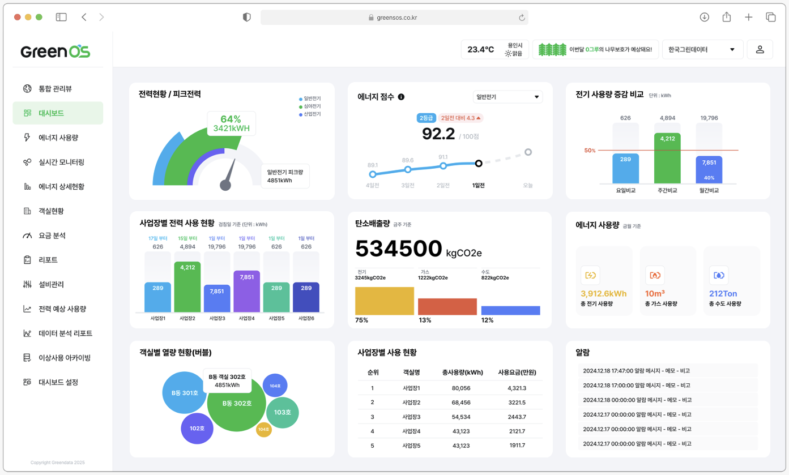
이호준 대표는 ‘GreenOS’를 “에너지와 탄소 데이터 관리의 민주화를 실현하는 플랫폼”이라고 정의한다. 기존 에너지 관리 시스템이 전문가 전용 도구에 머물렀다면, GreenOS는 비전문가 누구나 데이터 기반 실행과 판단을 내릴 수 있도록 설계됐다.
GreenOS의 핵심 가치는 세 가지다. 첫째, 접근성이다. 별도 센서 설치 없이 실시간 분석이 가능하며, 웹이나 모바일 어디서든 AI 챗봇을 통해 에너지·탄소 데이터를 확인할 수 있다. 둘째, 자동화다. LSTM와 TCN, TFT 등 고도화된 전력 예측 알고리즘과 NILM 기반 설비별 분석 기술을 탑재해 이상 감지부터 탄소 리포트까지 전 과정을 자동화한다. 셋째는 확장성이다. SaaS 기반으로 오피스부터 공장, 지자체 건물까지 다양한 공간에 유연하게 적용된다.
주목할 점은 멀티모달 챗봇 ‘그리니’다. 에너지 관리, 탄소 배출, 요금 시뮬레이션, ESG 공시 등 사용자 질의에 자연어로 실시간 응답하며, 생성형 AI 기술을 통해 복잡한 보고서를 자동 작성한다.
“AI 분석 대시보드는 사용자의 에너지 패턴을 학습해 최적의 운영 지침을 제공합니다. 시계열 예측 모델을 활용해 시간대별 부하를 96% 이상의 정확도로 예측하죠.”
실제 성과는 인상적이다. 아난티 리조트는 그리니와 AI 대시보드를 통해 객실별 냉난방을 최적화하면서, 연간 약 7%의 에너지 비용을 줄였다. 또한 삼성전자 SmartThings Pro 플랫폼과 연동해 관리자 업무 시간을 70% 단축시켰다.
공공에서 민간까지, 검증된 기술력
한국그린데이터의 기술력은 한국건설기술연구원(KICT)과 진행한 고양시 스마트시티 프로젝트에서 재차 검증됐다. GreenOS에 자체 개발한 M&V(측정 및 검증) 시스템을 내장해 설비 개선 전후의 절감률을 수치화했다. 그 결과 평균 18.6%의 에너지 절감률과 3.2년의 투자 회수 기간을 달성했다.
“공공기관은 투자 전 효과 검증을 중요하게 봅니다. 고양시에서의 사례는 객관적 데이터와 공공 인증기관 실증을 통해 강력한 답변을 제시했죠.”
삼성전자와의 협업도 중요한 전환점이었다. C-Lab 아웃사이드 프로그램을 통해 글로벌 SaaS로의 확장성과 UI/UX를 고도화했다. 그리고 SmartThings Pro 플랫폼에 GreenOS의 생성형 AI 리포트 엔진을 마이크로서비스 형태로 통합 제공했다. 현대건설, LS ELECTRIC, 메가존, KICT 등으로 이어지는 협업의 기반이 됐다.
글로벌 진출, 탄소회계연맹 가입으로 신뢰도 확보
한국그린데이터는 내년 상반기 미국과 동남아시아 진출을 본격화한다. 존슨컨트롤과 함께 하와이 호놀룰루 공항에서 GreenOS 기반 고빈도 전력 데이터 분석 플랫폼을 실증 중이다. 베트남 하노이 스마트시티 마스터플랜에도 참여한다. 인도네시아에서는 코린도 그룹과 협업해 에너지 최적화 솔루션 도입 PoC를 기획하고 있다.
특히 탄소회계연맹(CAA) 가입은 글로벌 진출의 핵심 동력이다. CAA는 CDP, IFRS, TCFD, PCAF 등 국제 ESG 공시 기준 제정기관과 연동해 Scope 1, 2, 3 데이터 구조를 구체화하는 역할을 한다.
“CAA 가입을 통해 국제 ESG 공시 규정의 수용자가 아닌, 설계자들과 협력하는 파트너로 이동했죠. 이는 글로벌 탄소회계 시장에서 통용되는 보편적 기술 플랫폼으로 진화할 토대를 마련한 중요한 전환점이에요.”
탄소를 ‘자산’으로 전환하는 미래 설계
한국그린데이터의 궁극적 목표는 단순한 에너지 절감 솔루션 기업을 넘어서는 것이다.
그는 “기업·정부·도시의 탄소 이행 전 과정을 연결하는 ‘토탈 엔터프라이즈 카본 플래닝(Total Enterprise Carbon Planning)’ 플랫폼으로 진화할 것”이라고 강조한다.
GreenOS는 평균 7~20%의 에너지 절감을 실현하며 ‘데이터로 절감 가능한 탄소’를 만드는 역할을 해왔다. 하지만 탄소중립은 절감만으로 완성되지 않는다. 측정된 저감 데이터를 ‘정량화·검증(MRV)’하고 제3의 시장과 연결해 경제적 가치를 창출해야 한다. 이를 위해 회사는 탄소배출권 인증 플랫폼과 데이터 기반 탄소거래 플랫폼을 구축하고 있다.
이호준 대표가 제시하는 세 가지 변화는 다음과 같다:
누구나 쉽게 참여할 수 있는 탄소중립: 복잡한 인증 제도와 회계 기준을 AI와 자동화된 리포팅으로 대중화해 스타트업은 물론, 중소기업, 교육기관도 ESG 경영을 실행할 수 있게 한다.
탄소를 ‘비용’이 아닌 ‘자산’으로: 탄소 데이터를 공시 의무가 아닌, 인증 가능한 저감 실적과 경제적 크레딧으로 전환해 금융, 조달, 수출 등 다양한 분야에서 자산화를 실현한다.
한국형 탄소 플랫폼의 글로벌 확장: 기술 기반으로 동남아와 중동, 남미 등 탄소 회계 인프라가 부족한 국가들 대상으로 확장해 한국의 디지털 탄소 플랫폼이 글로벌 ESG 인프라로 자리 잡는다.
지속가능한 미래를 향한 담대한 여정
“한국그린데이터가 궁극적으로 가고자 하는 길은 ‘탄소를 줄이는 기술’에서 나아가, ‘탄소를 구조화하고 거래 가능한 데이터로 전환해 ESG 경제를 가능케 하는 인프라를 만드는 것’입니다.”
탄소중립은 단순한 기술이 아니라 사회 구조를 바꾸는 일이기에, 한국그린데이터는 변화의 핵심 파트너로서 역할을 다하겠다는 포부를 밝혔다. 데이터가 숨 쉬는 공간에서 낭비는 사라지고 효율이 피어나는 미래, 한국그린데이터는 담대한 여정을 이어가고 있다.
서울 강남에 본사를 둔 한국그린데이터는 13명의 구성원으로 운영되고 있다. 구성원의 절반 이상이 AI와 데이터 엔지니어링, ESG 리포트 자동화 기술 개발에 집중된 기술 인력이다.
"When data breathes, waste disappears and efficiency blossoms," said Lee Ho-jun, CEO of Korea Green Data.
Energy democratization led by Greenie, turning even non-experts into ESG experts.
Turning carbon into an asset, dreaming of a global ESG infrastructure that goes beyond South Korea.
"Carbon can be an asset, not a cost. Through data-driven, precise measurement and AI automation, we aim to create an era where everyone can participate in the ESG transition."
The future envisioned by Lee Ho-jun (47), CEO of Korea Green Data, is clear: a world where complex energy management is entrusted to AI chatbots, and efficiency is maximized through precise predictions rather than vague savings.
A data innovator with accumulated Silicon Valley experience
The industrial workplace remained breathless. Faced with countless meters, managers relied on Excel to quantify energy usage late into the night, and carbon emissions measurement was considered mandatory. Despite the massive wave of ESG transformation, the workplace floundered in the swamp of analog.
In 2020, a startup emerged that began to crack this wall. Korea Green Data, with the vision of "innovating energy with data," is at the center of this effort. At its center is CEO Lee Ho-jun, who gained expertise in AI and data systems in Silicon Valley.
After majoring in computer engineering at Hanyang University, he moved to the US to pursue his master's and doctoral degrees, honing his AI expertise. He then worked at two energy startups in Silicon Valley. At the first, he led the North American branch, witnessing how technology transformed the industry paradigm. At the second, he oversaw product development and operations, leading the company to attract significant investment.
"In Silicon Valley, I've seen how data can simultaneously drive industrial efficiency and sustainability. Beyond simple automation, I've seen how data-driven decision-making reduces energy waste and creates new value."
However, upon returning to Korea, the reality he encountered was quite different. Manual energy management and unmeasured carbon emissions were still rampant in Korea. This is why he founded Korea Green Data with the goal of solving these problems through technology.
GreenOS: Democratizing Energy Management
CEO Lee Ho-jun defines GreenOS as "a platform that democratizes energy and carbon data management." While existing energy management systems have been limited to tools for experts, GreenOS is designed to enable anyone, even non-experts, to make data-driven decisions and actions.
GreenOS has three core values. First, accessibility. Real-time analysis is possible without installing separate sensors, and energy and carbon data can be accessed via an AI chatbot anywhere on the web or mobile. Second, automation. Equipped with advanced power prediction algorithms such as LSTM, TCN, and TFT, as well as NILM-based facility-specific analysis technology, it automates the entire process, from anomaly detection to carbon reporting. Third, scalability. As a SaaS-based platform, it can be flexibly applied to a variety of spaces, from offices to factories and local government buildings.
Of note is the multimodal chatbot "Greenie." It responds in real time to user queries on topics such as energy management, carbon emissions, rate simulation, and ESG disclosures in natural language, and automatically generates complex reports using generative AI technology.
"The AI analytics dashboard learns your energy patterns and provides optimal operating guidelines. Using a time-series forecasting model, it predicts hourly load with over 96% accuracy."
The actual results are impressive. Ananti Resort reduced energy costs by approximately 7% annually by optimizing heating and cooling for each room using Greenie and an AI dashboard. Furthermore, integration with Samsung Electronics' SmartThings Pro platform reduced administrator work time by 70%.
Proven technology from public to private sector
Korea Green Data's technological prowess was further validated in the Goyang City Smart City Project, conducted in collaboration with the Korea Institute of Civil Engineering and Building Technology (KICT). By incorporating a proprietary M&V (Measurement and Verification) system into GreenOS, the company quantified energy savings before and after facility improvements. As a result, an average energy savings of 18.6% was achieved, with a payback period of 3.2 years.
"Public institutions place importance on verifying the effectiveness of their investments before they invest. The case of Goyang City provided a compelling response through objective data and verification by a public certification agency."
Collaboration with Samsung Electronics was also a key turning point. Through the C-Lab Outside program, we enhanced our global SaaS scalability and UI/UX. Furthermore, we integrated GreenOS's generative AI reporting engine into the SmartThings Pro platform as a microservice. This laid the foundation for future collaborations with Hyundai Engineering & Construction, LS ELECTRIC, Megazone, and KICT.
Expanding globally and securing credibility by joining the Carbon Accounting Alliance.
Korea Green Data plans to actively expand into the US and Southeast Asia in the first half of next year. It is currently testing a GreenOS-based high-frequency power data analysis platform at Honolulu Airport in Hawaii with Johnson Controls. It is also participating in the Hanoi Smart City Master Plan in Vietnam. In Indonesia, it is collaborating with the Korindo Group to develop a proof-of-concept (PoC) for the introduction of an energy optimization solution.
In particular, joining the Carbon Accounting Alliance (CAA) is a key driver of global expansion. CAA works with international ESG disclosure standard-setting bodies such as CDP, IFRS, TCFD, and PCAF to concretize Scope 1, 2, and 3 data structures.
"By joining the CAA, we've moved from being a recipient of international ESG disclosure regulations to a partner collaborating with their designers. This is a significant turning point, laying the foundation for our evolution into a universal technology platform for the global carbon accounting market."
Designing a Future That Converts Carbon into an Asset
Korea Green Data's ultimate goal is to go beyond simply being a provider of energy-saving solutions.
He emphasizes that “we will evolve into a ‘Total Enterprise Carbon Planning’ platform that connects the entire carbon transition process of companies, governments, and cities.”
GreenOS has achieved energy savings of 7-20% on average and has played a role in creating "data-driven carbon reduction." However, carbon neutrality is not achieved through reduction alone. Measured reduction data must be quantified and verified (MRV) and linked to third-party markets to create economic value. To this end, the company is building a carbon emissions certification platform and a data-driven carbon trading platform.
The three changes proposed by CEO Lee Ho-jun are as follows:
Carbon neutrality made easy for everyone: By democratizing complex certification systems and accounting standards through AI and automated reporting, we enable startups, SMEs, and educational institutions to implement ESG management.
Turning carbon into an asset, not a cost: Transform carbon data into verifiable reduction performance and economic credits, rather than mandatory disclosure requirements, to realize assetization in various sectors, including finance, procurement, and exports.
Global expansion of the Korean carbon platform: By leveraging technology to expand to countries with inadequate carbon accounting infrastructure, such as Southeast Asia, the Middle East, and South America, Korea's digital carbon platform will establish itself as a global ESG infrastructure.
A Bold Journey Towards a Sustainable Future
"Korea Green Data's ultimate goal is to move beyond 'carbon reduction technology' to 'creating infrastructure that structures carbon and transforms it into tradable data, enabling an ESG economy.'"
Carbon neutrality is not simply a technological advancement; it involves transforming the social structure. Therefore, Korea Green Data has expressed its commitment to serving as a key partner in this transformation. Korea Green Data is embarking on a bold journey to create a future where waste disappears and efficiency flourishes in a space where data thrives.
Headquartered in Gangnam, Seoul, Korea Green Data operates with a team of 13. More than half of its members are technical professionals focused on developing AI, data engineering, and ESG reporting automation technologies.
「データが呼吸する時、無駄に消えて効率は咲く」、イ・ホジュン韓国グリーンデータ代表
– 非専門家もESG専門家で、「グリニー」が率いるエネルギー民主化
-炭素を資産に、大韓民国を越えてグローバルESGインフラを夢見る
「炭素はコストではなく資産になることができます。データ駆動型の正確な測定とAI自動化を通じて、誰もがESG移行に参加する時代を作りたいと思います」
イ・ホジュン韓国グリーンデータ代表(47)が想像する未来は鮮明だ。複雑なエネルギー管理をAIチャットボットに任せ、漠然とした節約ではなく、正確な予測で効率を最大化する世界。
シリコンバレーの経験が蓄積された「データイノベーター」
産業現場は依然として息を切った。数多くのメーターの前で、管理者はエクセルに依存して夜遅くまでエネルギー使用量を合わせ、炭素排出量の測定は義務とされた。 ESGの転換という巨大な波が押し寄せてくるが、現場はアナログの沼で厄介だった。
2020年、この壁に亀裂を出し始めたスタートアップが登場した。 「データでエネルギーを革新する」というビジョンを掲げた韓国グリーンデータだ。中心にはシリコンバレーでAIとデータシステムの専門性を築いたイ・ホジュン代表がある。
漢陽大学コンピュータ工学を専攻した後、米国に渡って修士課程を踏んでAIを研磨した彼はシリコンバレーで2回のエネルギースタートアップを経験した。最初のスタートアップでは北米法人総括を引き受け、技術が産業パラダイムを変える過程を目指し、2番目は製品開発と事業を総括して大きな投資誘致を導いた。
「シリコンバレーで、データが産業の効率性と持続可能性を同時に引き上げることを確認しました。単純な自動化を超えて、データ駆動型の意思決定がエネルギーの浪費を減らし、新しい価値を創出するのを見ました。」
しかし、韓国に戻ってきた彼の目に映った現実は大きく異なっていた。国内は依然として手作業エネルギー管理と測定されない炭素排出が蔓延している。この問題を技術で解決するという目標で韓国グリーンデータを設立した理由だ。
「GreenOS」、エネルギー管理の民主化を実現する
イ・ホジュン代表は「GreenOS」を「エネルギーと炭素データ管理の民主化を実現するプラットフォーム」と定義する。既存のエネルギー管理システムが専門家専用のツールにとどまった場合、GreenOSは非専門家の誰でもデータ駆動型の実行と判断を下すように設計された。
GreenOSの重要な価値は3つです。まず、アクセシビリティです。別途センサーを設置せずにリアルタイム分析が可能で、ウェブやモバイルのどこでもAIチャットボットを通じてエネルギー・炭素データを確認することができる。第二に、自動化です。 LSTMとTCN、TFTなど高度化された電力予測アルゴリズムとNILMベースの設備別分析技術を搭載し、異常感知からカーボンレポートまで全過程を自動化する。第三は拡張性です。 SaaSベースで、オフィスから工場、自治体の建物まで様々な空間に柔軟に適用される。
注目すべき点はマルチモーダルチャットボット「グリニー」だ。エネルギー管理、炭素排出、料金シミュレーション、ESGの開示など、ユーザーのクエリに自然言語でリアルタイムに応答し、生成型AI技術により複雑なレポートを自動作成する。
「AI分析ダッシュボードは、ユーザーのエネルギーパターンを学習して最適な運用指針を提供します。時系列予測モデルを活用して時間帯別負荷を96%以上の精度で予測します。」
実際の成果は印象的です。アナンティリゾートはグリニーとAIダッシュボードを通じて客室別冷暖房を最適化し、年間約7%のエネルギーコストを削減した。また、サムスン電子のSmartThings Proプラットフォームと連動して管理者の業務時間を70%短縮した。
公共から民間まで、検証された技術力
韓国グリーンデータの技術力は韓国建設技術研究院(KICT)と進行した高陽市スマートシティプロジェクトで再度検証された。 GreenOSに独自開発したM&V(測定および検証)システムを内蔵し、設備改善前後の節減率を数値化した。その結果、平均18.6%の省エネ率と3.2年の投資回収期間を達成した。
「公共機関は投資前の効果検証を重要に見ています。
サムスン電子とのコラボレーションも重要な転換点だった。 C-Labアウトサイドプログラムを通じてグローバルSaaSへのスケーラビリティとUI/UXを高度化した。そしてSmartThings ProプラットフォームにGreenOSの生成型AIレポートエンジンをマイクロサービス形態で統合提供した。現代建設、LS ELECTRIC、メガゾーン、KICTなどにつながるコラボレーションの基盤となった。
グローバル進出、炭素会計連盟加入で信頼性確保
韓国グリーンデータは来年上半期、米国と東南アジア進出を本格化する。 Johnson Controlと一緒に、ハワイホノルル空港でGreenOSベースの高頻度電力データ分析プラットフォームを実証しています。ベトナムのハノイスマートシティマスタープランにも参加する。インドネシアではコリンドグループと協業し、エネルギー最適化ソリューション導入PoCを企画している。
特に炭素会計連盟(CAA)加入はグローバル進出の核心動力だ。 CAAはCDP、IFRS、TCFD、PCAFなど国際ESG開示基準制定機関と連動してScope 1、2、3データ構造を具体化する役割をする。
「CAA加入を通じて、国際ESG開示規定の受容者ではなく、設計者と協力するパートナーに移動しました。これはグローバル炭素会計市場で通用する普遍的技術プラットフォームに進化する基盤を設けた重要な転換点です」
炭素を「資産」に変える未来設計
韓国グリーンデータの究極の目標は、単純な省エネソリューション企業を越えることだ。
彼は「企業・政府・都市の炭素履行全過程を結ぶ「トータルエンタープライズカーボンプランニング」(Total Enterprise Carbon Planning)プラットフォームに進化するだろう」と強調する。
GreenOSは平均7~20%の省エネを実現し、「データで節減可能な炭素」を作る役割を果たしてきた。しかし、炭素中立は節減だけでは完成しない。測定された低減データを'定量化・検証(MRV)'して第3の市場と連結して経済的価値を創出しなければならない。そのために会社は炭素排出権認証プラットフォームとデータ基盤の炭素取引プラットフォームを構築している。
イ・ホジュン代表が提示する3つの変化は次の通りである。
誰でも簡単に参加できる炭素中立:複雑な認証制度と会計基準をAIと自動化されたレポートで大衆化し、スタートアップはもちろん、中小企業、教育機関もESG経営を実行できるようにする。
炭素を「費用」ではなく「資産」に:炭素データを開示義務ではなく、認証可能な削減実績と経済的クレジットに転換し、金融、調達、輸出など様々な分野で資産化を実現する。
韓国型炭素プラットフォームのグローバル拡張:技術基盤で東南アジアと中東、南米など炭素会計インフラが不足している国々向けに拡張し、韓国のデジタル炭素プラットフォームがグローバルESGインフラとして位置づけられる。
持続可能な未来への大胆な旅
「韓国グリーンデータが究極的に行こうとする道は「炭素を減らす技術」から進んで、「炭素を構造化して取引可能なデータに切り替えてESG経済を可能にするインフラを作ること」です。」
炭素中立は単純な技術ではなく社会構造を変えることだから、韓国グリーンデータは変化の核心パートナーとして役割を果たすという抱負を明らかにした。データが呼吸する空間で無駄は消えて効率が咲く未来、韓国グリーンデータは大胆な旅を続けている。
ソウル江南(カンナム)に本社を置く韓国グリーンデータは13人の構成員として運営されている。メンバーの半分以上がAIとデータエンジニアリング、ESGレポート自動化技術開発に集中した技術人材だ。
韩国绿色数据公司首席执行官李浩俊表示:“当数据呼吸时,浪费就会消失,效率就会提高。”
Greenie 引领的能源民主化,让非专家也能成为 ESG 专家。
将碳转化为资产,梦想超越韩国的全球ESG基础设施。
“碳可以成为一种资产,而不是成本。通过数据驱动、精准测量和人工智能自动化,我们的目标是创造一个人人都能参与ESG转型的时代。”
韩国绿色数据公司首席执行官李浩俊(47岁)所设想的未来很明确:将复杂的能源管理委托给人工智能聊天机器人,通过精确的预测而不是模糊的节省来最大限度地提高效率。
拥有硅谷丰富经验的数据创新者
工业工作场所依然令人窒息。面对数不清的仪表,管理人员不得不依靠Excel来量化能源使用情况,直至深夜,碳排放测量也被视为强制性要求。尽管ESG转型浪潮席卷而来,工作场所却依然在模拟的泥沼中挣扎。
2020年,一家初创公司崛起,开始打破这道壁垒。韩国绿色数据公司(Korea Green Data)秉承“用数据创新能源”的愿景,是这项努力的核心。其核心人物是首席执行官李浩俊(Lee Ho-jun),他在硅谷积累了人工智能和数据系统方面的专业知识。
他在汉阳大学计算机工程专业毕业后,前往美国攻读硕士和博士学位,磨练自己的人工智能专业知识。之后,他在硅谷的两家能源初创公司工作。在第一家公司,他领导北美分公司,见证了技术如何改变行业模式。在第二家公司,他负责产品开发和运营,带领公司吸引了大量投资。
在硅谷,我看到了数据如何同时推动工业效率和可持续性。除了简单的自动化之外,我还看到了数据驱动的决策如何减少能源浪费并创造新的价值。
然而,回到韩国后,他面对的现实却截然不同。韩国的能源管理依然以人工为主,碳排放也未得到有效计量。正因如此,他创立了韩国绿色数据公司,旨在通过技术手段解决这些问题。
GreenOS:实现能源管理民主化
首席执行官李浩俊将GreenOS定义为“一个使能源和碳数据管理民主化的平台”。现有的能源管理系统仅限于专家使用,而GreenOS旨在使任何人,甚至非专家,都能做出数据驱动的决策和行动。
GreenOS 拥有三大核心价值。首先,可访问性。无需安装单独的传感器即可进行实时分析,并且可以通过 AI 聊天机器人在任何地方(无论是在网络还是移动设备上)访问能源和碳排放数据。其次,自动化。它配备了 LSTM、TCN 和 TFT 等先进的功率预测算法,以及基于 NILM 的设施专用分析技术,可实现从异常检测到碳排放报告的整个流程的自动化。第三,可扩展性。作为一个基于 SaaS 的平台,它可以灵活地应用于从办公室到工厂和地方政府大楼等各种空间。
值得注意的是多模式聊天机器人“Greenie”。它以自然语言实时响应用户关于能源管理、碳排放、费率模拟和 ESG 披露等主题的查询,并使用生成式 AI 技术自动生成复杂的报告。
人工智能分析仪表板可以学习您的能源模式并提供最佳操作指南。使用时间序列预测模型,它可以预测每小时负荷,准确率超过 96%。
实际效果令人印象深刻。Ananti Resort 通过使用 Greenie 和 AI 仪表板优化每个房间的供暖和制冷,每年可降低约 7% 的能源成本。此外,与三星电子 SmartThings Pro 平台的集成使管理员的工作时间减少了 70%。
从公共到私人的成熟技术
韩国绿色数据的技术实力在高阳市智慧城市项目中得到了进一步验证。该项目与韩国土木工程与建筑技术研究所 (KICT) 合作开展。通过将专有的测量与验证 (M&V) 系统融入 GreenOS,该公司量化了设施改进前后的节能效果。结果,平均节能效果达到 18.6%,投资回收期为 3.2 年。
“公共机构在投资前非常重视验证投资的有效性。高阳市的案例通过客观数据和公共认证机构的验证,提供了令人信服的答案。”
与三星电子的合作也是一个关键的转折点。通过 C-Lab Outside 项目,我们增强了全球 SaaS 的可扩展性和 UI/UX 体验。此外,我们还将 GreenOS 的生成式 AI 报告引擎作为微服务集成到 SmartThings Pro 平台。这为未来与现代工程建设、LS ELECTRIC、Megazone 和 KICT 的合作奠定了基础。
加入碳核算联盟,拓展全球业务,确保信誉。
韩国绿色数据计划于明年上半年积极拓展美国和东南亚市场。目前,该公司正与江森自控合作,在夏威夷檀香山机场测试基于GreenOS的高频电力数据分析平台。此外,该公司还参与了越南河内智慧城市总体规划。在印度尼西亚,该公司正与Korindo集团合作,开发引入能源优化解决方案的概念验证(PoC)。
尤其值得一提的是,加入碳核算联盟 (CAA) 是其全球扩张的关键驱动力。CAA 与 CDP、IFRS、TCFD 和 PCAF 等国际 ESG 披露标准制定机构合作,以具体化范围一、范围二和范围三的数据结构。
加入CAA,我们从国际ESG披露法规的接受者转变为与其制定者合作的合作伙伴。这是一个重要的转折点,为我们发展成为全球碳核算市场的通用技术平台奠定了基础。
设计将碳转化为资产的未来
韩国绿色数据的最终目标是超越单纯的节能解决方案提供商。
他强调,“我们将发展成为一个‘企业全碳规划’平台,连接企业、政府、城市的整个碳转型过程。”
GreenOS 平均节能 7-20%,在打造“数据驱动的碳减排”方面发挥了重要作用。然而,碳中和并非仅仅通过减排就能实现。测量到的减排数据必须进行量化和验证 (MRV),并与第三方市场对接才能创造经济价值。为此,该公司正在构建碳排放认证平台和数据驱动的碳交易平台。
李浩俊代表提出的三项变革如下:
让每个人都能轻松实现碳中和:通过人工智能和自动报告使复杂的认证系统和会计标准民主化,我们使初创企业、中小企业和教育机构能够实施 ESG 管理。
将碳排放转化为资产而非成本:将碳排放数据转化为可验证的减排绩效和经济信用,而不是强制披露要求,以实现金融、采购、出口等各个领域的资产化。
韩国碳平台的全球扩张:通过利用技术扩展到东南亚、中东和南美等碳核算基础设施不足的国家,韩国的数字碳平台将确立其作为全球ESG基础设施的地位。
迈向可持续未来的大胆旅程
“韩国绿色数据的最终目标是超越‘碳减排技术’,实现‘构建碳结构并将其转化为可交易数据的基础设施,实现 ESG 经济’。”
碳中和不仅仅是一项技术进步,它还涉及社会结构的变革。因此,韩国绿色数据公司承诺成为这一变革的关键合作伙伴。韩国绿色数据公司正踏上一段大胆的征程,在数据蓬勃发展的空间中,创造一个消除浪费、提高效率的未来。
Green Data 总部位于韩国首尔江南区,拥有 13 名团队成员,其中一半以上是专注于开发人工智能、数据工程和 ESG 报告自动化技术的技术专业人员。
« Lorsque les données respirent, les déchets disparaissent et l'efficacité s'épanouit », a déclaré Lee Ho-jun, PDG de Korea Green Data.
La démocratisation de l’énergie menée par les écologistes, transformant même les non-experts en experts ESG.
Transformer le carbone en un atout, rêver d’une infrastructure ESG mondiale qui va au-delà de la Corée du Sud.
Le carbone peut être un atout, et non un coût. Grâce à des mesures précises et basées sur les données, ainsi qu'à l'automatisation par l'IA, nous souhaitons créer une ère où chacun pourra participer à la transition ESG.
L'avenir envisagé par Lee Ho-jun (47 ans), PDG de Korea Green Data, est clair : un monde où la gestion complexe de l'énergie est confiée à des chatbots IA, et l'efficacité est maximisée grâce à des prévisions précises plutôt qu'à des économies vagues.
Un innovateur en matière de données avec une expérience accumulée dans la Silicon Valley
Le monde du travail industriel est resté à bout de souffle. Confrontés à d'innombrables compteurs, les managers s'appuyaient sur Excel pour quantifier la consommation énergétique jusque tard dans la nuit, et la mesure des émissions de carbone était considérée comme obligatoire. Malgré la vague massive de transformation ESG, le monde du travail a sombré dans le marasme de l'analogique.
En 2020, une startup a émergé et a commencé à percer ce mur. Korea Green Data, dont la vision est d'« innover dans l'énergie grâce aux données », est au cœur de cet effort. Son PDG, Lee Ho-jun, a acquis une expertise en IA et en systèmes de données dans la Silicon Valley.
Après avoir obtenu un diplôme en ingénierie informatique à l'Université Hanyang, il s'est installé aux États-Unis pour préparer son master et son doctorat, perfectionnant ainsi son expertise en IA. Il a ensuite travaillé dans deux startups du secteur de l'énergie dans la Silicon Valley. Dans la première, il a dirigé la branche nord-américaine, témoin de la transformation technologique du secteur. Dans la seconde, il a supervisé le développement et les opérations des produits, permettant à l'entreprise d'attirer d'importants investissements.
Dans la Silicon Valley, j'ai pu constater comment les données peuvent simultanément favoriser l'efficacité industrielle et la durabilité. Au-delà de la simple automatisation, j'ai pu constater comment la prise de décision basée sur les données réduit le gaspillage d'énergie et crée de la valeur.
Cependant, à son retour en Corée, la réalité était bien différente. La gestion manuelle de l'énergie et les émissions de carbone non mesurées étaient encore monnaie courante en Corée. C'est pourquoi il a fondé Korea Green Data, avec pour objectif de résoudre ces problèmes grâce à la technologie.
GreenOS : démocratiser la gestion de l'énergie
Le PDG Lee Ho-jun définit GreenOS comme « une plateforme qui démocratise la gestion des données énergétiques et carbone ». Alors que les systèmes de gestion de l'énergie existants se limitent aux outils destinés aux experts, GreenOS est conçu pour permettre à tous, même aux non-experts, de prendre des décisions et d'agir en s'appuyant sur les données.
GreenOS repose sur trois valeurs fondamentales. Premièrement, l'accessibilité. L'analyse en temps réel est possible sans installer de capteurs distincts, et les données énergétiques et carbone sont accessibles via un chatbot IA, partout sur le web ou sur mobile. Deuxièmement, l'automatisation. Équipé d'algorithmes avancés de prédiction de puissance tels que LSTM, TCN et TFT, ainsi que d'une technologie d'analyse spécifique aux installations basée sur NILM, il automatise l'ensemble du processus, de la détection des anomalies au reporting carbone. Troisièmement, l'évolutivité. En tant que plateforme SaaS, elle peut être appliquée avec flexibilité à une variété d'espaces, des bureaux aux usines en passant par les bâtiments des collectivités locales.
Le chatbot multimodal « Greenie » est particulièrement remarquable. Il répond en temps réel aux questions des utilisateurs sur des sujets tels que la gestion de l'énergie, les émissions de carbone, la simulation tarifaire et les informations ESG, en langage naturel, et génère automatiquement des rapports complexes grâce à une technologie d'IA générative.
Le tableau de bord d'analyse IA analyse vos habitudes énergétiques et fournit des directives d'exploitation optimales. Grâce à un modèle de prévision chronologique, il prédit la charge horaire avec une précision de plus de 96 %.
Les résultats sont impressionnants. Ananti Resort a réduit ses coûts énergétiques d'environ 7 % par an en optimisant le chauffage et la climatisation de chaque pièce grâce à Greenie et à un tableau de bord IA. De plus, l'intégration avec la plateforme SmartThings Pro de Samsung Electronics a permis de réduire le temps de travail des administrateurs de 70 %.
Une technologie éprouvée du secteur public au secteur privé
Les prouesses technologiques de Korea Green Data ont été confirmées par le projet « ville intelligente » de Goyang, mené en collaboration avec l'Institut coréen de génie civil et de technologie du bâtiment (KICT). En intégrant un système propriétaire de mesure et de vérification (M&V) à GreenOS, l'entreprise a quantifié les économies d'énergie avant et après les améliorations des installations. Résultat : des économies d'énergie moyennes de 18,6 % ont été réalisées, avec un retour sur investissement de 3,2 ans.
Les institutions publiques accordent de l'importance à la vérification de l'efficacité de leurs investissements avant d'investir. Le cas de la ville de Goyang a apporté une réponse convaincante grâce à des données objectives et à la vérification par un organisme public de certification.
La collaboration avec Samsung Electronics a également marqué un tournant décisif. Grâce au programme C-Lab Outside, nous avons amélioré l'évolutivité de notre SaaS mondial et notre interface utilisateur/expérience utilisateur. De plus, nous avons intégré le moteur de reporting génératif d'IA de GreenOS à la plateforme SmartThings Pro sous forme de microservice. Cela a posé les bases de futures collaborations avec Hyundai Engineering & Construction, LS ELECTRIC, Megazone et KICT.
Développer son activité à l'échelle mondiale et consolider sa crédibilité en rejoignant la Carbon Accounting Alliance.
Korea Green Data prévoit une expansion active aux États-Unis et en Asie du Sud-Est au premier semestre de l'année prochaine. L'entreprise teste actuellement une plateforme d'analyse de données énergétiques haute fréquence basée sur GreenOS à l'aéroport d'Honolulu, à Hawaï, avec Johnson Controls. Elle participe également au plan directeur de la ville intelligente de Hanoï, au Vietnam. En Indonésie, elle collabore avec le groupe Korindo pour développer une preuve de concept (PoC) en vue du lancement d'une solution d'optimisation énergétique.
L'adhésion à la Carbon Accounting Alliance (CAA) est notamment un moteur essentiel de l'expansion mondiale. La CAA collabore avec des organismes internationaux de normalisation des informations ESG tels que le CDP, l'IFRS, le TCFD et le PCAF pour concrétiser les structures de données des Scopes 1, 2 et 3.
En rejoignant la CAA, nous sommes passés du statut de bénéficiaire des réglementations internationales en matière de divulgation ESG à celui de partenaire collaborant avec leurs concepteurs. Il s'agit d'un tournant majeur, qui pose les bases de notre évolution vers une plateforme technologique universelle pour le marché mondial de la comptabilité carbone.
Concevoir un avenir qui convertit le carbone en un atout
L’objectif ultime de Korea Green Data est d’aller au-delà du simple fait d’être un fournisseur de solutions d’économie d’énergie.
Il souligne que « nous évoluerons vers une plateforme de « planification totale du carbone de l’entreprise » qui relie l’ensemble du processus de transition carbone des entreprises, des gouvernements et des villes. »
GreenOS a réalisé des économies d'énergie de 7 à 20 % en moyenne et a contribué à la réduction des émissions de carbone grâce aux données. Cependant, la neutralité carbone ne s'atteint pas uniquement par la réduction. Les données de réduction mesurées doivent être quantifiées et vérifiées (MRV) et reliées à des marchés tiers pour créer de la valeur économique. À cette fin, l'entreprise développe une plateforme de certification des émissions de carbone et une plateforme d'échange de droits d'émission de carbone basée sur les données.
Les trois changements proposés par le PDG Lee Ho-jun sont les suivants :
La neutralité carbone simplifiée pour tous : en démocratisant les systèmes de certification complexes et les normes comptables grâce à l'IA et aux rapports automatisés, nous permettons aux startups, aux PME et aux établissements d'enseignement de mettre en œuvre la gestion ESG.
Transformer le carbone en un atout et non en un coût : convertir les données carbone en performances de réduction vérifiables et en crédits économiques, plutôt qu’en exigences de divulgation obligatoire, pour réaliser l’assetisation dans divers secteurs, notamment la finance, les achats et les exportations.
Expansion mondiale de la plateforme carbone coréenne : en tirant parti de la technologie pour s'étendre aux pays dotés d'infrastructures de comptabilité carbone inadéquates, comme l'Asie du Sud-Est, le Moyen-Orient et l'Amérique du Sud, la plateforme carbone numérique de la Corée s'établira comme une infrastructure ESG mondiale.
Un voyage audacieux vers un avenir durable
« L'objectif ultime de Korea Green Data est d'aller au-delà de la « technologie de réduction du carbone » pour « construire l'infrastructure qui permet une économie ESG en structurant le carbone et en le convertissant en données négociables ». »
La neutralité carbone n'est pas une simple avancée technologique ; elle implique une transformation de la structure sociale. C'est pourquoi Korea Green Data s'engage à être un partenaire clé de cette transformation. Korea Green Data se lance dans une aventure audacieuse pour créer un avenir où les déchets disparaissent et où l'efficacité s'épanouit, dans un espace où les données prospèrent.
Basée à Gangnam, Séoul, Corée, Green Data opère avec une équipe de 13 personnes. Plus de la moitié de ses membres sont des professionnels techniques axés sur le développement de technologies d'IA, d'ingénierie des données et d'automatisation des rapports ESG.
You must be logged in to post a comment.