



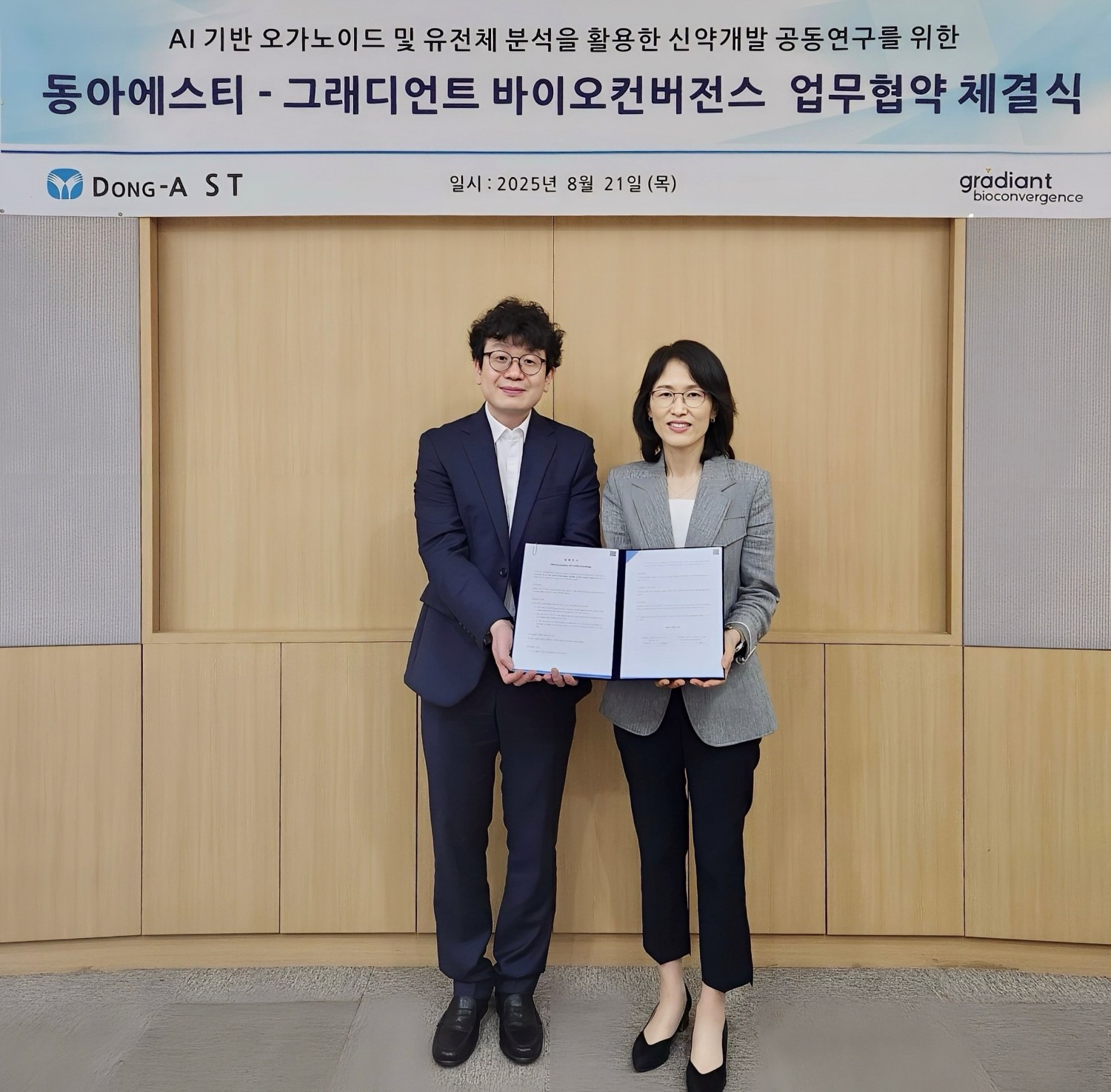
Gradient Bioconvergence (CEO Jin-Geun Lee), a subsidiary of Gradient, announced on August 22 that it signed a memorandum of understanding (MOU) with Dong-A ST (CEO Jae-Hoon Jeong) for joint research in the early stages of new drug development using artificial intelligence (AI)-based organoid and genome analysis.
Through this agreement, Gradient Bioconvergence will utilize its Patient-Derived Organoid (PDO) platform to conduct preclinical analyses of drug responsiveness and mechanism of action for Dong-A ST's new drug candidates in the areas of anticancer and brain disease. This approach aims to secure data more closely resembling the patient environment compared to existing animal models, and big data-based research coupled with AI analysis will also be conducted in parallel.
Through collaboration, the two companies aim to address structural issues in existing new drug development, such as limited predictive accuracy, high development costs, and long development periods, and to establish an efficient new drug development system through a precise initial verification process.
Gradient Bioconvergence possesses approximately 1,000 cancer patient-derived organoids and next-generation sequencing (NGS)-based genomic data. Based on this, it plans to evaluate tumor-specific responsiveness to Dong-A ST's anticancer pipeline and contribute to clinical design optimization by predicting patient groups with high therapeutic efficacy through AI analysis.
In addition, the company plans to apply brain organoid models utilizing human induced Pluripotent Stem Cells (hiPSCs) to precisely examine the pathological mechanisms of major brain diseases, such as Alzheimer's disease and tauopathies. This is expected to strengthen Dong-A ST's research and development capabilities in the field of neurological diseases.
Through this collaboration, the two companies aim to increase the likelihood of success in the early stages of new drug development and secure research competitiveness in the development of patient-tailored treatments.
- See more related articles
You must be logged in to post a comment.