



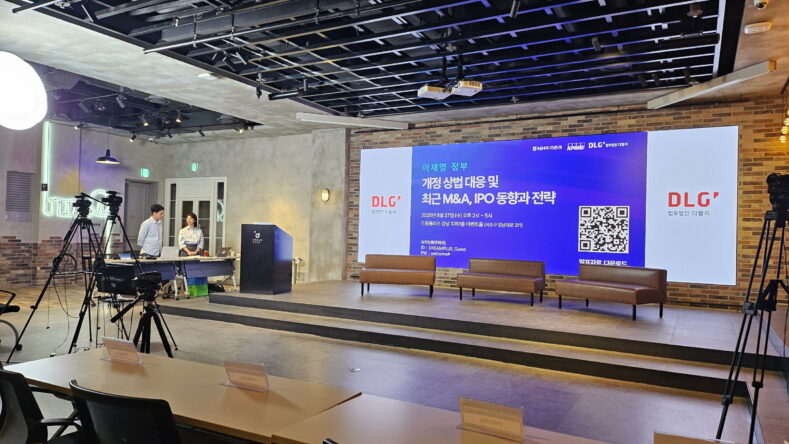
The time comes when you must choose between an IPO and an M&A. While each has its advantages, choosing either option requires significant time and effort. The recent revisions to the Commercial Act have made this decision particularly challenging.
On the 27th, law firms DLG, KPMG, and NH Investment & Securities held a seminar titled "Responding to the Revised Commercial Act and Recent M&A and IPO Trends and Strategies," which offered guidance to startups and listed companies grappling with an increasingly challenging institutional environment.
This seminar was held at Dream Plus Gangnam in Seocho-gu, and was attended by approximately 100 executives and employees from startups and listed companies with M&A and IPO needs.
The first speaker at this seminar, Attorney Sim Geon-wook of DLG Law Firm, presented on the topic, "The Startup Ice Age: Essential Legal Issues in M&A Contracts." Using Supreme Court rulings based on real-life cases as examples, he explained the key considerations when legal disputes arise between investors and startups.
In the following session, the 'Ministry of SMEs and Startups Notice and Limitation of Liability of Stakeholders' was mentioned, and the differences would have been if the contract in the previous session had been a contract after the revision of the Ministry of SMEs and Startups Notice.
Attorney Shim emphasized, “There are parts where the court’s interpretation and judgment can differ depending on whether the contents of the contract document are clear or not, and whether a separate agreement was left or not.” He added, “From the perspective of receiving investment, it is necessary to carefully review the investment contract in preparation for contingencies, and it is necessary to leave a contract document for any parts that may cause problems in the future.”
The second speaker, Partner Attorney Yang Jae-seok of DLG Law Firm, gave a presentation on the topic of "M&A Risk, Resolution Strategies through Representation and Warranty Insurance." He then explained the concept of representation and warranty in M&A transactions, its key contents, cases of actual breach, and the reasons why representation and warranty insurance is necessary.
Attorney Yang further explained, "The main content of the representation and warranty is the past facts that influence the judgment of the company's value and the factors that directly influence investment decisions. If the representation and warranty are properly implemented, there will be no unnecessary noise during the M&A process."
Prepare meticulous documentation and respond to M&A risks with statement guarantee insurance.
In explaining the concept and necessity of 'W&I Insurance', the two partner attorneys pointed out that "W&I Insurance is intended to cover the seller's risk of insolvency, and is basically an insurance policy to protect both the seller and the buyer, but if the seller intentionally violates the representation and warranty, the buyer can be compensated and then claim compensation from the seller."
The third speaker, attorney Kang Song-wook of DLG Law Firm, presented on "Lee Jae-myung Administration's Response Strategy to the Revised Commercial Act: Key Contents, Implications, and Response Measures," explaining the key provisions of the revised Commercial Act and its applicable scope. He particularly emphasized that the revised provision, "Expanding the Duty of Loyalty for Directors," applies equally to all corporations, from startups to listed companies, and is therefore applicable to current law, as it takes effect immediately on the date of promulgation.
Attorney Kang urged people not to jump to conclusions, saying, “There are some who think that the revised Commercial Act will only increase the burden on companies, and some are making provocative claims. We need to watch this more carefully.”
He suggested that companies should understand the essence of the revised Commercial Act and ensure that measures to protect shareholders’ interests do not feel abstract and vague, and that they should take concrete measures such as “establishing a governance structure that can confirm that the review process for shareholder loyalty obligations is reflected in internal decision-making procedures, and documenting the actual discussions of the board of directors/audit committee on major management matters of the company” as response measures for companies to Article 382-2 (Directors’ Duty of Loyalty, etc.) of the revised Commercial Act.
In addition, practical measures were presented for companies to realistically respond to ▲ the 3% Rule for appointment and dismissal of audit committee members, ▲ change of name and expansion of ratio of independent directors, ▲ introduction of electronic general shareholders' meeting system and parallel holding of electronic general shareholders' meetings by large listed companies.
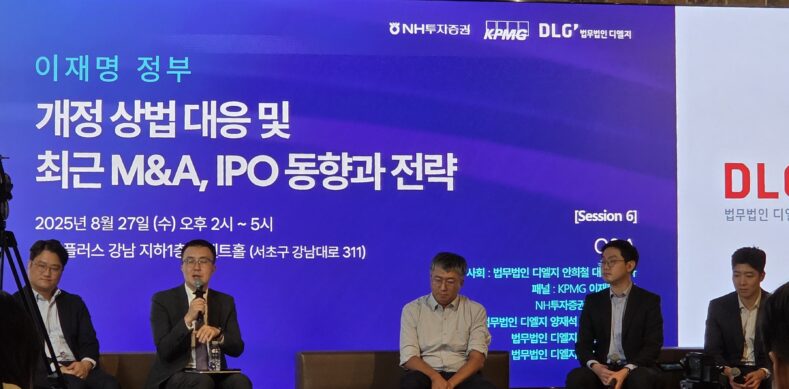
KPMG Managing Director Lee Jae-han, the first speaker of Part 2, addressed the topic of “M&A Strategies under the Lee Jae-myung Administration’s Policies,” and stated that the revision of the Commercial Act has brought about changes in M&A procedures, costs, and even pricing, and that companies need to prepare for the reduction in the influence of major shareholders and the expansion of variables at general shareholders’ meetings, as well as strategies to secure the transparency and legitimacy of transactions through fair corporate value calculations and due diligence.
This executive director stated, “Although the difficulty of M&A between startups and listed companies has increased, the demand for M&A is expected to increase in the short term due to rising transaction costs, leading to an increase in transactions.” He added that it is necessary to establish mid- to long-term strategies and make systematic preparations in line with the changing institutional environment.
As activism is expected to expand beyond large funds to include small shareholders and strategic investors, it is recommended that companies planning to go public focus on expanding activism and stabilizing governance.
NH Investment & Securities Director Kwak Hyeong-seo, the second speaker in Part 2, gave a presentation on the topic of 'Recent IPO Trends and Preparation Strategies', explaining the current state and outlook of the IPO market, IPO work flow, listing requirements, IPO tracks, and other matters that companies preparing for an IPO should consider in advance.
Director Kwak emphasized that companies should have sufficient time and funds when making listing plans, citing the recent downward trend in the approval rate for preliminary listing reviews compared to the past and the possibility that the preliminary listing review period could be extended due to unexpected variables.
Download presentation materials:
https://drive.google.com/drive/folders/1dyGEmTV49ydp1mOSRifn9y9YZFM6a7Yd
You must be logged in to post a comment.