



The LIPS project, hosted by the Korea Early Investment Accelerator Association (KAIA) (hereinafter referred to as the "Association (KAIA)"), is an innovative program that fosters entrepreneurial small business owners into "LICORNs." The LIPS project breaks away from the existing technology-centered investment ecosystem and focuses on fostering non-tech companies closely related to daily life. The 2025 Innovative Small Business Investment Linkage Support (LIPSⅡ), which aims to select 300 companies by 2025, goes beyond simple financial support to foster small business owners through a systematic nurturing program and serves as a bridge connecting small business owners and private investors.
"LIPS" stands for "Licorn Incubator Program for Small Brands," and its goal is to grow small businesses that have received pre-investment into "LICORNs" (Lifestyle & Local Innovation UNICORNs). "LICORNs" are companies that have achieved unicorn-level growth in the lifestyle and local sectors. This program holds special significance in that it aims to differentiate itself from existing tech-based unicorns by fostering innovative companies in the lifestyle and local sectors.
Launching its first project this year, LIPS II is a government project managed by the Ministry of SMEs and Startups, the Small and Medium Business Administration, and the Korea Association of Small Businesses (KAIA). It aims to support 300 small business owners, working with 28 operating companies (investors).
We met with Jang Hyun-seok, Director of the Ecosystem Cooperation Business Office at the Korea Association of Industrial Innovation (KAIA), which is in charge of the LIPS project, and discussed the specific operation method and vision of the LIPS project, as well as the ripple effect it will have on the domestic startup ecosystem.
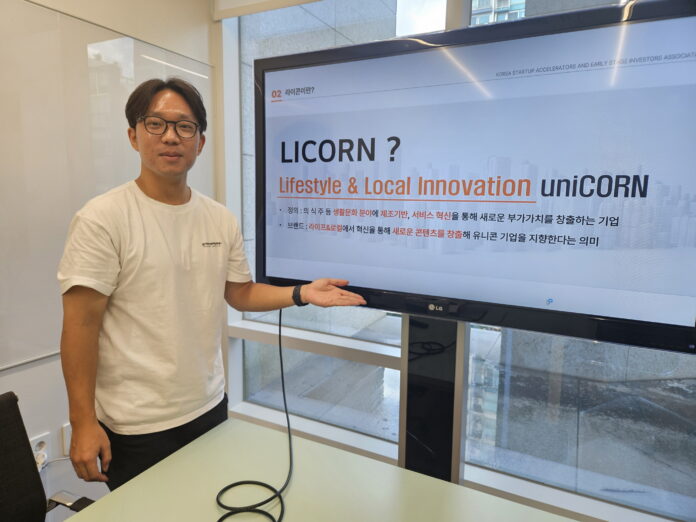
Q. First, please introduce the ‘Association (KAIA)’.
The Korea Accelerator Association (KAIA) was launched in July 2024 through the merger of the Korea Accelerator Association (KAIA) and the Korea Early-stage Investment Association (KAIA). This organization, formed by institutions investing in early-stage startups and companies, aims to support the growth of its member companies and foster industry development. Currently, approximately 300 major domestic investment firms are participating, and the Association's chairman is Jeon Hwa-seong, CEO of CNT Tech.
The Korea Association of Startups (KAIA) operates various programs to revitalize the startup investment ecosystem. First, it supports the establishment of new accelerators through startup planner certification training and actively participates in government-linked projects such as Freetips and LIPS. Furthermore, it operates networking programs for its members, expanding opportunities for industry exchange and collaboration.
In particular, the 'BLiNK' investment IR linkage program has established itself as a representative program that strengthens the connection between investment firms and companies by introducing portfolios directly invested in by investment reviewers.
Q. There seems to be a growing interest in "LIPS" recently. Could you explain what the "LIPS" business is?
"LICORN" refers to companies that have grown significantly, like unicorns, in the life and local sectors. Unicorns are tech-based, while "LICORN" refers to large companies in the life and local sectors. "Life" refers to small, everyday brands or areas closely related to daily life, while "local" refers to companies that have grown based on regional characteristics.
LIPS is an incubation program that supports small business owners' growth into "LICORN." While TIPS supports the growth of technology-based startups, LIPS is a program that fosters entrepreneurial growth for small business owners.
The key to corporate growth lies in attracting investment. LIPS is a public-private partnership investment model where investors first identify the growth potential of small businesses and invest, and the government provides additional support. This model allows small businesses to achieve stable growth through market validation.
Q. I understand that there are two types of 'LIPS': 'LIPS'Ⅰ and 'LIPS'Ⅱ. What is the difference between the two types?
LIPS is broadly divided into LIPS I and LIPS II. LIPS I, launched in 2023, is a loan-based program. LIPS II, launched this year, provides commercialization support, or subsidies.
LIPS I focuses on financing, while LIPS II combines commercialization grants with an acceleration program. Beyond financial support, LIPS II systematically supports the growth of small business owners by providing investment linkages, growth support services, and networking.
Q. "LIPS" II is a program essential for the growth of small business owners. So, what is the operational process for "LIPS" II?
LIPS II supports small business owners who have received pre-investment. The operating company is the investment firm that executes the investment. A total of 28 operating companies have been selected.
The operator discovers and invests in small and medium-sized enterprises, and the Association (KAIA) evaluates the companies recommended by the operator and makes the final decision on whether to support them. To ensure transparency and fairness, the evaluation criteria and self-assessment questionnaire are utilized throughout the process. Furthermore, selected companies are systematically provided with subsidies and programs through agreements.
Q. What is the scale and period of support for 'LIPS'Ⅱ?
The project period, or contract period, is six months. There are two types of support: "Scale-up" and "Scale-deep." Scale-deep refers to companies that have received initial investment, while Scale-up refers to companies that have received follow-up investment from a designated operating company. Scale-deep provides up to 100 million won in funding, while Scale-up provides up to 200 million won, with varying amounts paid based on evaluation.
Q. What are the application qualifications for ‘LIPS’Ⅱ?
ScaleDeep is open to companies that have received at least KRW 10 million in investment, and ScaleUp is open to companies that have received at least two rounds of follow-up funding of KRW 50 million or more. Detailed requirements and application procedures are outlined in the business announcement, and all companies are selected based on the same criteria.
Q. You previously explained that 'LIPS'Ⅱ is a model that combines financial support and an acceleration program. What are the 'LIPS'Ⅱ incubation programs provided by the 'Association (KAIA)' and the operator?
Each operator has its own childcare program, allowing businesses to access the support they need. The Korea Association of Small Businesses (KAIA) also offers various programs to strengthen the investment capacity of small business owners.
In particular, the "Investment Roadshow" program provides small business owners with the opportunity to meet professional investors directly, present their businesses, and receive feedback. This allows businesses to increase their chances of attracting investment and receive practical advice on business strategy.
We also offer a 1:1 customized IR matching service (IR365) for small business owners with limited investment experience. When a small business owner applies for the IR matching service, they are immediately connected with a professional reviewer. This program minimizes time, space, and network constraints, allowing them to receive investment advice year-round.
Q. I've heard that it's difficult to distinguish between LIPS-type companies and TIPS-type companies. What exactly is a LIPS-type company?
It's difficult to accurately distinguish between "LIPS"-type companies. This is because the boundaries between LIPS and TIPS have become blurred due to technological diffusion, and there are differing interpretations of the LIPS criteria. To address this, the Korea Association of Industrial Innovation (KAIA) developed the "LIPS/TIPS Self-Diagnosis Table." The self-diagnosis table consists of 10 questions based on four key keywords: lifestyle-based, manufacturing-based, service innovation, and technology-based. It is designed to help companies self-evaluate and determine whether they are LIPS-type companies.
Q. The "LIPS" project appears to be of great help to small businesses. As a LIPS practitioner, what are your thoughts on the significance and future prospects of LIPS?
While it's important for Korea to focus on technology, I believe fostering companies in non-technology sectors is also a crucial strategy. In particular, I believe the growth of non-technology, lifestyle, and local businesses plays a key role in national development. In this regard, I believe the LIPS project is highly significant. Rather than solely focusing on technology as a growth engine, I believe fostering excellent companies in non-technology, lifestyle, and local sectors is crucial from a national strategic perspective.
From an investment perspective, the current startup investment market tends to be concentrated in specific areas, such as IPOs. By supporting businesses closely related to everyday life and local communities, LIPS can diversify investment methods and pioneer new growth areas. This, in turn, can contribute to the creation of a balanced startup ecosystem, including non-technology-based companies, at the national level.

The Korea Investment & Securities Association (KAIA) is creating new connections between the investment industry and small business owners. This network of 28 operating companies and 300 small business owners goes beyond simple financial support and serves as the foundation for building a new business ecosystem.
In particular, the introduction of a new concept called "LICORN" is shedding new light on the potential of businesses closely tied to daily life, previously overshadowed by the myth of the unicorn. Companies that thrive while remaining rooted in their local communities and those creating innovations in the F&B and lifestyle sectors are beginning to attract renewed attention.
Of course, there are many challenges ahead. Critical tasks include establishing a continuous support system to ensure stable growth for small business owners, strengthening cooperation between operators and companies, and solidifying the ecosystem that connects investment and growth.
Director Jang emphasized, "In the long term, it's crucial to transcend the distinction between systems and programs and collectively consider how to enable outstanding companies to grow sustainably." The true value of the LIPS project lies in creating an ecosystem where promising companies of all types can thrive.
Although the Korea Association of Internet Industry Analysts (KAIA)'s "LIPS" project has only just begun, its ripple effects are already creating a breath of fresh air across the entire startup ecosystem. It deserves recognition as a significant effort to create a more diverse and healthy startup ecosystem, offering diverse success models that extend beyond technology to everyday life, beyond global to local, and beyond IPOs.
Attention is focused on how the growth stories of the 300 companies will unfold in 2025 and how many of them will become "LICORNs."
You must be logged in to post a comment.