



Building a data-driven system and culture… Driven by growth in Brandon's 150 billion won and Equalberry's 20-fold growth.
From ERP implementation to automation of 300 tasks in just three months… Boosters' 'reproducible formula for success'
"Financial data even interns can see, Boosters' 'transparent management' establishes a culture of autonomy."
"We need to go beyond just looking at data and work with it."
Amid rapidly changing consumer behavior and market trends, the old methods of relying on intuition and experience are no longer effective. Building a data-driven decision-making system is now key to securing competitiveness, and for e-commerce companies, data-driven decision-making is no longer optional but essential.
A data-driven approach delivers three core values: it enables accurate and unbiased decision-making based on objective facts. It also analyzes customers' purchasing history and behavioral patterns to deliver personalized experiences, leading to increased customer satisfaction and loyalty. It also enables early detection of market changes, enabling risk management and the identification of new opportunities.
However, the reality is that many e-commerce companies are reluctant to leverage data. They lack the specialized skills and personnel necessary for data collection and analysis, and legacy systems fail to support integrated data analysis. Furthermore, organizational cultures that have long relied on intuition and experience often resist change.
There's a company that aims to "provide differentiated brand experiences and value to global consumers based on data-driven insights." Boosters (CEO Choi Yoon-ho), a fashion and beauty commerce startup operating the compression and organization solution "BRANDEN" and the K-beauty brand "EQQUALBERRY," has developed its own real-time data analysis system to automate demand forecasting and analysis. This data-driven approach is the result of its ability to tap into the organizer market through "BRANDEN" and rapidly expand "EQQUALBERRY" into 80 countries.
Brandon is a compression and organizing solutions brand that holds over 90% of the domestic organizer market. Under the slogan "PACK IT EASY," its products specialize in storage and organization. Its flagship product, the "Volume-Saving Compression Pouch," as well as other compression pouches for outerwear, comforters, and living spaces, are gaining popularity. Recently, the company has expanded its lineup to include multi-packable bags, functional bags, and tote bags, leading the smart luggage organization trend. As of September 2025, the company has recorded cumulative sales of KRW 150 billion and cumulative sales of 8 million units.
Equalberry is a rapidly growing K-beauty brand in the global market. Its main products are toners and serums, and it emphasizes skin health-focused ingredients and benefits. Its flagship product, the "Vitamin Illuminating Serum," achieved the #1 K-beauty ranking in the serum category on Amazon North America. Since launching on Amazon in January 2024, Equalberry has consistently ranked in the top 100 in the toner and serum categories. Currently, it exports to over 80 countries, including Europe, Southeast Asia, and Oceania, and is also ranked among the top 20 K-beauty brands on Shopee, Southeast Asia's largest e-commerce platform.
We met with Director Yongho Kim, who leads Boosters' data management, at Boosters' office in Gangnam-gu, Seoul, and heard about Boosters' unique data system, innovative organizational culture, and 'the formula for replicating success.'

Creating a Reproducible Formula for Success in Commerce
"I believe that essential competitiveness lies not in manipulating numbers, but in creating systems that accelerate growth. Success can be replicated only when these two elements—systems and culture—are combined."
These are the words of Director Kim, who oversees finance, supply chain management, and technology at Boosters. Director Kim attributes the success of "Brandon" and "Equalberry" to Boosters' unique data system and organizational culture. Previously at Deloitte Anjin, Director Kim worked in auditing, taxation, and M&A, and has witnessed the success and failure of startups such as NCSoft, Lycle, and Allwe Makeis. What he learned during this process was the importance of systems that go beyond simple number-crunching.
"I joined Boosters because CEO Choi Yoon-ho and I share the same vision. Rather than operating commerce like a box office hit, our vision was to create a reproducible growth formula."
The first task Director Kim, who joined Boosters in 2022, undertook was to build an ERP system. Although he chose to customize a commercial solution to fit the commerce environment, the system was completed in just three months, a remarkable achievement for Director Kim, who is not a developer.
"There are typically three reasons why ERP implementations are delayed: not knowing what to do, complex legacy systems, or unclear decision-making. Boosters had none of these issues. The entire management team had extensive commerce experience and fully understood the need for ERP. They'd all experienced how difficult it was to manage a brand in its later stages, and how frustrating it was to have data delayed."
Complete data-driven decision-making and workflows with Boosta.
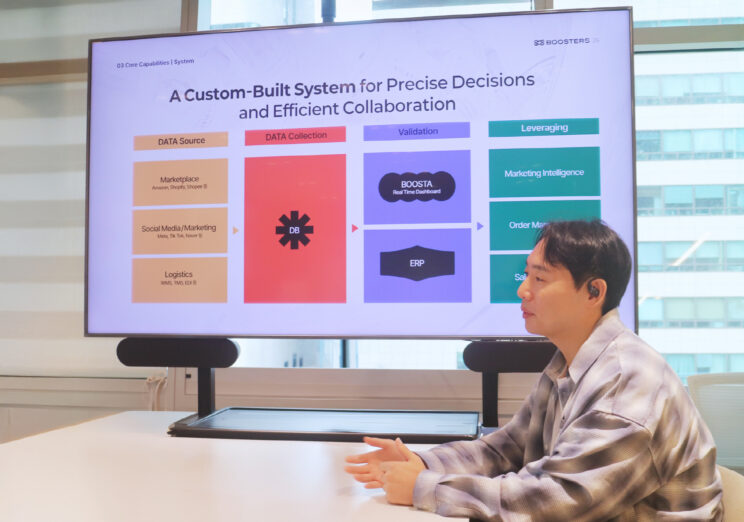
Boosters uses "BOOSTA" to make decisions and handle all operations. Short for Boosters Data, this system is a data warehouse that integrates data from various systems, including marketing, logistics, inventory, sales, and ERP, into its own database.
Boosta manages its data by dividing it into "leading data," "real-time data," and "lagging data" along timelines. Leading data forecasts demand, sets KPIs, and plans sales targets, serving as a compass for envisioning the future. Real-time data vividly shows current sales and inventory movements. Lagging data is verified data generated by the ERP system, providing reliable information with actual cash inflows and complete verification. Director Kim explained, "We continuously monitor and adjust real-time data through the ERP to ensure its accuracy."
This three-step verification system allows team members to trust the data without hesitation and make immediate decisions. Director Kim emphasized, "Data reliability is paramount."
The core of the Boosta system is divided into two axes: a BI dashboard that allows executives and employees to see the company's present and future at a glance, and a workflow platform where all employees actually perform their work.
A BI dashboard isn't just a list of numbers. Director Kim developed a metric called "CMIV," a unique cash flow forecasting indicator unique to Boosters. This metric, representing contribution margin relative to inventory investment, allows companies to gauge their financial health based on a clear standard: "Cash inflows are only possible if the contribution margin is above 230%."
Boosta's workflow platform is where employees actually perform their daily work. While the BI dashboard is a system that "views" the company's present and future, the workflow is a system that "works" based on that data. The new product planning management system registers all new products and tracks their progress. The performance analysis page allows for marketing strategy development, performance analysis by advertising channel, tracking of repeat purchase rates, and contract management. The inventory management system displays product arrival and departure times in real time, including the expected stock availability. Customer service management, automatic dispatching, warehouse system integration, and automated overseas shipping are all handled through this platform.
Boosters' system capabilities are clearly demonstrated by its brand performance. The recent "Nego King" promotion generated significant buzz, recording 140,000 orders and 1 million visitors to the company's online store.
"Usually, large-scale promotions are plagued by delivery delays, but Boosters successfully completed the campaign without any major issues by forecasting demand based on data and tracking inventory in real time."
The growth of K-beauty brand "Equalberry" is even more remarkable. In August of this year, it recorded 20-fold growth compared to the same period last year, and it currently ranks 14th in the toner category and tops the serum category on Amazon North America.
"We focused our social media marketing on the keyword 'irritating exfoliation' and pioneered new ingredient categories like 'bakuchiol.' This was the result of systematically identifying and allocating budgets from the beginning to determine where and how much resources should be focused."
Autonomous organizational culture created by transparency
Boosters' most groundbreaking approach is its approach to information sharing. Director Kim has established a clear principle: "All information necessary to achieve company goals will be transparently disclosed." In fact, all employees, including interns, can access the Boosters system and access real-time financial data, inventory status, and even sensitive data like CMIV (Country of Revenue Information), which helps predict cash flow.
This transparency brought about organizational change. Employees began to understand the company's situation on their own and proactively propose solutions. Director Kim said, "There's no need to give directives. By looking at the data, employees are the first to suggest, 'This is the situation the company is in, so we should do this.'" The moment data was shared, a culture of autonomous problem-solving was naturally formed.
This transparency is also implemented in the new product planning process. Employees subscribe to products of interest and receive Slack notifications whenever a product's progress changes. This systematically addresses the issue of information isolation.
Create what you need yourself… Boosters' learning culture
Boosters currently operates over 300 automated business processes. These processes range from taking meeting minutes to checking social media metrics to notifying cafeteria menus. How is this possible?
Boosters runs a permanent "818 Class." The name "818 Class" comes from Boosters' original address, 818 Seolleung-ro, and embodies the message of never losing sight of your original intentions.
The 818 class covers a wide range of topics, including Google Sheets, SQL queries, RPA tools, and AI Vibe coding. Boosters' C-level executives and team leads serve as instructors, and external experts are invited as needed. All classes utilize real-world company data, ensuring a high level of practical application. The program is so popular that applications for each class are always full, demonstrating the program's high level of employee interest and effective training.
"Employees are creating Slackbots to automate notifications and using AI to create daily newsletters and share them across the company. I believe this demonstrates the power of education."
The formula for replicating success: the era of working with data.
Director Kim expressed regret about the current level of data utilization in the domestic commerce industry.
"There are companies that heavily use data analysis. However, none have marketing, supply chain management, and finance organically integrated and functioning as a single system. In most cases, data is fragmented across departments, and decision-making often relies on intuition or experience."
Director Kim stated that finance, supply chain management (SCM), and technology are "like the nervous system, musculoskeletal system, and brain in our bodies," adding, "These three are organically connected, and for a healthy body, these three must be organically connected." He emphasized, "We must go beyond simply viewing data and reach the level of working with it." He advises entrepreneurs preparing to launch a commerce startup to "forget the 'later' mindset."
"If a company grows without developing a data-driven mindset, it's difficult to change that habit. Even if you can't implement a grand ERP system, consider structuring your data, even if it's just in Google Sheets. Above all, it's crucial to develop the habit of tracking the profit margins generated by each product you sell."
This is the secret to Boosters' pursuit of "reproducing commerce success without relying on luck." While a brand can succeed through a favorable market or good luck, surviving a downturn requires a formula based on data and systems.
"Every brand grows differently. Ultimately, the formula for repeating success lies in the combination of systems and culture, and the continuous testing and validation of what to do at each stage."
Director Kim's personal goals are also aligned with this.
"Building a startup with this kind of system and culture isn't easy. I want to build Boosters into a sustainable company by building a truly robust system, from data visibility at our global logistics hub to our production and distribution systems."

Director Kim's actions revealed the true face of a "data nerd." Boosters demonstrates the potential of a new commerce model that goes beyond simply creating great products, but replicates success through systems. In this era of data-driven operations, Boosters' experiments are only just beginning.
With sales expected to surpass 100 billion won this year, we look forward to seeing what innovations Boosters will bring in the future, and what changes their "reproduced success formula" will bring to the commerce industry as a whole.
You must be logged in to post a comment.