



– Robotics expert forum attended by Professors Dennis Hong, Kim Sang-bae, and others was a great success, with over 200 participants.
-“Seoul, a robot-friendly city”
The <2025 Seoul AI Robot Show Robot Expert Forum>, hosted and organized by the Seoul Metropolitan Government and the Seoul Economic Promotion Agency (SBA), concluded successfully on the 1st at the COEX Conference Room. Speakers included Professor Dennis Hong of UCLA, Professor Sangbae Kim of MIT, Professor Kyungchul Kong of KAIST, and Executive Director Rigun Choi of Hyundai Motor Group's Robotics Lab. Around 200 people attended, including researchers and entrepreneurs related to the robotics industry, students hoping to pursue careers in robotics, and ordinary citizens curious about how robots will transform our lives. The forum showcased the eagerness of leading scholars and industry leaders at the forefront of the robotics industry to see firsthand how robots will transform our present and future.
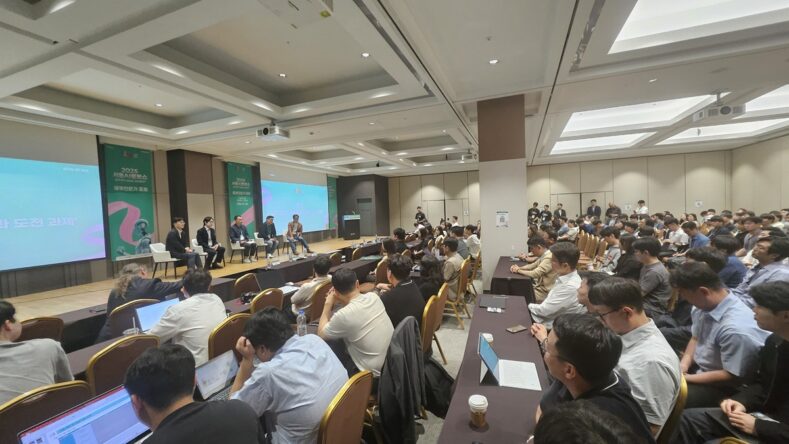
In his congratulatory remarks, Seoul City Economic Affairs Director Joo Yong-tae said, “We are already living in a reality where robots are changing our daily lives,” and added, “Seoul will strive to become a robot-friendly city so that citizens can lead better lives with robots.”
The first speaker, Professor Kyoung-Chul Gong of the Department of Mechanical Engineering at KAIST (Chairman/CTO of Angel Robotics), presented on the topic of "Seoul, the Potential of a Robot City." Professor Gong emphasized that "the robotics industry is a collection of cutting-edge technologies and is at the forefront of global competition." He touched on various factors that impact the robotics industry as a whole, including the current realities and challenges facing South Korea amidst competition for materials like rare earth resources and the conflict between the US and China over global hegemony.
Professor Gong also discussed new opportunities based on Seoul's medical infrastructure. A video showing Angel Robotics' wearable robot assisting with rehabilitation therapy for a child with partial lower-extremity paralysis who was unable to walk independently elicited gentle applause from the audience.
Choi Ri-gun, Executive Director of Hyundai Motor Group Robotics Lab, explained how innovative robotics technology can enhance the value of industrial and everyday spaces under the theme of “Space, People, and Robotics.” Choi said, “The value of space is determined not by its physical structure, but by human experience.” He gave examples of how Hyundai Motor Group Robotics Lab can create value in spaces through robots, including ▲ space innovation for patients and medical staff, ▲ manufacturing logistics innovation for industrial workers, ▲ office innovation for all who work together, and ▲ innovation in public life/community spaces that everyone can enjoy.
The third speaker, Professor Dennis Hong of the Department of Mechanical and Aerospace Engineering at UCLA, introduced the unique robots he has developed through video. He explained that the form of a robot should follow its function and not be limited by stereotypes or prejudices. Regarding the development of humanoid robots, Professor Hong explained, "In the spaces created by humans for humans to coexist with us in our daily lives, robots must take on a human form."
The last speaker, Professor Sangbae Kim of MIT, said that the reason why online internet services cannot fundamentally change our lives is because they cannot replace physical services. He pointed out that “the disappearance of SNS will not cause major problems for our society, but if workers in the care, medical, and safety fields who support our lives disappear, our daily lives will collapse.” He explained the background of the rise of humanoid robots in the current era of a super-aging society. Professor Kim said that there are many problems in areas that cannot be solved by just “virtual intelligence,” which collects information online and acquires data. He said, “Since a mistake in a robot working around people can cause great damage, ‘physical intelligence’ that recognizes and understands the physical world is important.”
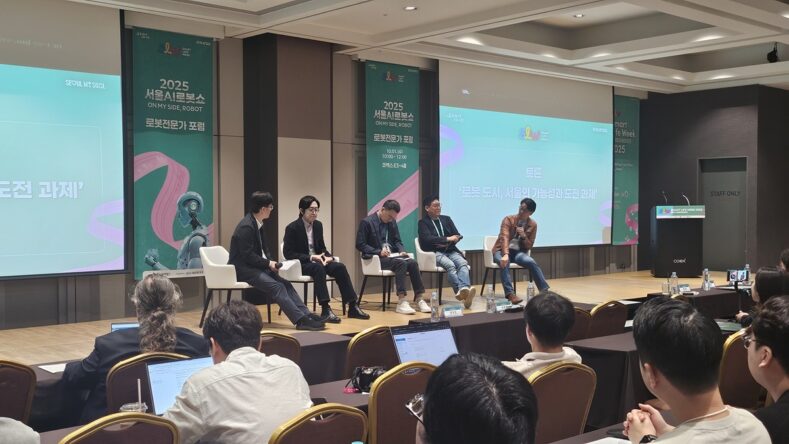
A panel discussion followed.
The first discussion topic was “The Possibilities and Challenges of Seoul, the Robot City.” Moderator Director Kim Ik-jae asked, “What is the most important prerequisite for not only the Korean people but also many people around the world to accept robots?” Professor Gong Gyeong-cheol responded, “As a robotics engineer, I am happy that robot technology is in the spotlight, but in order to actually change the world with our technology, we need time to innovate the technology as well as go through institutional regulations and certification.” He said that the public’s expectations and interest must not wane and must support robotics engineers until they can incorporate robots into their daily lives. Professor Dennis Hong mentioned the example of Waymo, the self-driving taxi service that he had previously shown in a video of himself using it, and said, “Ultimately, I believe the most important factor in accepting robots is the user experience.”
When Director Kim Ik-jae asked the second topic of discussion, “What stance should we take to develop the robotics industry?” Professor Gong Gyeong-cheol said, “We need to think about what our country can do uniquely and how we can specialize by leveraging our strengths and infrastructure,” and proposed utilizing Korea’s advanced medical infrastructure as a cradle for robotics R&D. Managing Director Choi Ri-gun said, “Scientists and engineers with a high level of understanding of technology should be able to participate more in the decision-making process,” and Professor Dennis Hong said, “We need to cultivate talents who can understand the essence of problems and take the right approach.” Professor Kim Sang-bae agreed with the aforementioned points, but added, “The experience of realizing and understanding something is extremely important. For our country to become a leader in the robotics industry, we need to create an environment that encourages talented individuals and provides them with practical support.”
You must be logged in to post a comment.