



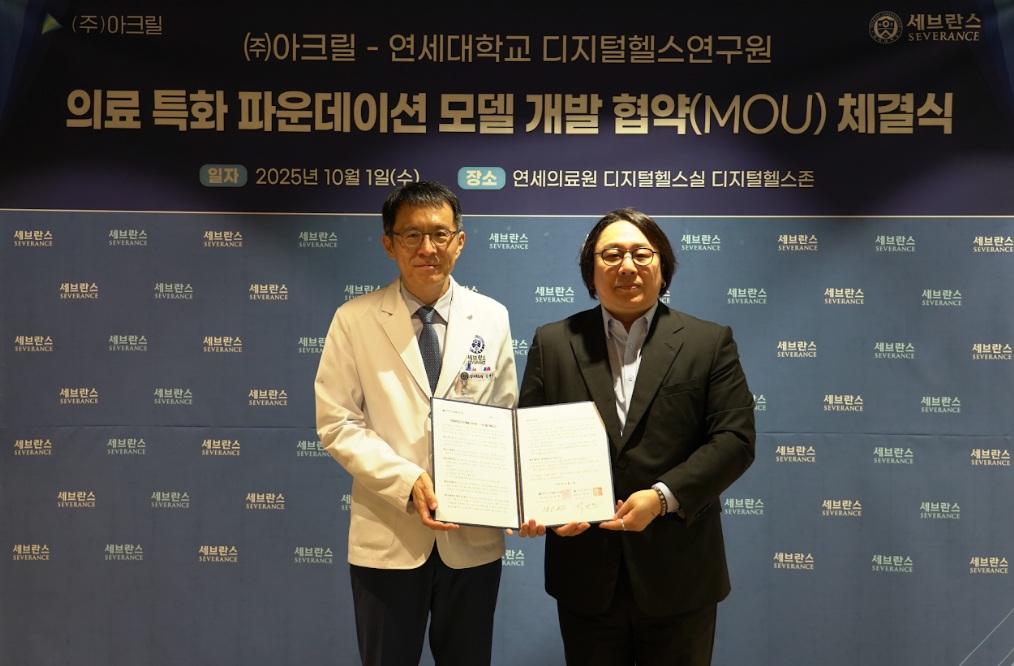
Acryl Co., Ltd. (CEO Park Oe-jin), an artificial intelligence platform company, announced that it has signed a joint research collaboration (MOU) with Yonsei University Digital Health Research Institute (Director Kim Hyeon-chang) for a world-class ‘medical specialized foundation model.’
This agreement aims to enhance the industrial application of medical AI by combining Acryl's generative AI technology with the high-quality clinical data (CDW) of Yonsei University Severance Hospital. Severance Hospital's single-institution data boasts strengths such as standardized terminology and long-term follow-up medical records, and is expected to be utilized in a variety of medical applications, including disease prognosis prediction, survival rate analysis, and early detection of high-risk groups.
Through this collaboration, Acryl plans to fully develop specialized healthcare services leveraging LLMOps-based agentic AI technology. Specifically, the strategy aims to expand AI utilization beyond diagnosis to encompass personalized healthcare and disease prevention, while also promoting innovation in the medical AI ecosystem through the proliferation of federated learning technology.
Acryl's AAAI Research Institute recently won recognition for its technological prowess in the medical AI field, being selected among 20 finalists out of 630 teams at the "AI Champion Competition" hosted by the Ministry of Science and ICT. The finalist, a "Medical Record Automation-Specific Generative AI-Based Multi-Agent Workflow and Service," is a technology that automates and intelligentizes clinical processes in real-world medical settings. It is considered a key foundation for the development of Acryl's medical-specific foundation model.
This technology is a lightweight foundation model with 4 billion parameters (4B), trained on Acryl's own medical dataset and public medical datasets. Furthermore, by applying a proprietary multi-layer hallucination suppression framework, it is designed to operate independently within hospitals without the need for large-scale computational resources. This ensures cost-effectiveness and practicality while delivering response quality comparable to that of ultra-large models.
Through this collaboration, Acryl plans to accelerate the advancement of its next-generation medical-specific foundation model, combining medical data with generative AI technology. Through this, the company aims to secure global-level competitiveness in medical AI.
- See more related articles
You must be logged in to post a comment.