



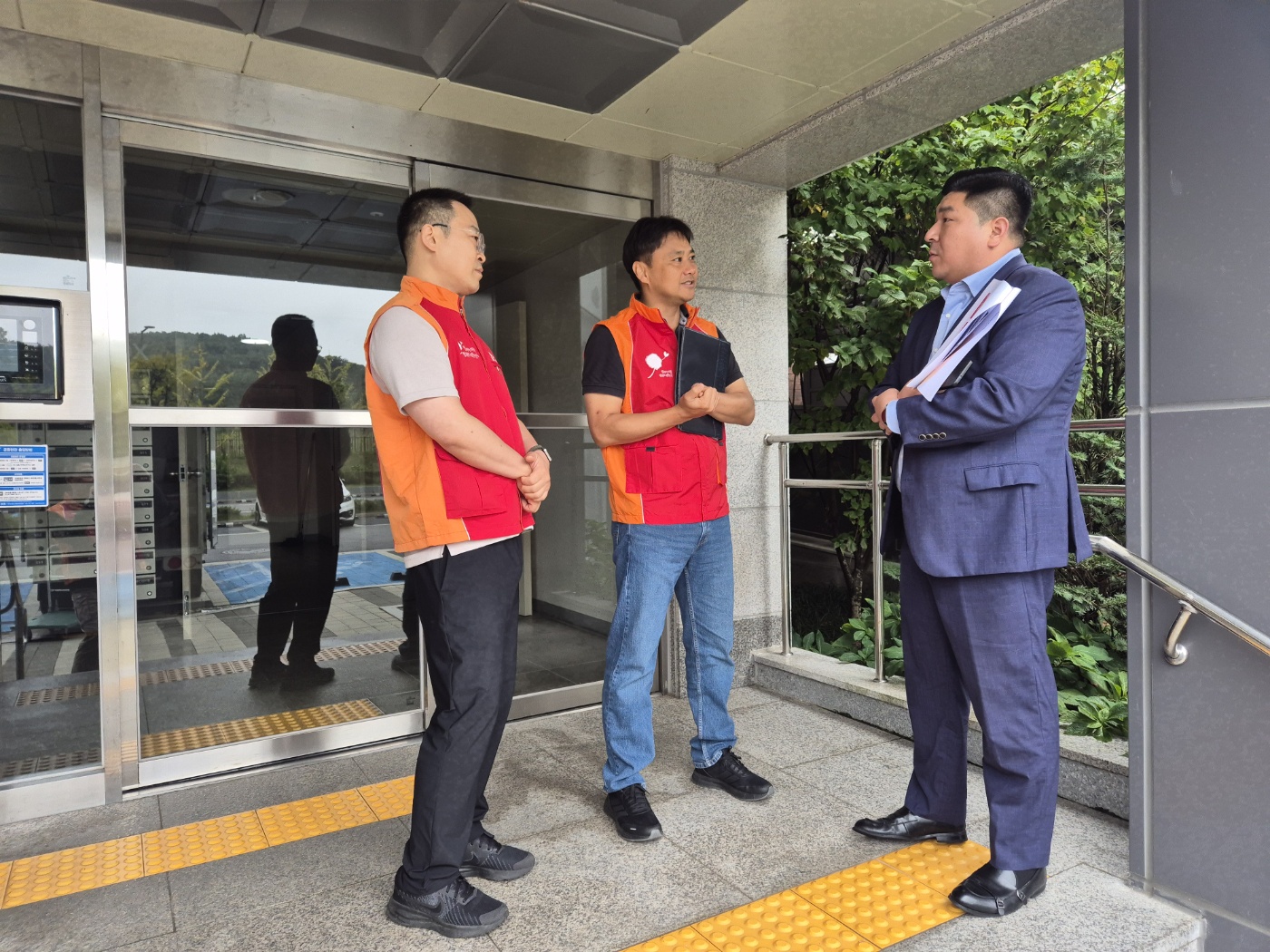
Sejong Creative Economy Innovation Center (CEO Oh Deuk-chang) held its first demonstration event for 'AI-based residential environment improvement open innovation' at Saenaru 12 Complex in Jiphyeon-dong, Sejong City on Tuesday, October 14.
This project is being promoted as part of the Community Chest of Korea's "Hope 2025 SK Telecom Designated Contribution Project," with the Sejong Center for Creative Economy and Innovation serving as the lead agency for the demonstration. This project, the first demonstration of open innovation for social value creation, aims to improve the living environments of vulnerable groups, such as elderly people living alone and young people preparing for independence, and to alleviate mental and social isolation.
On this day, the subject of the demonstration was the elderly living alone in Jiphyeon-dong, Sejong City, and a customized living environment improvement service was provided by a startup specializing in space diagnosis and organization/home care using AI object recognition technology.
A total of nine dedicated managers and volunteers participated in the project, which included cleaning the kitchen and bathroom, organizing unnecessary items, and rearranging spaces, thereby helping senior citizens living alone live in a safer and more sanitary environment.
This open innovation demonstration project is a creative technology demonstration project to address the housing environment of socially vulnerable people in Sejong City. Startup company Jeongri Habit Co., Ltd. was ultimately selected to participate in the demonstration.
Jeongri Habit Co., Ltd. combines AI object recognition-based spatial diagnosis technology with customized home care services to propose customized organizing solutions based on spatial data through AI image analysis and difficulty prediction.
Furthermore, through standardized service manuals and after-sales management systems, we achieve improved quality of life, high repurchase rates, and customer satisfaction, simultaneously realizing social value and technological innovation.
This pilot project is being evaluated as a social innovation experiment that goes beyond simple residential environment improvement, combining AI-based data analysis with living environment improvement services. It will verify whether changes in living environment, such as organizing and cleaning, lead to reductions in isolation and improved mental health.
The social value-creating open innovation project, launched for the first time this year by the Sejong Center for Creative Economy and Innovation, aims to provide startups with AI technology with opportunities to demonstrate their capabilities in solving real-world social problems, thereby creating a virtuous cycle model for public diffusion of private technology and regional welfare innovation.
Kim Young-hyun, a member of the Sejong Special Self-Governing City Council's Administrative Welfare Committee (Bangok, Jiphyeon, and Hapgang-dong), who participated in this demonstration event, said, "This demonstration project is a new type of social problem-solving model that combines technology and welfare, and it is very meaningful in that Sejong City is taking the lead in trying it." He added, "I hope that AI technology will go beyond simple convenience and become a practical means of eliminating blind spots in local care and welfare."
Oh Deuk-chang, CEO of the Sejong Center for Creative Economy and Innovation, said, “This demonstration is the starting point of true social innovation where technology changes people’s lives,” and added, “I hope that the combination of AI technology and the capabilities of startups will eliminate blind spots in the local community’s welfare and spread as a Sejong-style model for solving social problems.”
Meanwhile, the Sejong Center for Creative Economy and Innovation plans to sequentially expand the pilot program to include elderly people living alone and young people preparing for independence in Sejong City, including Dodam-dong, Jochiwon-eup, Jeonui-myeon, Jeondong-myeon, and Geumnam-myeon, by December of this year, and plans to continuously develop the AI-social service convergence open innovation model based on the results of this pilot program.
- See more related articles
You must be logged in to post a comment.