



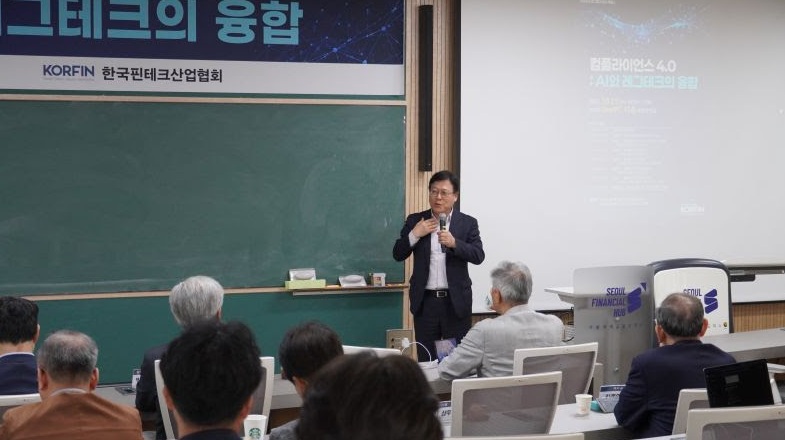
The Korea Fintech Industry Association (Chairman Lee Geun-joo, CEO of Hanpass, hereinafter referred to as the Fintech Association) held the '2025 Regtech Division Seminar' on the topic of 'Compliance 4.0: Convergence of AI and Regtech' in the large lecture room on the 17th floor of the Seoul International Finance Office IFC at 2:00 PM on October 15th.
This seminar was designed to share the latest trends in anti-money laundering with industry experts and strengthen the capabilities of practitioners. It also served as a forum for exploring ways to utilize regtech appropriately in the context of emerging technologies such as AI and stablecoins.
In his opening remarks, Lee Geun-joo, Chairman of the Korea Fintech Industry Association, said, “As the financial industry faces rapid changes in the regulatory environment, RegTech is not simply a tool for efficiently implementing regulations, but is establishing itself as a core infrastructure that implements financial trust through technology.” He added, “Detecting abnormal transactions using artificial intelligence, automating AML, and digitally transforming internal controls are no longer optional but essential tasks.”
The first presentation was by Park Man-seong, CEO and Chairman of the RegTech Division of the Association, on the topic "Why RegTech, Why Now?" Chairman Park examined the history of compliance from the perspectives of changing regulatory, technological, and financial industry environments, defining the current era as Compliance 4.0. Furthermore, he presented a case study of RegTech, centered on artificial intelligence, to overcome the limitations of current regulatory response methods, proposing a new regulatory response paradigm for the Compliance 4.0 era.
The second presentation was by Professor Seokbin Yoon (Sogang University) on "AI Technology Trends and RegTech." Focusing on the concept of AI native, Professor Yoon delved into how the convergence of AI and RegTech will transform business paradigms by 2025. He proposed a strategy for automating complex regulatory compliance tasks, such as anti-money laundering, by leveraging AI agents and generative AI, transforming regulation from a cost to a new competitive advantage based on trust.
The third presentation was by Professor Ji-Yeol Jeong (Hanyang University), titled "AML Response Strategies for Stablecoins and CBDCs." Professor Ji-Yeol Jeong stated, "CBDCs and stablecoins are not simply digital payment methods; they represent a new policy experiment where the global financial order and anti-money laundering regulations intersect." He emphasized, "Technology-driven innovation alone is not enough. We need to internalize AML principles into both institutional and technological structures from a 'Regulation by Design' perspective."
In the fourth presentation, Kim Jong-young, Executive Director of Octa Solutions, presented on "Latest Regulatory Trends and Response Strategies." He explained recent trends in financial authorities' anti-money laundering efforts, the revised anti-money laundering laws that have been enacted in 2025 or are scheduled to be enacted in 2026, and the response measures for financial companies. He also analyzed and shared the results of inspections conducted by authorities on financial companies in 2025, suggesting ways for financial companies to utilize RegTech in the anti-money laundering field.
The fifth presentation was by Executive Director Jeong Hae-jeong (Hanwha Systems), on the topic of "Maximizing Data Value Using AI Analytics Platforms." He presented ways to maximize the value of corporate data, using examples of dashboards built using AI analytics platforms and generative AI-based chatbots. He then reiterated that "effectively introducing AI into a business requires comprehensive capabilities across IT, AI, and domains, and the entire process of data collection, analysis, and visualization is crucial."
Meanwhile, this seminar, which explored innovative compliance strategies through the convergence of AI and RegTech in a rapidly changing regulatory environment, is expected to contribute to strengthening the practical anti-money laundering capabilities of fintech companies in the future.
- See more related articles
You must be logged in to post a comment.