



-Research from 'expensive and slow' to 'cheap and fast'
-“Customer feedback within 48 hours”
A world where research becomes routine… Changing Asia
Quickly identifying and addressing user needs and issues is essential for gaining a competitive edge in the market. User research can help products and services move in the right direction, and companies are recognizing this importance. Recently, there's a growing trend toward gathering customer feedback more quickly and frequently. However, despite the growing need for internalized research, the lack of a robust research system has hindered companies from moving beyond their reliance on agencies.
The challenge lies in time and cost. User research must be conducted in line with product and service launch schedules, and the chosen methodology incurs significant costs. Furthermore, the complexity of question design, methodology selection, and participant recruitment adds to the complexity. Furthermore, there are numerous responsibilities, including managing personal information protection, participant compensation payments and management, and operational and administrative tasks. If collected research results are not systematically managed, a vicious cycle of repeated research can occur.
There's a startup that's set out to solve these problems: DBDLAB. DBDLAB focuses on operational issues that remain constant regardless of the research being conducted: targeted recruiting, compensation payments, personal information processing, results capitalization, and ethical compliance.
A variety of UX research tools exist overseas. UserTesting, UserInterviews, and UserZoom have achieved successful growth through large-scale investment, M&A, and NASDAQ listings.
"User research is essential. However, it's often impossible due to time and cost constraints. Research needs to be made easier, faster, and more affordable. This way, you can conduct research whenever you need it. I felt the need for such a system."
Kang Ji-soo, CEO of DBDLAB, said, "Research is a large, legacy market. Unlike other industries where innovative companies emerge and transform their markets, the research market has yet to see any innovation."

What Customers Want Isn't a 'Research Tool,' But a 'Research Operations Infrastructure.'
CEO Kang came up with the idea for DBDLAB while working on the UX team at a closed commerce startup. While his work required frequent user research, time and cost constraints were significant. To address these challenges, he developed a user research solution, which led to the founding of DBDLAB.
DBDLAB's first service is "The Tester," a log analysis tool that tracks where users click and what paths they take on websites and apps. The second service, "Diby," is a platform that allows users to complete research designs with just a few clicks using question templates.
"Working with The Tester and DB, I discovered common problems companies face. Ultimately, they boil down to things like target recruiting, operations, compensation payment administration, and research asset management. These issues remain constant even when tools change."
User research faces recurring operational challenges, such as target recruitment, compensation payments, personal information processing, results capitalization, and ethical compliance. DBDLAB developed a system to address these "permanent issues." This led to the creation of "UserSpoon," a research operations infrastructure. "UserSpoon" enables companies to build brand panels and directly manage their own customers. It also delivers rapid research completion within 48 hours.
User research completed in just a few clicks
UserSpoon provides user survey forms, panels, and operational automation as a service. Its modular design allows customers to select and use only what they need.
UserSpoon Survey is equipped with features specialized for user research. After receiving responses, it automatically generates follow-up questions using "AI tail question generation." It also offers a "First Click Test," which shows screen images and measures the first area users click on. The "Tree Test" tracks how users navigate from upper-level menus to lower-level menus. By measuring users' intuitive understanding, it can be used to determine whether the current menu structure is easily understood by customers. The "5-Second Test," as its name suggests, is a first-impression test. After showing a screen for five seconds, the screen is covered and users are asked to identify phrases or images that impressed them. This test is commonly used for marketing campaign drafts or app landing pages. "Card Sorting" identifies users' information structure. By grouping cards into similar categories, it analyzes which services should be grouped together to help users find the information they need most easily. The "Focus Group Discussion" conducts group interviews via chat. Compared to face-to-face interviews, it provides a more comfortable environment, resulting in more than twice the amount of conversation.
3-step target recruiting
Panels are crucial in user research. They must be actual or potential customers of the product or service. However, finding these panels is not easy. That's why DBDLAB offers a variety of panels.
DBDLAB offers three main panels. First, there's the Brand Panel, designed for companies conducting their own research. Second, there's the Partner Panel, which provides panels to companies that don't conduct their own research. Third, there's the DBDLAB Panel, which DBDLAB itself builds and manages.
Building your own panel is simple. When a company creates a profile question on UserSpoon, a response link is generated, which can be embedded in your company's app or website. Once a user registers as a panelist, the user becomes a dedicated panelist for the company. Clients can check the panelist list on the admin screen and analyze profile question responses. CSV mappings can also be made to user IDs and other information from the company's database, such as purchase count and subscription date. If an interview is required, a notification message is sent to the client upon checking availability.
You can leverage third-party customers, not just your own, as your panelists. DBDLAB doesn't conduct its own research, but it embeds UserSpoon links in its apps, allowing other companies to leverage its panelists. This is useful when you need a specific target audience. Partners generate revenue by providing the panelists.
"The panel network in Asia is weak. Korea is relatively good, but Vietnam, the Philippines, Malaysia, and Singapore are all agency-centric. If we partner with a public platform like Grab, all Grab users will become part of the research panel."
DBDLAB has its own panel called "wouldyou." It's used when clients lack their own panelists or need to quickly recruit a specific target audience. It currently has a panel of 65,000 members.
Everything from compensation to privacy and research automation is managed automatically.
DBDLAB handles reward payments. Depending on the method chosen by the participant, rewards are automatically converted into points, gift cards, or cash. Companies conducting user research simply need to confirm participation, freeing themselves from payment administration, tax issues, and currency exchange procedures.
Personally identifiable information is encrypted and stored, making it unreadable. The company identifies participants solely by user ID. When interviews are needed, the DBDLAB system sends a notification message instead of the company contacting users directly. When mapping its own database, only behavioral data, such as number of purchases and subscription dates, is uploaded as CSV. Customer research can be conducted without the approval of the privacy protection team.
All research history is stored on the admin screen. It records who conducted the research, when, under what conditions, and the results. Profile questions and response data are de-identified and stored. Other team members can search past research and review the results, avoiding duplication and leveraging past insights.
Participants undergo a clear consent process when registering as a panelist. Regulations such as the protection of minors, the handling of sensitive information, and data retention periods are automatically reflected in the system and ensured compliance. Anonymization is also automatically applied when results are shared. This allows companies to focus on generating insights without worrying about regulations.
Get results within 48 hours
Leveraging DBDLAB's research infrastructure, companies can receive feedback from customers in any country within 48 hours, at the lowest cost, and in the way they want. Traditional research methods involve companies commissioning agencies, which then commission a panel, and the results are then returned to the company through the agency. This process takes at least two weeks to a month. DBDLAB eliminates this distribution structure.
Results can be seen in just 48 hours thanks to the rapid survey design. UX-specific techniques like first-click testing, tree testing, and 5-second testing can be set up with just a few clicks. You can use UserSpoon forms or directly integrate with tools like Moa, Wala, and Typeform. Using a Figma plugin, designers can create surveys directly within Figma.
Company L improved its mobile sign-up screen through UserSpoon's First Click Test. The test split the process of selecting billing and payment methods into two steps, which previously took place on a single screen. This process was shortened from seven seconds to two seconds. The overall mobile sign-up process was also shortened by 57 seconds (25%), from 227 seconds to 170 seconds.
Global Expansion: The Key to Success: The Asian Panel Network
"Finding Product Solution Fit and Market Fit"
CEO Kang experienced trial and error for five years at The Tester and DB, but discovered that what customers wanted wasn't research tools, but infrastructure. As a result, the company achieved break-even point (BEP) in July 2025 and is currently operating profitably.
DBDLAB was selected for this year's "AI Startup Accelerator," hosted by SK Telecom. Selected startups will receive a variety of benefits over a six-month period, including: specialized AI startup mentoring and seminars; business collaboration opportunities with SKT; mentoring and investment review from leading domestic venture capital firms; and participation in demo days and external investor relations events. SKT has been intensively discovering and nurturing 30 innovative AI startups over the next two years, starting in 2023.
The key now is speed. Unlike the US or Europe, Asia lacks a robust panel network. Most agencies operate on a first-come, first-served basis. Even global companies like UserTesting, User Interviews, and UserZoom have little Asian panel network. The key to success lies in how quickly they can capture this market.
DBDLAB is currently preparing to secure Series A funding to secure a global panel network, localize its brand panel for overseas markets, and enhance its AI persona. Ultimately, it is benchmarking its global competitors, UserTesting's 2 trillion won IPO and UserZoom's 1 trillion won M&A.
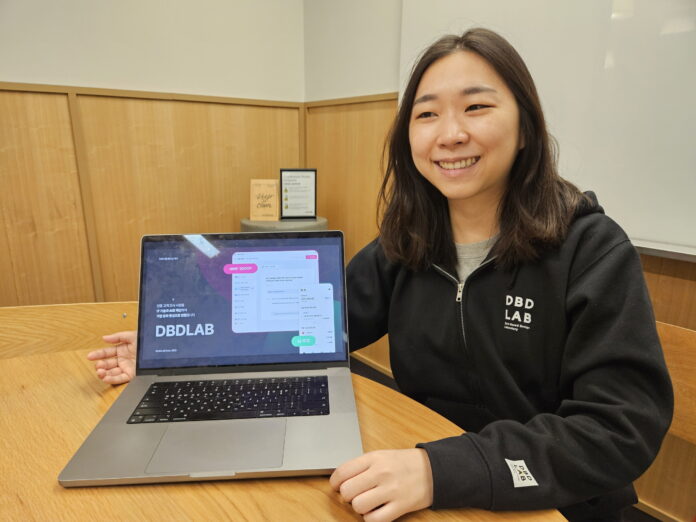
To achieve 'research democratization'
CEO Kang says, "What DBDLAB sells isn't research tools, but a research culture." He emphasizes that research should be conducted frequently, cheaply, and extensively, and that it shouldn't be a one-time, year-long commitment; instead, it should be possible to quickly receive feedback whenever needed. He emphasizes that a corporate culture change is necessary to create a culture where people feel comfortable saying, "I don't know this. Then ask the customer." To achieve this, he emphasizes that research must be easy and convenient. Many companies fear research, viewing it as something elaborate and specialized, but CEO Kang believes, "Even if you call a customer and ask, that's still research." Research isn't an end in itself, but a means to problem solving.
It remains to be seen whether DBDLAB's efforts to "democratize research" will be realized.
You must be logged in to post a comment.