



– A survey of 3,650 business and HR leaders from nine countries, including Korea, the US, and the UK, on HR industry and human resource management trends.
73%: "More than half of new hires by 2026 will be sourced overseas"… AI use is increasing in global workforce management, with 89% of Korean respondents stating, "More than half of HR tasks will be handled by AI by 2026."
– 48% of people use multiple HR and AI tools to improve work productivity… Immature AI use actually poses risks to companies, highlighting the need for an integrated HRIS.
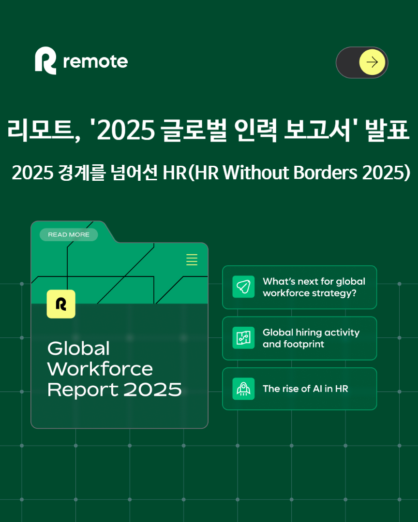
Global HR platform 'Remote' announced on the 23rd that its recently released 'Global Workforce Report 2025' predicts that overseas hiring will become more widespread by 2026 and that the role of AI in many areas of HR work will grow.
Remote conducts an annual survey on HR industry and workforce management trends across various countries in the Americas, Europe, Asia, and Oceania, publishing the results as a Global Workforce Report. This year's survey involved 3,650 corporate decision-makers from nine countries—South Korea, the US, the UK, Germany, France, the Netherlands, Spain, Australia, and Singapore—and provided insights into key trends in HR for the two years leading up to 2026. 300 respondents from Korea participated.
In this survey, 73% of respondents said they plan to hire more than half of their new workforce from outside their home country by 2026. 72% of Korean companies responded similarly, indicating that the demand for HR professionals to manage global teams is expected to increase further in the future.
Among these companies, the majority (87%) have small HR teams of fewer than 10 people, leading to projections that AI technology will fill a significant portion of global HR management. Seventy-five percent of respondents said, "By 2026, more than half of routine HR tasks will be handled by AI." Furthermore, 89% of Korean respondents said the same, demonstrating a high level of AI utilization in HR in Korea.
As AI adoption in HR has become more active, various changes have occurred within companies. Seventy-seven percent of respondents said that their company has reduced new hire hiring due to AI technology. Forty-eight percent said they use four or more different HR tools or solutions to improve work productivity. Thirty-two percent said that the biggest technical inconvenience is the lack of connectivity between various HR and AI tools. Consequently, 51% of respondents said they are currently looking for a new, fully integrated HRIS (human resources system).
While small HR teams are increasingly leveraging AI-powered HR solutions to seamlessly handle a range of HR tasks, including recruiting, payroll, compliance, and benefits, these solutions also present ongoing risks. Twenty-eight percent of respondents said they stopped using AI tools they had been using in the past year due to issues with fairness, efficiency, and compliance, while 21% said employees had raised concerns about the use of AI tools.
“HR is inherently a human resource intensive field, dealing with people data,” said Job Van Der Voort, CEO and co-founder of Remote. “This is particularly true with the globalization of recruitment. Recently, AI technology has transformed the way HR professionals work by automating repetitive tasks and streamlining the management of a global workforce spread across hundreds of countries.” “However, fragmented systems and the inherent characteristics of each technology have led to significant inefficiencies and errors. This is why demand for integrated, global HR solutions is growing.”
You must be logged in to post a comment.