



Three papers utilizing Liner Research AI were selected for the world's first AI author academic event, 'Agents4Science 2025.'
A Korean high school student who collaborated with Liner Research AI achieved the feat of having his paper selected for the "Spotlight" award.
– Improving research efficiency and quality with Liner Research AI agents such as 'hypothesis generation, peer review, and survey simulator.'
Liner realizes its vision for "Vibe Research"… AI emerges as a new research companion.
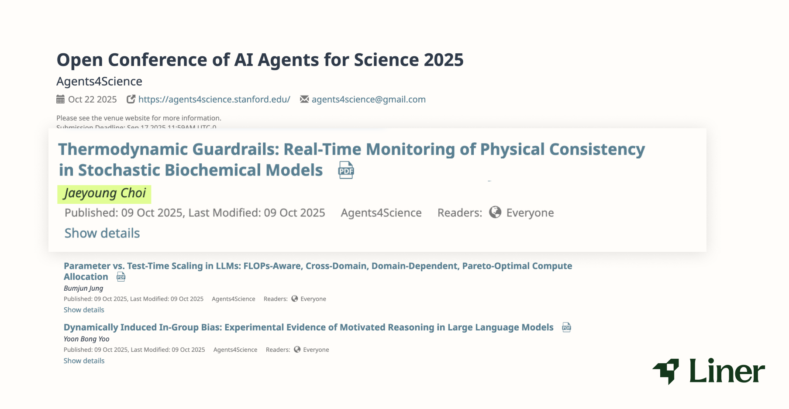
Global AI search startup Liner (CEO Jinwoo Kim) announced on the 23rd that three papers completed using the company's research AI agent were finally accepted to 'Agents4Science 2025', the world's first AI author-centered academic event. Among them, the paper by Jaeyoung Choi, a freshman at Korea Science Academy, was accepted as a 'Spotlight' paper, which only the top 11 papers are selected, proving that Liner's research AI agent has contributed substantially to improving research productivity.
Agents4Science 2025, an international conference hosted by Stanford University, is the world's first event where AI participated as both first author and peer reviewer of scientific papers. A total of 253 papers were submitted from around the world. After an initial screening process using three large language models (LLMs), the top 80 papers underwent qualitative evaluation by a panel of expert reviewers. Furthermore, an LLM-based verification system that detects miscitations was introduced, further enhancing the reliability of accepted papers. The highly competitive event, with only 48 papers accepted, garnered significant attention and successfully concluded with the presentation of the Spotlight papers on the 22nd (local time in the US).
Last August, Liner ran a scholarship program that provided free support for 'Liner Max', allowing challengers to collaborate with AI to write papers and participate in 'Agents4Science 2025'. Three papers submitted through this program were ultimately accepted, and ▲'Real-time thermodynamic validity verification of probabilistic biochemical models' by Choi Jae-young, a freshman at Korea Science Academy, was selected as a spotlight paper and garnered attention. The other accepted papers were ▲'A Study on Efficient Computational Resource Allocation Strategies for Large Language Models' by Jeong Beom-jun, Liner ML Inference Engineer, and ▲'A Study on Verification of Cognitive Mechanisms by Yoo Yoon-bong, Liner Product Director.
The three authors quickly overcame the challenges they faced in writing their papers by leveraging Liner Research AI agents. The "Hypothesis Generator" helped them refine their research topic, the "Citation Recommender" helped them quickly secure references, and the "Peer Review" helped them significantly improve the quality of their papers through multiple rounds of review in a short period of time. Yoonbong Yoo, Head of Liner Products, who conducted AI research in the field of social cognition, leveraged the "Survey Simulator" to secure over 300 data points, enhancing the sophistication of his research.
Liner evaluates these results as a realization of "Vibe Research," a new research method in which AI acts as an "intellectual companion" that expands human thinking and creativity. Choi Jae-young, selected as the author of the spotlight paper, collaborated solely with AI, despite being a high school student with no research experience, and completed an international conference-level paper in just one month. This is considered a significant advancement in that AI lowers the barrier to entry in research and opens up opportunities for broader exploration beyond age and background limitations.
Choi Jae-young, a freshman at Korea Science Academy, said, "The most impressive thing was that I was able to complete a paper on my own using the Liner AI agent and submit it to a global academic conference without any help from others." He added, "The results of AI ultimately depend on the thinking ability of the person asking the question. Now, the core of research seems to be 'how deep and fundamental the questions can be asked.' This experience motivates me to continue conducting research that contributes to scientific advancement."
Kim Jin-woo, CEO of Liner, said, "The fact that three papers, including Choi Jae-young's Spotlight paper, were accepted demonstrates that 'Vibe Research' has established itself as an empirical innovation rather than a conceptual approach." He added, "By enabling AI to replace repetitive and time-consuming tasks, researchers are creating an environment where they can focus on deeper thinking and creative exploration. Liner will continue to innovate so that researchers around the world can create new knowledge with AI."
You must be logged in to post a comment.