



– An IT planning platform accessible to non-specialists and individual entrepreneurs.
-IT planning shortened to one week
"We're ushering in an era of 'vibe planning.'"
Statistics show that 70% of IT projects fail due to initial planning failures. This wastes an estimated 420 trillion won annually.
IT planning is the process of transforming vague ideas into concrete, developable instructions. In other words, it's the process of transforming vague ideas held only in the mind into clear blueprints that developers can actually implement in code.
Planning is crucial because it impacts all subsequent processes. If planning is flawed, designers, developers, and testers will all end up designing, coding, and testing flaws. If development proceeds in the wrong direction from the start, the project will fall into a vicious cycle of revisions and rework. While revisions during the planning stage are relatively easy, those made during the development stage are time-consuming and costly.
One company is trying to solve this problem. MANYFAST (formerly LEOLAP) operates a tool called "MANYFAST (MANYFAST)" for foolproof planning. "MANYFAST" is like a doctor listening to a patient's symptoms and diagnosing them. It's like an experienced planner who listens to a client's vague descriptions, identifies their exact needs, and translates them into clear documentation.
'MANYFAST' is currently in closed beta, with over 500 users participating and generating over 2,000 project deliverables. It is scheduled for official launch at the end of this month.
MANYFAST was selected for SK Telecom's "AI Startup Accelerator" last month, providing the company with the opportunity to collaborate with SKT. The company recently completed its seed round and plans to pursue Series A funding in the US next year.
To enter the global market next year, MANYFAST is planning to ▲participate in CES 2026 in January, ▲register with the Figma community and overseas marketplaces, ▲participate in MWC 2026 in March, ▲participate in overseas communities such as Reddit, Indie Hackers, and Discord, and ▲launch Product Hunt.
"We discovered that planning was constantly creating bottlenecks," said CEO Jaehyuk Heo, whom we met at the MANYFAST (formerly Rio Lab) office in Gangnam-gu, Seoul. "I thought that if we could structure this through data, AI could automate it. Then, even non-experts and solo entrepreneurs could easily and quickly implement their ideas."

Why Planning Bottlenecks Occur
The IT development process is divided into planning, design, development, QA testing, and operations. "MANYFAST"'s planning falls between these two stages. By systematizing and automating this process, it allows experienced planners to accomplish tasks that would take months in a matter of days.
"Planning bottlenecks directly lead to sales losses. Structured planning capabilities have become essential for survival."
CEO Heo Jae-hyeok believes that the most important reason for IT project failure is a fundamental communication gap between customers and practitioners. While customers may simply say, "I want to create this service," translating that short statement into concrete, developable specifications is a completely different matter.
For example, if a client says, "I want to build a delivery app," planning requires clarity on the target user, key features, expected usage environment (mobile only, web, tablet), performance requirements, and the extent to which the payment system should be implemented. Otherwise, constant revisions will occur throughout the development process.
Planning deliverables include things like product requirements documents (PRDs), information architecture diagrams, flowcharts, and wireframes. If these documents aren't organized systematically, developers won't know exactly what to create, and designers will be confused about how to design.
Planning output
- PRD (Product Requirement Document): Defines functions, technical requirements, performance indicators, etc.
- Information Architecture (IA): This diagram shows the overall structure of an app or website. It visualizes what menus are available and how each page is connected.
- Flowchart: Shows the order in which a user navigates through the screens when using an app. For example, visualize the entire flow of "food search → store selection → menu selection → payment → order completion."
- Wireframe: A simple line drawing of how each screen will be structured. It's not the actual design, but a blueprint showing where buttons, text, images, etc. will be placed.
A major problem for most IT outsourcing professionals is their focus on development and their lack of planning and consulting capabilities. Without specialized planning skills, it's difficult to concretize vague client requirements.
By structuring and automating planning data, an average of two months of work is reduced to one week.
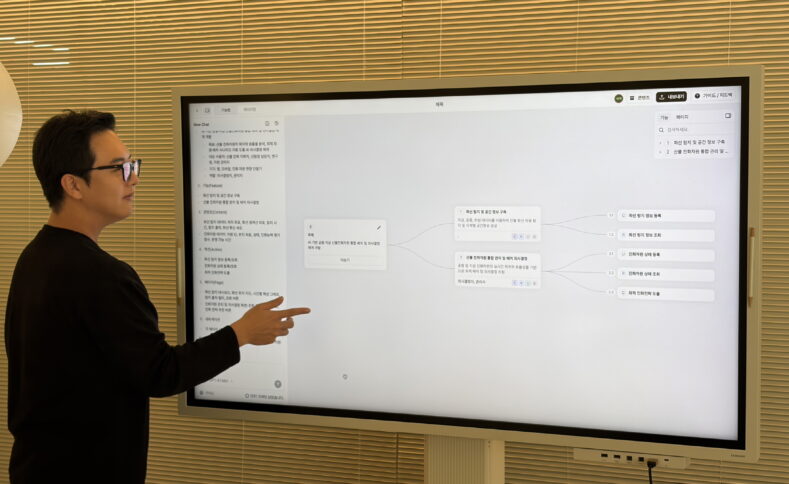
'MANYFAST' responds to client requests with structured data, enabling visualization and editing within a dedicated planning tool. The planning process, which previously took an average of two months, is now shortened to just one week, and all necessary documents are generated in just 10 seconds.
IT planning is fundamentally about data. Until now, we've worked with general-purpose tools like Word, Excel, and PowerPoint. MANYFAST organizes IT planning and design data into a structured graph data structure. Its defining characteristic is the introduction of software configuration management (SCM) concepts into the UX/UI planning stage.
The way 'MANYFAST' works is divided into three steps.
The first is an initial planning guide utilizing AI agents. By transforming vague requirements into structured data, AI agents can complete tasks that previously took an average of one week in less than a day.
The second is a planning tool specifically designed for IT projects. Instead of general-purpose tools, it enables rapid planning using specialized IT project tools. Information architecture diagrams, flowcharts, and wireframes are linked in real time. Changes are immediately reflected in all documents, reducing a previously average two-month process to less than a week.
The third feature is the automatic document generation function. It automatically generates all necessary documents, including RFPs (Requests for Proposals), contracts, reports, and handover documents, all in one place, reducing a task that previously took an average of two weeks to just 10 seconds.
MANYFAST offers a hybrid SaaS and on-premises model. The SaaS model starts with a free tier and operates on a pay-as-you-go basis based on monthly subscription fees and AI token usage. The on-premises model offers customized LLM integration, simulation technology, and vertical AI tailored to the needs of large enterprises and brokerage platforms.
Build a fully automated pipeline with over 200,000 pieces of planning data and MCP.
MANYFAST's distinguishing feature lies in two key areas. First, its extensive planning data. MANYFAST has worked on IT projects with 350 companies and maintains a database of over 200,000 planning outputs accumulated through this process. By learning from this data, the AI can respond more accurately and quickly to new planning requests.
"Data is paramount. Before building a product, we need to consider, 'What data do we have?' and 'How do we structure this data?' Without data, AI won't work."
The second is a design based on the Model Context Protocol (MCP). MCP is a protocol for connecting AI tools proposed by Anthropic. "MANYFAST" features both an MCP server and client, connecting to design automation tools like Figma AI, uizard, Galileo AI, and V0, as well as development automation tools like Cursor, Windsurf, Lovable, and FlutterFlow.
MANYFAST is developing a comprehensive solution that encompasses everything from planning to completion. Usability simulation technology allows us to predict post-development usability, user conversion rates, and projected revenue from the planning stage. This technology, which enables us to predict post-development revenue, user conversion rates, and usage patterns during the planning stage of a premium delivery app, is currently under development as a TIPS project.
The era of planning AI: Pioneer of "Vibe Planning"
CEO Heo presented a new concept called "Vibe Planning." Like Cursor's "Vibe Coding" and Figma's "Vibe Design," Vibe Planning entails a collaborative structure where AI first creates plans, followed by human review and selection. This represents a new paradigm that separates the roles of AI and humans, breaking away from the traditional approach of humans handling all tasks.
"Currently, the area where AI adoption is most active is development automation tools (1st wave). AI is rapidly expanding in design (2nd wave). Next, the area most in need of AI adoption is planning (3rd wave). MANYFAST provides structured planning data, helping subsequent design and development AI tools operate more accurately."
MANYFAST's ultimate goal is to implement a fully automated pipeline, where AI automatically handles everything from planning to development based on a single customer request. MANYFAST will structure the plan, Figma AI will generate the design, and Cursor will automatically write the code, creating an integrated ecosystem.
A world where anyone can have the courage to take on challenges.
Creating a world where everyone can have the courage to take on challenges.
This is MANYFAST's mission. To achieve this, CEO Heo emphasized the importance of not neglecting planning.
"Don't neglect planning. Many entrepreneurs start development with a 'let's just build it and see what happens.' However, if the plan isn't clear, the direction will constantly change during the development process, ultimately wasting time and money. Investing a week in planning can save a month in development."
A message on the wall of the MANYFAST office reads, “We grew by helping our customers succeed, and now we are immersed in our own success.”
MANYFAST's ambitious goal of an IPO in 2029 is worthy of attention. It remains to be seen whether this small step toward structuring planning data and automating it with AI can spark a wave of innovation across the IT industry.
You must be logged in to post a comment.