



– Celebrity IP into a sustainable commerce brand.
-Expand from F&B to lifestyle without marketing costs through data-driven planning and fandom utilization.
Viewers of "Black and White Chef" likely wanted to visit Chef Kim Tae-seong's restaurant, "Ponno Buono," at least once. However, the reality was harsh. Most people were pushed out of the reservation war or gave up due to physical distance.
The restaurant experience of wanting to go but being unable to was once a TV show. But things have changed. Wakebunny's "Phono Buono" product brings the taste and experience of that restaurant to your home, and its export to the Taiwanese market is proving the global potential of K-food IP.
This is why the 'IP-based brand building' proposed by Kim Young-wook, CEO of Wakebunny, is attracting attention as a new commerce model that goes beyond simple licensing.

IP is an asset, not a waste.
“The essence of IP commerce is transforming the powerful story and fandom inherent in IP into sustainable brand assets.”
CEO Kim Young-wook's definition of IP commerce is clear. He accurately identifies the limitations of existing licensing models.
"The structural limitations are clear: sales and core customer data are held by distributors, and IP is 'used' in a single instance, leading to a loss of market share."
The alternative he proposes is an "IP-based brand building model." It begins with a go-to-market (GTM) strategy that leverages IP content and owned media to reduce the initial customer acquisition cost (CAC), the largest cost of launching a new brand, to zero.
“Zero CAC is the premise of IP commerce.”
His firm tone reflects his over 20 years of experience launching F&B brands.
Based on this, Wakebunny focuses on two things.
First, we will invest the reduced marketing costs in product R&D and quality to enhance our core product competitiveness. Second, we will focus on capitalizing on our D2C channel.
He explained, "We are also securing initial volume from large channels like Coupang and Kurly, but in the long term, the key is to directly accumulate customer data and secure repeat purchase cycles through D2C assets."
Their first project, "Phono Buono," proves this. Based on the IP of Chef Kim Tae-seong's restaurant, "Black and White Chef," this brand has become a desirable destination through content, but has solved the problem of physical distance and fierce competition for reservations making visits difficult through IP.
"Given the chef's immense popularity, the challenge of developing RMR was to strike a balance between two conflicting goals: achieving the efficiency of an offline restaurant while also capturing the tables of domestic and international customers who find reservations and walk-ins difficult."
To solve this problem, CEO Kim Young-wook established a highly specialized MD team in RMR development, and went beyond simply receiving recipes from chefs to ensuring quality through dozens of samplings and feedback sessions with Chef Kim Tae-seong based on a single menu.
In fact, the first product, 'Hidden Appetizer's Aglio Olio', was launched in March 2025, which was late compared to its popularity.
He said, “However, products that replicate the taste and experience of restaurants have been well-received and have become steady sellers.”
Maximizing LTV and repeatedly building sustainable, high-growth brands into a portfolio is the core of the next-generation IP commerce model pursued by CEO Kim Young-wook.
The strategic positioning of the second brand, "Iron Bag Chef," is even more meticulous. CEO Kim Young-wook stated, "Rather than grandiose statements like 'strategic portfolio development,' our goal is to capture more customers' dining tables by adding the Italian culinary experience proven through 'Forno Buono,' to the more popular category of 'Chinese cuisine.'"

Quality First and Global Expansion Strategy
However, the path to converting IP into products is not smooth. CEO Kim Young-wook cites two practical challenges. First, there are difficulties in brand management, and second, there are difficulties in establishing relationships with IP.
“The challenge from an operational perspective is resolving the fundamental trade-offs between quality and cost, and completeness and speed.”
His diagnosis is sobering. The IP business faces significant pressure to quickly enter the market, especially when a buzz is generated. However, obsessing over this speed alone will drive up production costs and compromise completion and quality.
“Many companies fall for this temptation and launch products in pursuit of buzz, ultimately compromising the authenticity of their IP.”
CEO Kim Young-wook's 'Operation Playbook' sets clear principles here.
"We intentionally prioritize 'quality' over 'speed.' As with the 'Phono Buono' case, even if a delayed launch is insufficient to generate buzz, our top priority is to ensure 'appropriate quality' that preserves the value of the IP. We firmly believe this is the only way to create a 'steady seller,' not a 'flash in the pan.'"
Secondly, and perhaps more importantly, is the ‘difficulty of relationship’ with IP, that is, the coordination of interests.
"IP holders (chefs, celebrities, creators, brands, etc.) worry that their reputation and authenticity will be damaged by commercialization. They especially fear that their fans will perceive them as solely commercial."
He emphasized that the process of coordinating a single vision with IP holders as "partners" is an invisible core competitive edge, and that in reality, the most time and effort is being invested in this process.
Movement in the global market is also rapid. Export negotiations are currently underway with the US and Japan, and our first F&B IP, "Phono Buono," has already been exported to Taiwan.
“It was a small but significant success that allowed us to feel the power of K-content and K-food.”
In particular, "Iron Bag Chef" revealed that from the project planning stage, exports to major overseas markets like the US and Japan were considered, and export-specific SKUs were pre-planned to proactively address customs issues, such as strict "meat quarantine" in each country. Wake Bunny's global expansion strategy is to leverage globally beloved Korean IPs and implement thoroughly localized plans to enter overseas markets. CEO Kim Young-wook's assessment that IP commerce is not a one-time fad but a structural change is persuasive.
The Korean market boasts a world-class OEM/ODM infrastructure for both K-food and K-beauty. As a result, it has become a highly competitive market, where differentiation through product quality alone is nearly impossible. The key to success has become a battle of branding and marketing.
This is precisely why he is confident that IP commerce will become the new standard, not a fad. IP commerce is becoming a fast and efficient playbook for brand building in a market where product quality is standardized. He added that the continued emergence of successful IP commerce examples, not only in the US, where this trend has quickly taken hold, but also in Korea, attests to this structural shift. As an entrepreneur, CEO Kim Young-wook adheres to the principle of "responsiveness and speed of immediate execution" as his leadership principle.
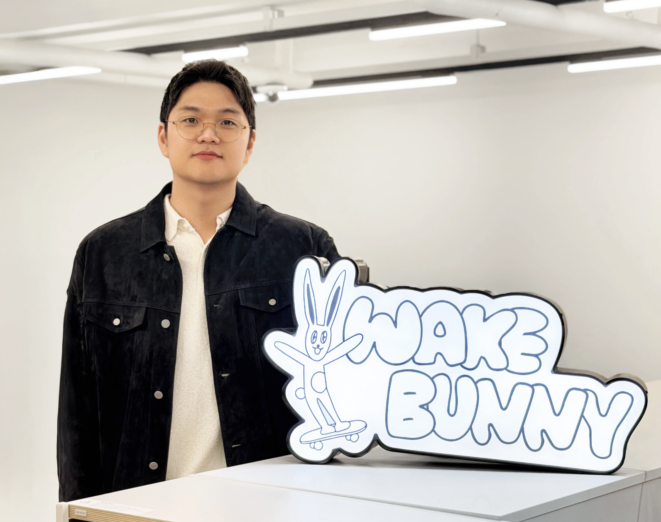
“Like the company name ‘WAKEBUNNY,’ which suggests that like a rabbit in a mine that reacts much more sensitively to changes in oxygen concentration than humans, we have adopted the ability to quickly detect and respond to market trends and changes in consumer needs (BUNNY) and to awaken the value of potential IP (WAKE) as core values of the entire organization.”
He expressed his desire to build this agility, "hipness," and "fun" mindset with talented individuals who possess the execution ability to rapidly transform data-driven products. After securing Pre-A funding from Korea Investment Partners, CEO Kim Young-wook is focusing on executing the "Phase 2" roadmap.
"The key is to systematize our proven 'IP conversion power' and 'execution speed' into a repeatable formula for success."
At the core of this system is its data-driven planning capabilities. CEO Kim Young-wook's goal of expanding beyond F&B to encompass a lifestyle portfolio is clear.
"We start our planning from data analysis, rather than from the question, 'What should we make?' First, we reverse engineer best-selling products with proven product marketing capabilities, based on social and distributor data. Furthermore, we analyze customer reviews using social listening tools to plan future products that address the shortcomings of existing products. Finally, we leverage brand IP, which ranks first in recall in the relevant segment, to penetrate the market with a low cost-to-consumer (CAC) rate."
He plans to accelerate this playbook in the future. Building on the expertise he's gained from operating F&B brands, he pledged to enter lifestyle categories like beauty and health functional foods by 2026. The premise behind his strategy of expanding beyond F&B to encompass "lifestyle in general" is clear.
“The IP’s ripple effect is only expanding to areas where it can provide ‘trust.’”
Wakebunny's experiment, which builds IP commerce not as a one-time marketing campaign but as a sustainable brand asset, is expanding into a case study that demonstrates the synergy that the combination of K-food and K-content can create in the global market.
The growth story he envisions as an "IP commerce platform" opens up a new horizon for IP commerce, where brands are quickly and efficiently built and grown by discovering IPs with outstanding potential.
You must be logged in to post a comment.