



– Search for verified papers using our self-developed Triple Helix AI engine.
Kim, a PhD student, was facing an important academic conference presentation. With only a month left, he decided on "Trends in Neuroplasticity Research," but was having trouble gathering up-to-date data. His solution: tlooto. When he asked tlooto's SaaS service, "What are the major findings in neuroplasticity research over the past three years?", he received a surprisingly quick response. It systematically organized the latest trends, new methodologies, and notable findings from leading global research institutions. Using this data, Kim was able to write a research paper and successfully present it at the conference.
Recent advances in AI technology have made it easier to find and generate necessary data. However, a fundamental problem exists in academic fields. Generative AI typically cites nonexistent papers or presents incorrect information as fact, a phenomenon known as hallucination. This can be fatal in academic research.
Launched in 2023, the academic AI "tlooto" identifies the most relevant answers to users' questions from over 20 billion academic papers and cites the supporting papers to provide reliable information. This automates the process of researchers manually reviewing vast amounts of academic data, reducing repetitive and time-consuming tasks.
"Many researchers waste time on the mechanical task of finding, organizing, and summarizing references. tlooto is an AI engine that solves this problem."
tlooto boasts over 1 million monthly active users (MAU). Ninety-nine percent of its users are English-speaking, and international traffic accounts for 96% of its traffic.
tlooto's Triple Helix algorithm, integration of academic paper databases, and reliability-based answering systems are recognized as specialized technologies in the academic field. In recognition of these technological prowess, CODE CRAIN was selected as a representative Korean startup at TechCrunch Disrupt in 2024 and as an excellent R&D company at CES 2025. Last August, it was selected as a finalist for SK Telecom's "AI Startup Accelerator 3rd Batch" program.
Triple Helix AI, an AI engine specialized in academic fields
"When developing tolooto, accuracy was paramount. In academic research, even a single error can derail the entire study."
tlooto's "Triple Helix AI" engine searches a database of over 20 billion academic papers for relevant articles, automatically analyzing and synthesizing them to generate academically refined answers, and attaches reliable citations to all content. More than a simple search engine, it's an AI-powered academic research assistance system that understands large-scale academic data based on meaning, compares and analyzes the arguments of multiple papers, and provides comprehensive scholarly insights. Search, analysis, summarization, and citation are organically linked, enabling researchers to quickly and efficiently access highly reliable academic information. Ultimately, the core goal of the Triple Helix AI engine is to dramatically reduce the time researchers spend searching for papers and gathering information, freeing them to focus on critical thinking and creative research.
All the materials you need for academic research are here.
'tlooto SaaS' is a core service provided by CODE CRAIN, and is a subscription service available to individual researchers, graduate students, undergraduate students, the general public interested in academia, and corporate research teams, with prices ranging from $9.99 to $29.99 per month.
- Quick Paper Search
The Triple Helix AI engine identifies relevant papers from a database of over 20 billion academic papers. Triple Helix AI's search is based on semantic search, not keyword matching. It understands the deep meaning of the user's query, searches for all papers that express the same meaning differently, and prioritizes the papers with the highest relevance and reliability (from top-tier journals and highly cited publications).
- AI Comprehensive Analysis
We analyze the research methodology and findings of each selected paper to generate an integrated response. We identify multi-layered relationships, such as whether the papers share or differ in their arguments, what aspects they emphasize, and how research trends have changed over time.
- summation
It automatically synthesizes the content of analyzed papers to generate clear answers to users' questions. It extracts the overall picture from all retrieved papers, creates structured answers, and even extracts implicit meanings not explicitly stated in the papers, generating new insights.
- Auto-quote
Generated answers automatically display sources, allowing users to copy citation information directly into their own papers. Each sentence is clearly identified as a reference, along with information such as whether the paper is published in a top-tier journal and how many times it has been cited by other researchers. Users can assess the reliability of the paper at a glance and navigate directly to the source paper.
- Various output formats
Users can receive responses in the format they want, such as summary, description, table, or graph, and use them directly in reports or papers.
- Storage and Management
You can save previous search results by project for quick access later. This is especially useful for long-term research projects.
Ask anything you need about college life.
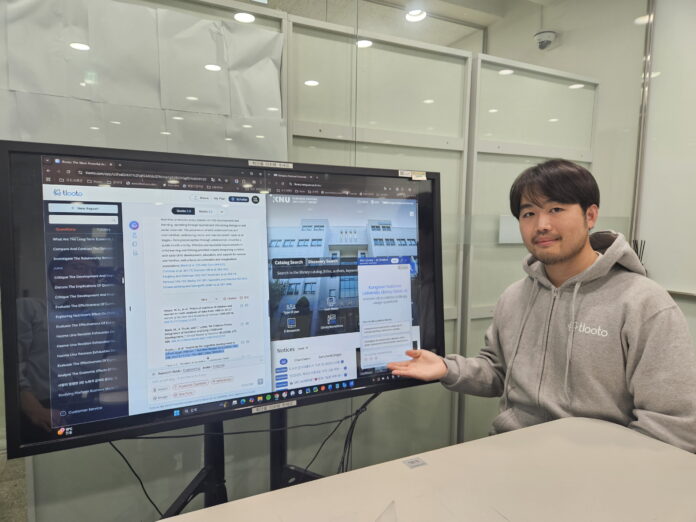
'tlooto Copilot' is an AI chatbot that can be easily installed as a plugin on libraries and educational institutions' websites. It has currently been implemented in 20 university libraries and is expected to expand to 50 universities by the end of this year.
After implementing tlooto Copilot, K University Library saw a 15% increase in website usage and time spent on the site. CEO Shin explained, "Previously, libraries were limited to storing and searching books. However, with tlooto, libraries have evolved beyond mere archives to become intellectual companions for students and researchers."
tlooto Copilot not only searches for academic papers, but also answers questions about student life in general, such as "What hours does the library open?" It automatically collects all data from university websites, including text, attachments, announcements, and images, and updates the information almost daily to maintain its current state. The collected data is then restructured into a form understandable by the search system, after undergoing reliability assessment, review for recency, and importance determination through the Triple Helix AI engine.
CEO Shin explained, "General chatbot services attempt to cover all industries, making it difficult to provide features like automatic website collection. However, CODE CRAIN was designed from the beginning specifically for universities, and our in-depth understanding of university administrative documents and structures makes this possible."
Expanding by securing local academic data and building an academic literature map.
The 20 billion academic data items currently searched by tlooto are concentrated in mainstream English-speaking fields (STEM). Academic materials in non-mainstream fields, such as culture, art, history, and philosophy, exist only in local languages and are largely unknown to the global academic community. CODE CRAIN plans to automatically crawl and refine local-language papers from universities, libraries, and museums in each country, integrating them into a global database. This will help build an inclusive academic ecosystem where each region's unique scholarship is recognized on the global stage.
The second is "creating academic literature maps." Beyond text-based searches, CODE CRAIN plans to develop a feature that visualizes the relationships between papers, authors, and keywords in an interactive network map. This is expected to serve as a tool for systematically understanding the current research landscape, identifying research gaps, and generating innovative ideas when determining research topics, determining technological development directions, and identifying future priority areas for policymakers.
For the democratization of knowledge
CODE CRAIN's ultimate goal is to "bridge the gap between advanced knowledge and the general public." If AI can make this possible, it would be incredibly meaningful. Making advanced knowledge accessible to everyone through tlooto signifies the dawn of an era where knowledge becomes a true public good.
It remains to be seen how CODE CRAIN will grow in the global market and how many individual researchers and students will benefit from it.
You must be logged in to post a comment.