



-Innovation in 'spatial intelligence-based music technology' where AI reads spatial data and automatically curates music.
Evolving into a "space operation infrastructure (OS)" company that extends beyond music to include stores, buildings, and vehicles.

From restaurants and cafes to exhibition halls and even cars, music flows like the air of a space. However, most spatial music remains confined to the realm of "repeat play." Music tech startup APLAYZ is reinterpreting this everyday background music with data and AI. APLAYZ is a service that uses AI to analyze factors such as home, time, weather, location, and visitor characteristics to curate the optimal music for each space. This is APLAYZ.
Entrepreneurship , trial and error, and the rebirth of the 'spatial music' idea at Hyundai Motor Company
CEO Bae Jeong-jin's entrepreneurial journey dates back to his time at KT. He mastered data-driven user experience design while working on digital service planning, and based on that experience, he founded a location-based social media startup. However, he experienced the structural limitations of early-stage startup operations after only two years, shutting down the business due to rising outsourcing development costs, the absence of a full-time team, and the lack of a clear business model. He recalls this experience:
“A business is not about an idea, but about the ability to execute, a team, capital, and marketability.”
Later, while working at Hyundai Motor Company and in charge of mobility and service planning, one day, a situation arose where the same music was playing repeatedly in a restaurant, sparking a new problem definition. Why did music flow in a standardized format, even though each space was unique? Restaurant operators lacked the technology to design music tailored to the specifics of space, time, and customer characteristics. Copyright, operational staff, and cost constraints forced most to rely on simple streaming. This led to the realization of the problem of "music optimized for each space."
To solve this problem, he and his developer friends worked nights and weekends to build an MVP, validating the potential of an AI-based curation engine that matches spatial and music data. However, without full-time focus, the speed of market entry was clearly limited. So, he entered Hyundai Motor Company's in-house venture program, "ZER01NE," and his combined model of "music promotion model + spatial music automation" was recognized for its high scalability, ultimately winning second place. After eight months of technical and market validation, APLAYZ was officially launched as an independent corporation in 2023.
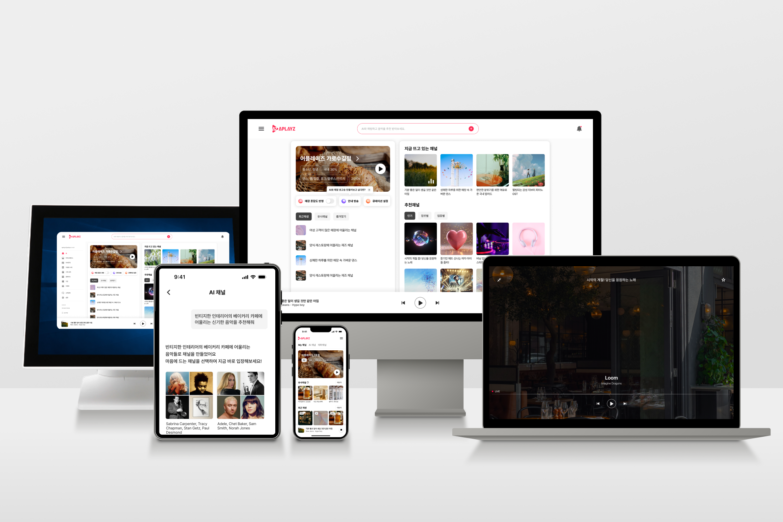
A space read by AI, the moment music changes
After its spin-off, APLAYZ began to seriously develop its technology to combine spatial data with music. Viewing stores not simply as "places," but as collections of data, APLAYZ developed an AI engine that combines 76 spatial elements—such as time of day, weather, lighting, congestion, and visitor composition—with 230 detailed attributes of music sources to interpret the spatial context.
This engine automatically generates playlists based on factors such as customers' visit times, preferred atmosphere, and whether the store is used for relaxation or high turnover. Another key differentiator is its ability to integrate with in-store POS, IoT, and CCTV data to automate music creation that reflects the "purpose of the space." Major clients such as Terarosa, E-Land Eats, and Hyundai Motor Company have confirmed significant performance improvements in maintaining spatial identity, store operational efficiency, and customer satisfaction.
This shift is structurally different from existing services that simply play music. CEO Bae explains, "Music may seem like a matter of emotion, but it's actually a matter of data and purpose."
"While the act of playing music is simple, data determines which music is played, where, when, and at what tone. APLAYZ is a technology that automates that 'purpose.'"
Beyond stores, buildings and vehicles become "space management infrastructure."
APLAYZ's expansion meant "expansion of space." Starting with in-store services, the company expanded its reach to encompass buildings and vehicles. To achieve this, it developed a building-based solution that controls diverse spaces, such as parking lots, lobbies, lounges, restaurants, and conference rooms, from a single platform. It automates everything from sound type and volume to playback timing, brand sounds, and announcements, enabling integrated management of the entire building's "sound experience." This technology has been implemented at Hyundai Motor Company's headquarters, affiliate offices, and business sites, and is expanding into large-scale commercial and residential facilities.
In-vehicle services are also going beyond music playback. They analyze vehicle data, such as the driver's speed, air conditioning status, lighting, and passenger presence, to automatically adjust the mood and volume of the song. They also detect drowsiness patterns and change the music accordingly, creating a "driving-situation-based sound experience." First introduced at PLEOS 25 in March of this year, this service is slated for commercial availability in vehicles slated for release by Hyundai in the second quarter of next year.
Representative Bae describes it as “an operating system (OS) for offline spaces.”
"It may seem like a music service, but it's actually an engine that understands spatial data and transforms it into content. We're building the infrastructure that powers space."

The blue ocean of the 'spatial music market'
The current domestic in-store music service market is centered around streaming services priced between 20,000 and 30,000 won, and innovation is stagnant due to constraints such as copyright, operational structure, and personnel costs. CEO Bae emphasizes that this market is essentially a legacy industry, and that innovation comes from technology, not content.
"Most stores play music because they have to. However, music is a highly strategic element that directly impacts sales, dwell time, and branding. Few companies are yet to design this based on data."
APLAYZ capitalized on this gap as its business model. Thanks to its structure, which supports not only music playback but also branding, marketing, and customer experience design, APLAYZ has rapidly expanded into diverse industries, including franchises, exhibition halls, hotels, and offices. In particular, its building-based solution is considered a proprietary technology with virtually no domestic alternatives, and is expanding into the corporate, local government, and resort industries.
APLAYZ is also developing new revenue models through the combination of music and advertising. This enables music-based spatial data marketing, including automatic in-store announcements, branded sound in specific situations, and smart bus stop projects with local governments.
APLAYZ's next step toward the global market
APLAYZ first gained attention overseas. After unveiling its unique "AI Spatial Music" concept at CES Eureka Park, collaboration offers followed from North America, Japan, the Middle East, and Brazil.
In Japan, discussions are underway to establish a joint venture (JV) with a local company, while the Middle East is showing strong interest in public sound systems for smart bus stops and public buildings. In Brazil, a proof-of-concept collaboration focused on complex shopping malls and bus stops is being considered.
“We are aiming to become a global space content hub,” said CEO Bae, presenting the following vision.
"While we started with music, spaces need to be filled with a wealth of content beyond music. Podcasts, tourist information, ambient sound, branded content, and even visual content. Our next step is to create an infrastructure that automatically delivers the 'optimal content' to every space."
The future envisioned by APLAYZ isn't simply a "better music service." It's a message that an era where AI understands the purpose of a space and content shapes the experience—in other words, an era of automated space management—is upon us. Music is just the starting point; the technology that interprets the emotions, information, and situations within a space as data and transforms them into real-time content is likely to become a core infrastructure for the offline industry. CEO Bae states, "I want to create an era where AI understands a space and content completes it." The sound that flows throughout a space is no longer a mere backdrop but a corporate strategy. APLAYZ's challenge lies in establishing that new standard.
You must be logged in to post a comment.