



AI can even read human emotions, making network-constrained spaces like stadiums, ports, and ships more intelligent.
K-League AI voice broadcasting for the visually impaired is preparing to expand to BC Ferries and the Port of Vancouver in Canada.
We are targeting mission-critical industries like defense and space, leveraging edge AI and data sovereignty.
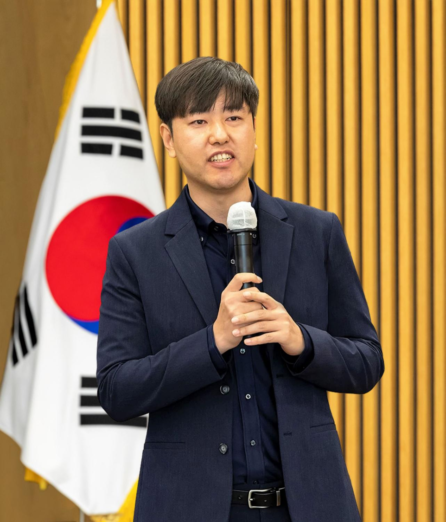
The stage where AI transforms human life is increasingly being moved to the "field." Stadiums, ports, ships, airports, even space. Countless sensors and cameras pour out data, but the ability to understand what's happening within it as a "story" remains a human prerogative.
H' Intelligence is a startup exploring this very point. The company aims to create not an AI that can tell you the ball's position or the score, but a "spatial intelligence AI" that can interpret the flow and context of movement within a space, even the tension and cheers of the moment.
On November 1st, a K-League match held at Daejeon World Cup Stadium saw a pilot program for visually impaired spectators using AI-powered commentary. Thanks to this system, which analyzes player and ball movements in real time and delivers the emotional commentary of a commentator, Han Jong-min, who is visually impaired, said, "This is the first time I've watched a soccer game without the help of my younger brother."
For Kim Byungjoon, CEO of H-Intelligence, this scene isn't just a technology demonstration. It's a moment where technology restores a person's independence and dignity, and a starting point for greater change. We met with CEO Kim to learn about H-Intelligence's definition of "spatial intelligence AI" and its expansion strategy, which will extend from the K-League to Canada, and into ports, space, and defense.
AI that understands the process, not the outcome
The keyword that permeates H-Intelligence's identity is "spatial intelligence." CEO Kim described this concept as "a philosophy of AI that understands processes, developed through five years of field experience and trial and error."
"Most existing general-purpose vision AI or cloud-based AI only sees the outcome. They stop at things like, 'We're currently winning 2-1,' 'Where the ball is,' or 'That player is running.' They don't understand why it's 2-1, what happened in the last 20 minutes, or whether the shot is truly a decisive moment."
The spatial intelligence H-Intelligence talks about is different. CEO Kim summarized his company's definition of spatial intelligence as follows:
"This is an AI technology that comprehensively understands the movements of all objects within a specific space, across time and context, and conveys them as a meaningful story."
To implement this, H-Intelligence first redefined "space." For example, taking a soccer field as an example, the entire field is fixed to x and y coordinates ranging from 0 to 100, allowing AI to mathematically process the intuitive human sense of "front, back, left, right." The AI precisely recognizes locations, such as "This player is on the right wing (85, 40)." This is a significant departure from existing AI, which simply expresses "There's a person on the left."
The next step is timeline integration. The AI doesn't just see what's currently on screen; it remembers every movement from the start of the match to the present.
"We analyze where this player was at the 5th minute of the first half, where he is at the 38th minute, what paths he's taken, and what choices he's made in similar situations. This allows us to understand context, such as, 'We're on the verge of a comeback, how close is the goal, and this player has tended to cut to the left in similar situations in the past.'"
Multi-object tracking is added here. On a soccer field, 22 players, three referees, and a ball—a total of 26 objects—move simultaneously. H-Intelligence's AI doesn't just track these objects independently; it interprets their meaning within the context of tactics and the flow of the game. Beyond the action of "Player 11 breaks forward," it also understands the context of the breakthrough: "The opposing defense shifted to the left, opening up space on the right."
The information gained this way ultimately becomes a "story." CEO Kim stated, "Emotions aren't simply data; they're the result of a combination of context, importance, temporality, and human experience." Because spatial intelligence AI understands these elements, even visually impaired spectators can sense, simply by listening, whether this is a tense moment, a crucial opportunity, or a regrettable mistake.
The real-time voice broadcast engine adds a sense of presence.
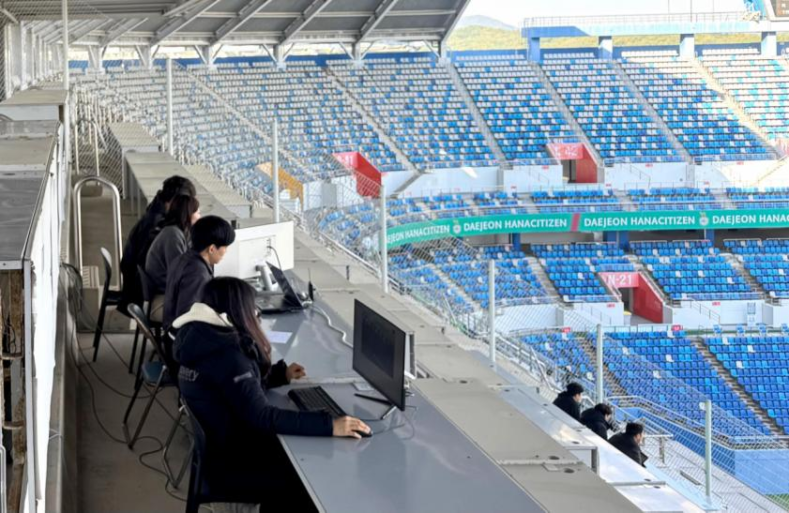
Spatial intelligence alone cannot fully convey the emotional arc of the scene. H-Intelligence combines this with a "real-time voice relay engine" to transform visual information into a complete experience. CEO Kim describes this system as "a structure that is meticulously synchronized in three stages."
The first step is silent analysis by spatial intelligence AI.
When multiple cameras installed at Daejeon World Cup Stadium or Suwon World Cup Stadium capture footage, AI running in an edge environment performs coordinate setting, object recognition, location calculation, relationship analysis, and temporal context analysis within 0.05 to 0.59 seconds. What is generated during this process is meaningful metadata.
The second step is natural language generation.
The vision-language model takes this metadata and translates it into a sentence describing the current situation. Rather than simply stating, "The ball went to the left," it also conveys tactical and temporal implications, such as, "A crucial space opened up on the left side in a situation where a comeback opportunity was imminent."
The third step reveals H-Intelligence's unique strength. The company records the voices of actual commentators (caster So Jun-il and commentator Lim Hyeong-cheol) according to specific situations, and AI matches these voices to the real-time context and broadcasts them.
"Existing TTS simply converts text into standardized machine-generated speech. We use a method that understands both the text and the context, then selects the commentator's true emotional tone in real time to match it. Even within the same sentence, the power, speed, and breathing of the voice can vary depending on the flow of the game."
Ultimately, this system has a structure that allows AI to understand the situation and express that understanding through human emotions. This allows visually impaired spectators to follow the same emotional curve as other spectators in the stadium.
Inclusive Design: A Beginning for the Visually Impaired
The K-League AI voice broadcast marks the first time H-Intelligence's technology has been showcased to the public, and it also serves as an example of what the company calls "inclusive technology."
"The experience of being on a football pitch isn't simply about 'seeing.' It's a holistic emotional experience, encompassing everything from the roar of the stands, the explosive cheers of a goal, and the thrill of added time. Even if a person is present, a significant portion of this experience is blocked."
While existing accessibility technologies focused on complementing the shortcomings of existing technologies, H-Intelligence set its design goal from the outset to create an experience where everyone can enjoy the same moment together. Therefore, they established three principles: real-time, lag-free experience, emotionally engaging voices from commentators, and a context-driven narrative that explains not just "what" happened but "why" it matters.
CEO Kim explains this from the perspective of inclusive design and universal design. Just as wheelchair ramps are also useful for parents pushing strollers, and audio guidance for the visually impaired is utilized by foreign tourists, technology designed for the visually impaired ultimately benefits a wider audience.
"An AI relay system designed for the visually impaired could also serve as a useful audio interface for drivers, parents cooking, and even exercisers. Initially, this technology was intended for a specific group, but over time, it will become accessible to a wider audience."
He explains the power of inclusive design in terms of 'scale'.
"Let's say a technology reduces a passenger's waiting time by one minute. If we apply this technology to infrastructure used by 20 million people annually, that saves 20 million minutes, or approximately 38 years of time. This is an example of how a small improvement can transform the efficiency of an entire society."
The scene at Daejeon World Cup Stadium where Han Jong-min said, "This is the first time I've seen a soccer game without my younger brother's help," carries even greater symbolic significance. Representative Kim said, "It's a moment where an individual's freedom and dignity are restored, and it demonstrates the potential to change countless lives."
From soccer fields to ports, ships, and space… Filling the network gaps.
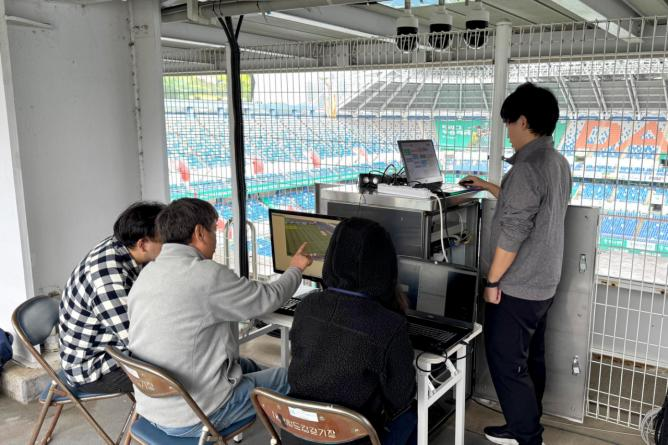
H-Intelligence's vision extends beyond the stadium. CEO Kim stated, "There are countless spaces in the world, and these spaces are attempting to become more intelligent through data and AI. Among these, spaces with significant network constraints, such as ports, ships, and airplanes, face structural and unresolved challenges."
This is precisely why H-Intelligence chose edge-based spatial intelligence AI. To ensure its use in truly mission-critical situations, AI must operate independently even in environments with unstable or no internet access. This AI is designed to recognize and identify objects within a space, track their movements, and then deliver the results in real-time voice.
The soccer field served as an "extreme testbed" for validating this technology. Tracking 22 players, three referees, and a ball in real time and interpreting their context in an environment where each player's movements are constantly changing, rather than predictable and repetitive, is a technically demanding challenge. "Validating the technology in the most challenging environments will ensure reliability when expanding to ports, ships, aviation, and space," said CEO Kim.
Now, H-Intelligence is heading to Canada with this technology. The company is preparing to establish a subsidiary in Vancouver, Canada, by January 2026. CEO Kim personally visited Canada and held discussions with BC Ferries, the Vancouver Port Authority, and Seaspan. Their facilities are extensive. BC Ferries operates 48 terminals, while the Vancouver Port Authority manages 27 ports. Seaspan owns 227 container ships. While their customer base may seem small, their "space" encompasses hundreds of vessels.
The business model also follows the characteristics of infrastructure businesses. Initially, system construction costs are one-time, while annual operating costs for each space generate recurring revenue in the form of subscriptions. The space-specific data accumulated over a period of operation becomes a key asset for service enhancement. Due to its mission-critical nature, once a system is implemented, it's difficult to replace it. This is why CEO Kim believes that "infrastructure dependency and mission-critical characteristics lead to high customer retention."
When asked about his growth strategy, he summarized it in one short sentence: “Start from the beginning.”
"Rather than setting a numerical target, it's more important to complete each terminal, each port, each vessel to the level the customer truly desires. Once a single reference is established, the space naturally becomes structured to introduce the next customer."
2026 marks a turning point for H Intelligence. It marks the first anniversary of the establishment of its Korean subsidiary and the launch of its Canadian subsidiary. CEO Kim stated, "Our goal for 2026 is to successfully complete at least one project in Canada and build trust. Starting with this, we hope to continue our steady growth in Canada."
Edge AI, Data Sovereignty, and Secure Guardrails
When CEO Kim explains spatial intelligence AI, there's one topic he never fails to mention: data sovereignty and guardrails.
Cloud-based AI offers superior scalability and flexibility, but it also means sensitive data like stadium footage, terminal vehicle information, and vessel operation data are all transferred to external servers. This poses a significant risk not only to privacy but also to national security.
Edge AI offers one solution to these concerns. Because data is processed on-site, without leaving the field, the risk of sensitive information being leaked is reduced. Because it operates independently, even in areas with limited network coverage, such as oceans and space, edge-based spatial intelligence offers a competitive edge in the defense and space industries.
CEO Kim has shared this concern with the international community. In the report "A Human Rights-Based Approach to AI for Tech Startups and Global Normative Governance (GENEVA II)," published by the United Nations Human Rights-Based Approach (UN/HRBA), he highlighted the cumulative risks of AI and the importance of early-stage guardrails.
"If an AI system learns from corrupted data, it can produce corrupted results, and when those results are fed back into the input, problems can multiply exponentially. Therefore, establishing safe guardrails early on is paramount. As the degree of freedom in technology increases, so too does the importance of safeguards."
The guardrails he speaks of are not devices that hold back technology, but rather guardrails that allow technology to go further and longer.
“In every space, in every moment, in every story”
Throughout the interview, CEO Kim's main focus wasn't the technology itself, but the "space" where it resides and the "people" who inhabit it. These included the moment a visually impaired person could watch a soccer game without the assistance of a sibling, the experience of reducing passenger wait times by a minute at ports and ships, and systems that protect data sovereignty in military and space settings. Each of these moments is small, but when combined, they become a force that can transform the very fabric of society.
As AI technology rapidly advances, there are questions we often overlook: 'Who owns the data?' and 'Who will benefit from this technology first and foremost?' H-Intelligence aims to build a company that answers these questions more responsibly.
AI benefits everyone, from the visually impaired to passengers, port workers, and astronauts, even on the ocean floor, where networks are unavailable, in space, and in stadium stands. AI delivers peak performance while maintaining data sovereignty.
CEO Kim says this is the new standard the Korean AI industry should strive for.
You must be logged in to post a comment.