



The private sector is building an integrated platform to integrate access information from the government and local governments.
There are six or seven subway operators in the Seoul metropolitan area, divided into state, municipal, and private sectors. However, there was no integrated transfer map for wheelchair users. Information on the location of ramps and elevators was scattered across government ministries and local governments, and accessibility information required separate inquiries. With no legal sanctions for using wheelchair seats for other purposes, there hasn't been a single sign in the 70-year history of the Seoul subway system that addressed accessibility concerns.
It was in 2015 that Hong Yun-hee, the CEO of Muui, personally took the initiative to create the "Subway Transfer Map for the Disabled." Someone asked.
“Why is the child’s mother making that?” The question hit the nail on the head.
Data that should have been created by the government or subway operators was being created by a mother with a daughter in a wheelchair.
“That’s a valid point. I shouldn’t have to create it,” said CEO Hong Yun-hee.

However, because the Seoul Metropolitan Subway system was divided into multiple entities, paradoxically, no one had developed a wheelchair transfer map. He approached this issue from a data infrastructure perspective, leveraging his 20-plus years of experience working in IT.
While proposing and operating the "Care Plus" mall for disabled goods on Auction, I considered linking it with the subsidy support system, and while working on PR for an IT company, I thought about what "qualities for good data" were.
“When it was difficult to define how to collect data, I wondered whether I should just collect it and go with it, or collect it well from the beginning,” he explained.
There's still no standard for accessibility data. However, the goal is to raise awareness of why this data is needed during the data collection process, ultimately creating a world where collecting such data becomes unnecessary. When developing a subway transfer map for people with disabilities, retired seniors and young designers teamed up and rode in wheelchairs. Later, the seniors said, "Now I understand why we have to yield to wheelchairs in elevators." Achieving this kind of change in perception is also a meaningful goal.
Chairman Hong Yun-hee has plans to open up data. "Of course, we will open up the data," she stated. However, for data to be open, someone must be constantly updating it. "True innovation lies in focusing on and fostering public data created by the private sector out of necessity," she emphasized.
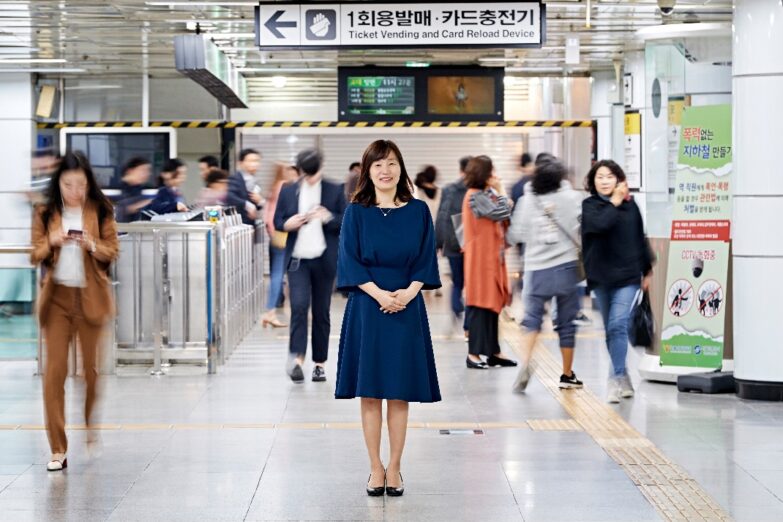
France has a public data law. This law allows the government to provide financial support for the production and management of privately generated data if it has significant public interest. For several years, Hong Yun-hee has been advocating for Korea to actively support public data. Currently, she serves as an advisory member of the Social Affairs Division of the National AI Commission, working diligently to incorporate public data and public AI into policy. A transfer map for people with mobility impairments will soon be released as a web app. Demand is so high that even international travelers are inquiring about it. By entering the departure and arrival stations, the app provides wheelchair transfer routes. These transfer routes may require passing through turnstiles or even exiting the station. Subway maps often lack GPS connectivity, requiring detailed transfer routes. "It's important to prepare yourself mentally by reviewing the transfer routes in advance," she explained.
Corporate collaboration is also active. LG Electronics' "Bold Move" is a community where people with disabilities can suggest features for LG Electronics products and discover their uniqueness through the use of home appliances. "My daughter, who is in a wheelchair, has never done her own laundry," said CEO Hong Yoon-hee. It's difficult to enter the laundry room in a wheelchair, and even removing laundry from the washing machine is a challenge. Making home appliances accessible to people with disabilities can open up a whole new world for them.
YG Entertainment and SM Entertainment have developed a concert accessibility guide for fans with disabilities. English-speaking countries, Europe, Australia, and Japan have higher concert accessibility standards than Korea. In Korea, there are no legal restrictions on using wheelchair seating for other purposes. He said, "The various entities that run concerts must be sensitive to accessibility issues and committed to continuously upgrading the current accessibility guide."
The "Momo Exploration Team" project, launched in November 2024, is a crowdsourcing data collection model involving students and teachers. While initially launched as a Google Form, the project is currently developing tools to aid research at various universities and competitions. Director Hong Yun-hee stated, "Our goal is to reestablish and properly disclose information from the Office of Education to schools, and from schools to actual users, so that students with disabilities and their parents don't have to individually inquire about accessibility at each school."
The 2025 "Everyone's Subway" signage is the first in the 70-year history of the Seoul subway system to incorporate disability-friendly design. For a decade, we've consistently advocated for public investment to transform the subway system, but it hasn't been easy. While the need is recognized, it's been pushed back in priority for various reasons. Chairman Hong Yoon-hee explained, "It all comes down to the power of story." The story of the signage—creating a solution to the absurd situation of a wheelchair-bound daughter having to take a detour—was compelling.
Public-private cooperation is also a key strategy. With the support of Hyundai Rotem and a public-private partnership between the Seoul Metropolitan Government and Seoul Metro, the "Everyone's Subway" signage system for the transportation disadvantaged is being developed. He explained, "When creating impact in public settings, we also utilize private social contribution funds."
In 2024, Muui converted to a non-profit organization. Chairman Hong Yun-hee stated, "Gathering public interest data is a public service activity, so there was no reason or intention to generate profit." Many people around me tried to dissuade me from this, as running an NGO is not easy. Muui's goal is to make the organization itself irrelevant. The goal is to end the project, like a "sunset," when the country and society take care of accessibility on their own.
Director Hong Yun-hee cited an accessibility map she saw at Goldsmiths, College London. Located in a prominent location right next to the main entrance, it displayed not only the locations of elevators and ramps, but also guide dog restrooms, road gradients, and wheelchair-accessible detours. "In Korea, accessibility information for people with disabilities is often not posted on public institution websites, and you have to ask for it separately," she said.
I hope that the successful operation of Muui will enable accessibility to become a daily reality, not just when people with disabilities request it. Korea has already become a hyper-aging society, with people aged 65 and over accounting for over 20% of the population. Universal design is also a crucial principle for planning spaces and experiences in this hyper-aging era. It remains to be seen how far the public data revolution, which began with the question, "Why would a mother make that?", will go.
You must be logged in to post a comment.