



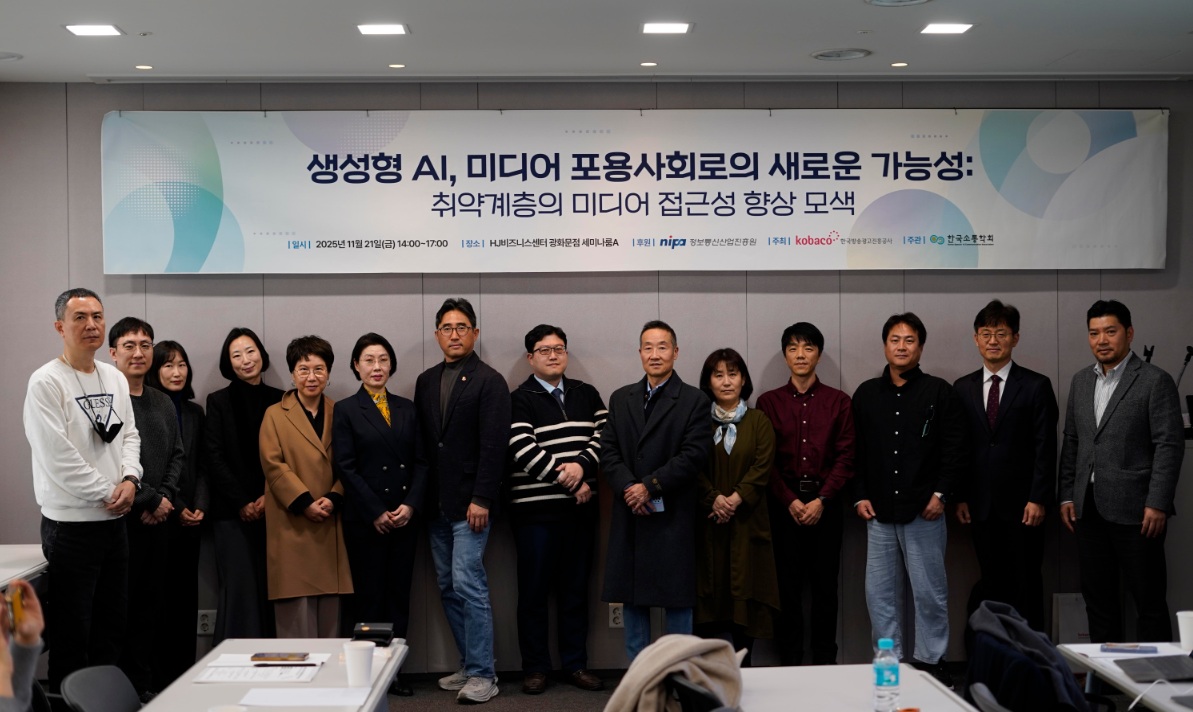
The Korea Broadcast Advertising Corporation (KOBACO) announced that it held a seminar titled “Generative AI, New Possibilities for a Media-Inclusive Society: Seeking to Improve Media Accessibility for the Vulnerable” at the HJ Business Center Gwanghwamun branch on November 21st, sponsored by the National IT Industry Promotion Agency (NIPA).
At this seminar, experts from academia and industry discussed the second year results of the research project, "Development of barrier-free content production technology based on generative AI for the media-vulnerable and demonstration of terrestrial and new media multi-platforms," which was carried out as a flagship project of the Ultra-Large-Scale AI Project supported by the Ministry of Science and ICT and the National IT Industry Promotion Agency, as well as related technologies and policies.
First, in the first part of the seminar, Kwon Ho-jung, Vice President of WiseNut Co., Ltd., presented the main contents of the project, ‘Generative AI-based barrier-free content production technology for the media-vulnerable,’ and Park Chan-hyeok, CEO of DataCrush Co., Ltd., presented the technology he had developed over the past two years under the theme of ‘Generative AI-based barrier-free content production solution.’
In Part 2, Professor Lee Young-hee of Hanyang University presented on the topic of “Video for All: Expanding Media Access for the Visually and Hearing Impaired,” and discussed media access services that guarantee comprehensive access to all video content beyond broadcasting for the disabled.
In the general discussion that followed, Professor Eom Nam-hyeon of Hongik University served as the moderator, and experts including Park Yoon-mi, Senior Researcher at the Viewers' Media Foundation, Jeong Hye-seung, Professor at Inha University, Hwang Deok-gyeong, Director of the Media Promotion Agency of the Korea Federation of the Blind, Lee Jun-tae, Director of the Korea Association of the Deaf, and Seong Yoon-taek, Senior Researcher at KOBACO, discussed ways to utilize generative AI-based technologies such as subtitles and screen descriptions to improve media accessibility for vulnerable groups, including the visually and hearing impaired, and policy implications for moving toward a media-inclusive society.
Participants shared the reality that many vulnerable groups desperately need improved media access, and emphasized the importance of technological development and policy foundations that support the free enjoyment of content for all. This seminar was recognized as a meaningful opportunity to share the achievements of barrier-free technology development using generative AI, and to further present application strategies and comprehensive response measures.
You must be logged in to post a comment.