



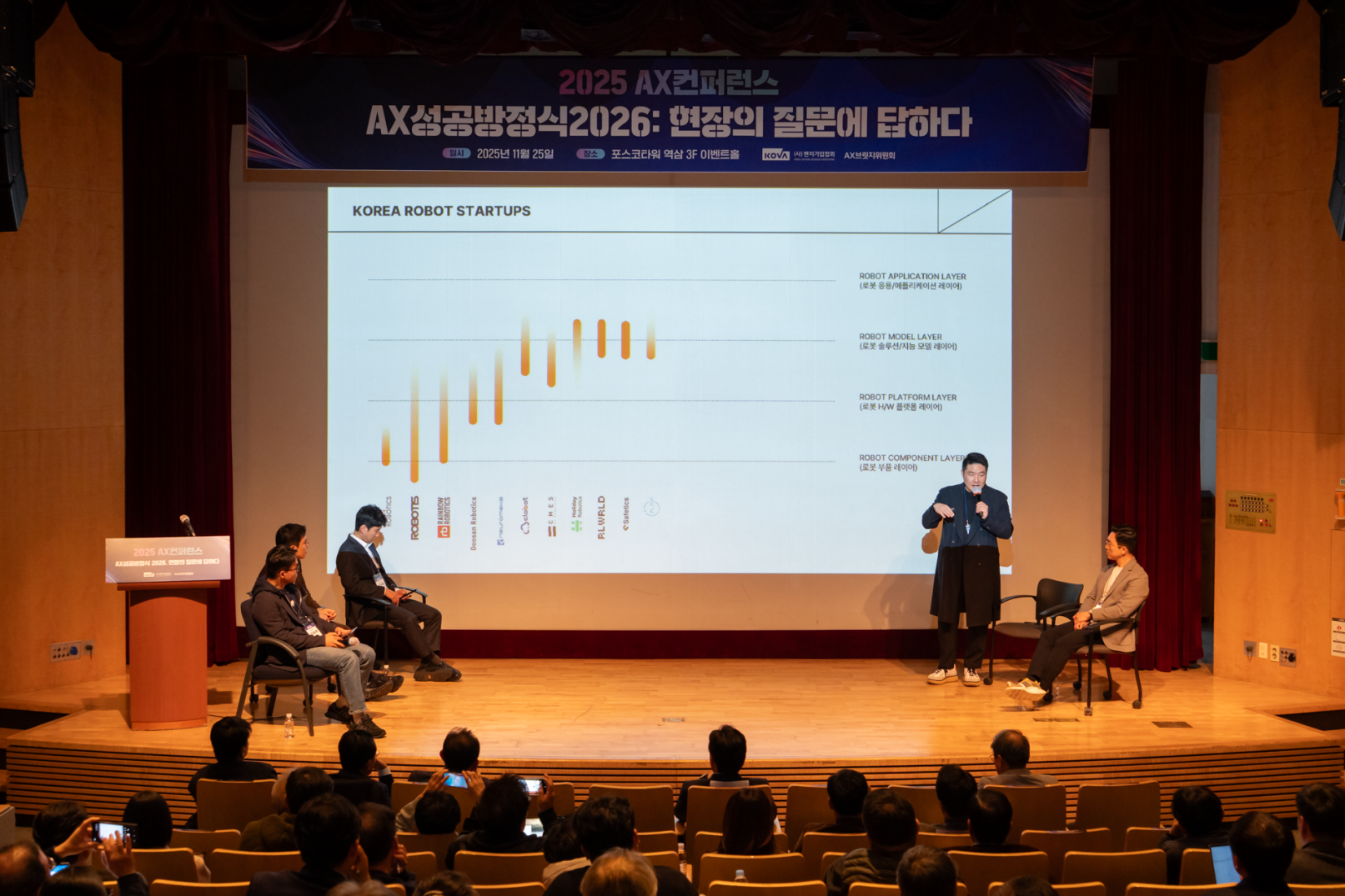
On November 25th, the AX Bridge Committee under the Korea Venture Business Association held a conference titled "AX Success Equation 2026: Answering Questions from the Field" at the POSCO Tower Yeoksam in Seoul. The committee announced three AX policies aimed at addressing recurring implementation barriers in venture companies' AI adoption processes. The event was designed to analyze key challenges faced by venture companies and startups in applying AI to their businesses and explore ways to bridge the implementation gap.
According to the "2025 Venture Business AI Adoption Experience and Barriers Survey" conducted by the committee in October, 81.4% of responding companies cited lack of data quality, refinement, and standardization as their biggest barriers. This was followed by failure to predict costs and errors in problem definition (73.3%), solution mismatch (68.8%), and proof-of-concept (PoC) limitations (64.3%), confirming the so-called "five AX barriers." Furthermore, 63.8% of responding companies are stuck in the initial adoption phase, and 85% of these are small and medium-sized ventures with fewer than 50 employees, revealing a structure of repeated pilot-centered experiments.
The on-site opening session featured companies in agricultural AI, food AI, robotics AI, and security AI, sharing AI application cases across industries. The presenters explained that data quality determines the success or failure of AI adoption and that the five major barriers are common issues across industries.
The tech and business solutions session that followed featured AI design automation, public AI integration, ontology-based AI in the defense sector, popularizing generative AI, and examples of enterprise-wide AI transformation within companies. Presenters presented strategies for overcoming barriers, focusing on problem-solving approaches for practical implementation.
Based on the survey results and field feedback, the AX Bridge Committee proposed three policy directions. First, regarding data policy, it stated that beyond the opening of public data, data governance and quality control support should be strengthened to enable companies to refine, process, and label their own data for utilization. Second, regarding human resources policy, it suggested moving beyond training advanced developers and expanding practical training that can enhance the capabilities of venture CEOs and practitioners to solve business problems with AI. Third, regarding support policies, it emphasized that one-time proofs of concept should be avoided and a system should be established to support all stages from introduction to operation and expansion, providing a practical support package from a total cost of ownership perspective.
Chairman Lee Ju-wan said, "AI competitiveness depends more on the number of companies that can utilize AI in the field than on the technology itself," adding, "In 2026, the government's AI policy needs to shift from focusing on technology supply to focusing on resolving the implementation gap."
The AX Bridge Committee plans to continue to serve as a bridge between AI suppliers and demanders and to propose policies to revitalize the ecosystem.
- See more related articles
You must be logged in to post a comment.