



Dreaming of becoming a legal OS builder that prioritizes customer friendliness , lowering down payments and increasing success fees.
"Law is the greatest system humanity has ever invented, enabling large-scale cooperation. However, today's legal services seem to be hindering growth through cost and inefficiency, rather than fostering innovation."
Why does Park Soo-jin, CEO of SOLARIS, argue that law firms need to be redesigned from a "system" perspective? Having worked in the public sector, large law firms, and legal tech startups, he assesses that the Korean legal market remains "stuck in a pre-modern, apprentice-style, cottage industry."
Solaris starts here. From its name to its philosophy, its direction is clear. As its slogan, "Make Humanity Greater," suggests, it aims to once again transform legal services into an "infrastructure of collaboration."
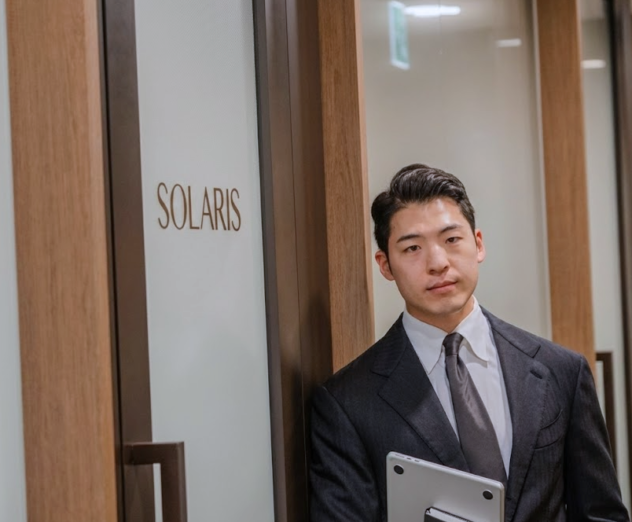
A law firm named after the sun: Why is it called "Solaris?"
Solaris means "of the sun" in Latin. The name embodies the firm's commitment to "illuminating the path like the sun" for clients facing the darkest moments of legal trouble. CEO Park Soo-jin explains the background of the slogan as follows:
"Humanity's greatness was possible because of the ability to collaborate on a large scale, and law was invented to resolve the conflicts that inevitably arise during that collaboration. However, due to high costs and inefficiencies, it has become a constraint rather than a catalyst for innovation and growth."
He emphasized, “Legal services must return to their original role,” and “Solaris wants to innovate legal services themselves so that the law can once again become the foundation for bringing out the ‘greatness’ of individuals and businesses.”
"Even large law firms are ultimately cottage industries"… A distorted market structure
Having spent most of his legal career between large organizations and startups, he has experienced both sides of the equation. He believes the current Korean law firm market is structurally inefficient.
"The biggest contradiction I've seen at large law firms is that clients expect top-tier service and pay premium fees, yet the actual work is handled by junior, inexperienced attorneys. In the individual (B2C) market, it's not uncommon for clients to be pressured by expert authority to raise reasonable questions, or for filing complaints to be delayed for months even after a retainer has been paid."
He sees this problem not as a problem of individual competence, but rather as a lack of a standardized system for transparently sharing case progress and consistently managing quality. Therefore, Solaris's first experiment is "designing a law firm that is systems-centric, not people-centric."
Creating a law firm that is client-friendly, not lawyer-friendly.
The first area Solaris tackled was "client experience." He cited "lack of transparency in the process" as the most unfriendly practice of existing law firms.
"Clients pay significant fees to resolve life-threatening issues. However, after signing a contract, they have little visibility into the progress of their case or what their attorney is doing. Attorneys are overwhelmed with the burden of drafting documents and attending court, so client communication is always a secondary priority. Ultimately, clients remain anxious throughout the case."
Solaris structurally overturns this point. The key is separation of roles.
"The traditional approach, where a single lawyer writes documents, attends trials, and provides client consultations, inevitably degrades service quality. Therefore, we separated the roles of 'researching legal principles and writing documents' from 'communicating with clients and coordinating strategies.'"
Currently, Solaris is divided into a "Connector Team," responsible for trials, consultations, and strategic coordination, and a "Builder Team," responsible for documentation and evidence. A system has also been added to visualize and share the entire case process.
"We display the entire process like a parcel delivery tracking system. The system proactively informs customers of which steps have been completed and when the next steps will be completed. Our goal is to eliminate the need for customers to contact us out of anxiety."

Focus on performance over down payment… Retention and referrals as KPIs
Another key point Solaris emphasizes is that "we value both the underwriting process and the execution process equally." This principle stems from the recognition that many law firms have a structure that prioritizes the actual execution process over the initial sales phase.
"There's a stereotype in the legal profession that legal services are one-time things, making retention and viral marketing difficult. But if a customer is truly impressed, isn't it only natural for them to return for another issue or recommend you to a friend?"
So, Solaris chose two metrics, unusual in the legal industry, as its core KPIs.
First, retention (re-referral) and viral referral (recommendation) rates. He explained, "We believe satisfaction with the work process drives these metrics, and we manage them with utmost importance." He added, "Currently, more than half of our customers come to Solaris through recommendations from existing customers or through their own referrals."
The second is ‘system update frequency based on feedback.’
"If customer complaints or internal communication errors are discovered during the implementation process, we don't blame individuals for the issues. Instead, we immediately revise our manuals and guidelines. We analyze why customers ask questions in the first place and update our processes accordingly. You can think of this as a structure that transforms failures and complaints into system improvements."
By reducing context switching, work time was reduced by 30%. The connector/builder system isn't simply about separating roles. Solaris's goal is to minimize context switching.
"A lawyer's work involves a mixture of highly focused writing and highly skilled communication skills, including arguments and consultations. After attending a trial, writing a document, and then answering a client call, your mind must constantly switch between modes. Brain fatigue increases, and efficiency plummets."
Solaris completely separates work modes. Builders focus on legal principles and logic without external distractions, while connectors focus solely on communication and strategy. He explains that internal time tracking results show that "the time required to process the same amount of work has been reduced by approximately 30% compared to the previous method."
"The time and energy saved are reinvested into paying closer attention to incident details and providing deep customer care. This organizational design simultaneously addresses efficiency, quality, and customer satisfaction."
"We Win to Profit": A Performance-Oriented Cost Structure and a "Lightweight" Organization
Experimentation continues in cost structures. Solaris has adopted a "performance-based cost structure" that lowers the down payment ratio and increases the success fee ratio.
"Traditional law firms have a certain level of revenue guaranteed the moment they receive their retainer fee. To put it bluntly, even if they lose a case, they don't suffer financial losses. On the other hand, clients are still burdened with significant upfront costs, regardless of the outcome."
Solaris chose a structure where “the law firm wins only when the client wins.”
"We basically charge a down payment equivalent to actual expenses. From the client's perspective, this reduces the initial financial burden and provides them with the psychological assurance that their lawyer will fight to the death to win."
Of course, the law firm faces significant risks if it loses. Solaris offsets this risk through its organizational structure.
Traditional law firms incur a significant portion of fixed costs, such as labor and rent, regardless of whether they take on cases. We've implemented a sales-based incentive system for most of our members, making labor a variable expense. We also strive to be a lean organization that minimizes fixed costs. This has enabled us to pursue a bold pricing policy.
KMS and Online Case Room: Breaking Information Asymmetry
Solaris' target customer base is clear: growth-stage companies (startups and SMEs) and digitally native individuals.
"These companies have complex issues that require the high-quality services of a large law firm, but the fees at large law firms are prohibitively high. It's also difficult to know whether those fees are reasonable. The same goes for individual clients. Because the system requires meeting with a lawyer to obtain information, even simple issues face high costs and a psychological barrier."
The solution offered by Solaris is a knowledge management system (KMS) and an online case room.
"We plan to collect internally accumulated case data and expertise into KMS, de-identify it, and reprocess it into high-quality content such as FAQs, legal guides, and columns. We want to help clients understand their issues to some extent even before meeting with a lawyer."
Ultimately, our goal is to become a “law firm that resolves information imbalance.”
Building a Legal OS, Aiming for Own Software by 2026
Solaris's technology strategy is centered around the "Legal Operating System." It is currently in the early stages of centralizing data and tracking workflows using Slack and Google Workspace. The company plans to develop its own software and further enhance its capabilities by 2026.
"The area I'd most like to automate is writing. While there are AI writing tools available in the legal market these days, most are based on general-purpose data, making them insufficient for lawyers to use on their own."
Solaris aims to create "AI that generates sharp, high-quality written documents that lawyers can immediately use" by intensively training on success stories and unique logic structures in specific fields. The ultimate goal is to have everything from evidence organization, risk mapping, and schedule management all running within a single operating system.
Startups, renewable energy, global… "Our customers are companies that stand at the boundary between regulation and innovation."
The customer group that Solaris is targeting first is “high-growth companies struggling at the boundary between regulation and innovation.”
"We're already advising companies across the solar value chain, including Korea's top energy platform company. We're also partnering with edutech and legal tech startups in Series B or higher, as well as foreign companies seriously considering entering the Korean market."
According to his explanation, these companies have one thing in common: "their business development is faster than the laws and regulations." Consequently, they often face "complex regulatory issues that cannot be resolved solely through interpretation of existing laws."
This field requires advanced industry understanding and regulatory compliance capabilities. However, large law firms can be prohibitively expensive for companies, and finding lawyers with a deep understanding of the industry is challenging. This mismatch has left many companies feeling a need, and we aim to offer practical solutions at reasonable costs, leveraging our practical experience in corporate practice.
Solaris's long-term goal is to become "a full-service law firm covering all aspects of corporate operations, rather than a boutique law firm focused on a specific field." As businesses become more sophisticated, regulatory issues inevitably arise, and the firm aims to become "a partner that works alongside companies at the intersection of regulation and innovation."
A perspective that views regulation as a "design variable" rather than a "barrier."
Solaris CEO Park Soo-jin's resume is steeped in experience collaborating with regulatory agencies such as the Ministry of Employment and Labor, the Ministry of Science and ICT, the Korea Communications Commission, the Financial Services Commission, and the Financial Supervisory Service. This experience is directly reflected in the law firm's service design.
"My experience in regulatory agencies helps me understand the context of why regulations are designed this way. Innovative companies always operate in gray areas, where existing laws don't cover them. While the wording alone often suggests a 'no,' understanding the regulatory intent and operating principles allows me to see where the red line truly lies and how to circumvent it legally."
That's why Solaris approaches corporate consulting by collaboratively designing "how to change your business model to achieve legal growth." We're not afraid to change the rules if necessary.
"We're currently working to ease the 'solar separation distance' regulation, which is currently cited as the biggest obstacle to the renewable energy industry. Rather than simply pointing out the problem, we're developing specific amendments and directly persuading the National Assembly and relevant ministries."
Can Korean Legal Services Be Exported?
Solaris is focusing on inbound investment, or "foreign capital entry into Korea," as the first step in its global strategy. In fact, the company recently held a face-to-face briefing with headquarters executives to assist a global private equity fund (PE) in its entry into Korea.
Even if we have a branch office in Korea, there are often differences in perspective between us and the headquarters. The headquarters always views risks with a "tread-and-tumble" perspective. We clearly explained the regulatory background and practical solutions, and after that, the decision to invest in the Korean market was made."
He also sees ample opportunity in the export potential of Korean legal services. "Korea relies on written law, so there are relatively few variables and the outcome of litigation is highly predictable. Legal tech companies have observed a 90% accuracy rate in predicting success. Furthermore, Korea boasts access to justice, allowing anyone to receive a trial relatively cheaply and quickly." He adds, "High predictability means it's easy to systematize and standardize," and "Korea is the perfect test bed for advancing legal systems." He also cautiously outlined a blueprint for packaging and exporting Korea's proven legal operating system to countries with similar legal systems.
We're looking for comrades who will overhaul the legal market system.
Finally, when asked about the type of talent Solaris is looking for, he used the expression “a small, elite special forces unit.”
"What we seek is not qualifications, but comrades who share the 'reckless dream' of revolutionizing the legal market through systems, rather than being complacent with the inertia of the existing legal profession." This sentence also describes Solaris' organizational culture. They operate two systems: "Failure Capitalization" and "Performance Sharing."
"Failure is inevitable with every new endeavor. Instead of holding individuals accountable for failure, we analyze the root cause through an autopsy process and incorporate it into our manuals and systems. Because failures are recorded and shared, becoming company assets, anyone can take on the challenge without fear." We also clearly reward achievements.
"Profits generated through success fees are shared with our members. We also offer a generous incentive system where, if a new business is successfully developed, a majority of the initial profits are distributed to the team. This is because we want our members to grow beyond mere 'hired lawyers' into entrepreneurs who pioneer new markets together."
While the specific three-year financial and investment plans were clearly stated as "internal circumstances make it difficult to disclose them externally," the direction is clear: "Focusing on areas where we can generate the greatest added value and returning legal services to the infrastructure of human cooperation. Solaris's experiments are making progress toward that goal, step by step."
You must be logged in to post a comment.