



Recycling of discarded lithium waste using biomineralization technology, the same principle used to make seashells.
Chlorella recovers 90% of lithium wastewater, reducing costs by a third.
– Proof-of-concept testing underway in Gwangyang… Mass production in 2027, IPO in 2030 targeted.
Lithium carbonate is a key cathode material used in lithium-ion batteries for electric vehicles, home appliances, and IT devices, and is also used in the manufacture of pharmaceuticals, specialty glass, and optical glass. Lithium carbonate is produced from mines or salt lakes (concentrated salt lakes). Mined ore is heated and crushed, mixed with sulfuric acid, and impurities are removed. After ion exchange and concentration, carbon is added to precipitate the lithium. This is followed by filtration, washing, and drying to extract the lithium carbonate. The brine extracted from the salt lake is then concentrated for lithium, lime is added to remove impurities, and carbonate is added to recover the lithium carbonate.
Even after lithium carbonate is extracted, low-concentration lithium remains. This is called low-concentration lithium or lithium waste. To extract lithium carbonate again, the process of concentrating and removing impurities must be repeated. The problem is that this is very expensive. Because extracting lithium carbonate from low-concentration lithium is less economical than extracting it from mined ore, it is often simply discarded. Low-concentration lithium remains after lithium carbonate extraction from salt lakes, but this too is uneconomical and is simply discarded.
Lithium accounts for approximately 10% of the lithium-ion batteries used in electric vehicle batteries, home appliances, and IT devices, while nickel and cobalt account for 10-40%. The lithium waste fluid from spent batteries contains various impurities. While nickel and cobalt are economically viable and can be separated, lithium is often discarded due to the small quantity and high costs associated with additional processing. Environmental concerns also arise. Extracting lithium from lithium waste fluid requires the use of sulfuric acid, caustic soda, and phosphoric acid, chemicals that have a significant environmental impact.
South Korea's annual lithium production is 43,000 tons. Of this, 4,300 tons, or 10%, remains as low-concentration waste. This translates to an annual waste of approximately 100 billion won (approximately $85 million USD). Adding in the low-concentration waste from spent batteries and salt lakes, the amount of lithium being wasted is even greater. Globally, the lithium left behind in spent batteries alone amounts to 150,000 tons, representing an unrecycled waste volume of approximately 12 trillion won (approximately $10 billion USD).
According to the EU Battery Regulation, which was enacted in 2020 and took effect in 2023, new industrial batteries, electric vehicle batteries, and SLI batteries must use recycled materials containing at least 16% cobalt, 6% lithium, 85% lead, and 6% nickel starting in 2031. By 2036, this ratio will increase to 12%. To meet this recycling rate, 50-80% of discarded batteries must be recycled. Due to this mandate for resource recycling, the global waste battery recycling market is expected to grow to KRW 200 trillion by 2050. Lithium raw materials account for approximately KRW 20 trillion of this market.
Low-concentration lithium waste liquids were previously discarded due to their low economic viability. However, recycling is now the only option. There's a company that extracts lithium from this waste liquid in an environmentally friendly and economical way: Green Mineral.
Green Mineral's CEO, Jeong Gwang-hwan, is a professor of life sciences at Sogang University. He began researching metal recycling using microalgae about ten years ago. This research led him to found Green Mineral in 2021. Currently, Green Mineral's research team consists of four Ph.D.s and four Master's degree holders, including Executive Director Lee Ho-seok (Professor of Life Sciences at Sogang University).
Green Mineral's technology is expected to be key to solving the biggest challenges facing the global battery recycling industry. Green Mineral is currently conducting a demonstration project in Gwangyang and plans to begin full-scale mass production in 2027. The company is expanding its business with the goal of an IPO in 2030. This year, Green Mineral was selected for SK Telecom's "ESG Korea" program and is receiving acceleration support.
We met with CEO Jeong Gwang-hwan at Green Mineral's office in Gasan Digital Complex to learn about its lithium extraction technology using microalgae from low-concentration lithium wastewater, the ongoing demonstration project in Gwangyang, and Green Mineral's future strategy for the next-generation battery market.
Finding the Answer in Chlorella
So how can Green Minerals extract lithium from lithium wastewater, which is often discarded due to its low economic feasibility, in an environmentally friendly way? The secret lies in chlorella (a type of single-celled green algae that mainly lives in freshwater and is rich in chlorophyll, which enables photosynthesis). When chlorella is added to lithium wastewater instead of chemical mixtures, white lithium carbonate crystals naturally precipitate. This phenomenon is called biomineralization. Biomineralization refers to the phenomenon in which organisms take in external substances and transform them into hard, crystalline forms like minerals. Both clams forming shells and humans forming bones are examples of this biomineralization phenomenon.
“A specific enzyme in chlorella triggers the biochemical process. This enzyme brings lithium ions into contact with carbon dioxide.”
When chlorella is added to lithium wastewater and carbon dioxide is added in the form of bubbles, chlorella absorbs carbon dioxide while photosynthesizing. During this process, enzymes within the cells are activated, converting carbon dioxide into carbonate (CO₃²⁻) ions. At the same time, lithium ions (Li⁺) meet with carbonate and cause a chemical reaction, causing lithium carbonate to crystallize and precipitate. White crystals settle to the bottom of the solution, like falling snow. The biomineralization enzyme ability of natural chlorella is not enough. Therefore, Green Mineral genetically modifies chlorella to enhance its biomineralization enzyme ability.
"We've inserted a gene into chlorella that creates an enzyme involved in biomineralization. Originally, chlorella only possessed the ability to biomineralize for its own survival. However, Green Mineral has added the gene for this enzyme, allowing it to produce more of the same enzyme within the same cell."
Green Mineral holds over 20 registered or pending patents, including 12 domestic patents and four international patents related to chlorella genetic technology and eight domestic and four international patents related to lithium, nickel, and cobalt leaching technology using biomineralization.
"Chlorella gene introduction technology is extremely difficult. This is because the plant's cell walls are incredibly rigid. The key is figuring out how to penetrate that rigid cell wall and insert the gene. Green Mineral has received a patent for this technology."
Low-concentration lithium wastewater is discarded due to uneconomical recycling techniques. Green Mineral uses genetically engineered chlorella to recover over 90% of the lithium carbonate from this wastewater.
Green Mineral achieves both economic and environmental benefits. Conventional methods repeatedly use strong acids and alkalis like sulfuric acid, caustic soda, and phosphoric acid, and involve a complex eight- to ten-step process. In contrast, Green Mineral uses only a small amount of sulfuric acid in chlorella and simplifies the process to just five steps, reducing costs to one-third of conventional chemical methods. Minimizing the use of chemicals also significantly reduces the serious environmental pollution problems associated with conventional methods. Chlorella can be recycled into biodiesel or fertilizer.
Validation phase and scaling
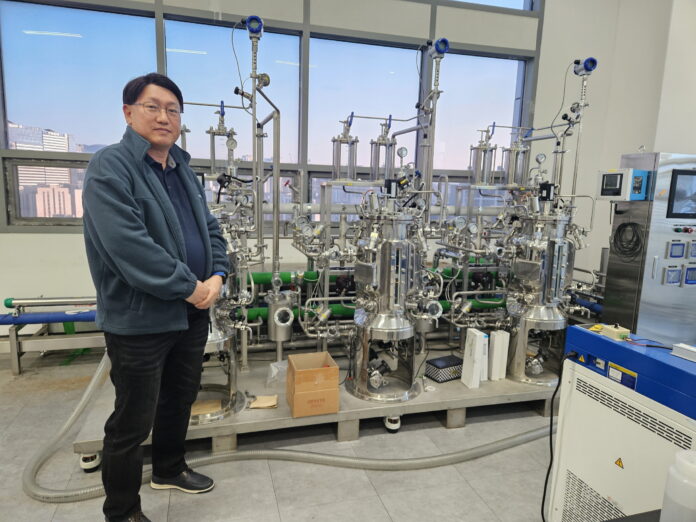
Green Mineral has completed its laboratory research and has begun the full-scale verification phase. This September, it was selected for Company P's verification project and relocated its research facilities to Gwangyang. Previously conducted only on a small scale, testing on a 5-ton scale has become possible.
The laboratory and the industrial field are vastly different. In a 30-liter reactor, the temperature was nearly uniform. However, at 500 liters, the temperature at the center and edges of the reactor varied. Because carbon dioxide is injected from above, the acidity at the top of the reactor is lower than at the bottom. Chlorella also consumes carbon dioxide, causing the pH to rise. This inhomogeneity directly affects the efficiency of the enzyme reaction.
Green Mineral has solved these problems. A temperature control system maintains a constant temperature throughout the reactor, a pH buffer system maintains acidity within the target range, and a pressure-controlled carbon dioxide bubbling system evenly distributes carbon dioxide. Inside the reactor, temperature, pH, dissolved oxygen, and turbidity sensors are placed for real-time monitoring, and blue and red LED lighting optimizes chlorella photosynthesis.
Green Mineral is also testing technologies to recover nickel and cobalt, as well as lithium. The biomineralization principle used for lithium recovery also allows for the precipitation of nickel, cobalt, and manganese. This would allow for the extraction of nearly all resources from spent batteries. Considering the market potential of battery recycling, nickel and cobalt hold greater value. While lithium accounts for approximately 10% of a lithium-ion battery, nickel accounts for 30-40%, and cobalt accounts for 10-20%, a much larger proportion. This is why Green Mineral has filed patents for nickel and cobalt leaching compositions.
Green Minerals is expected to be a game changer in the battery recycling industry once nickel and cobalt recovery technology is commercialized.
Batteries contain not only lithium but also various metals, such as nickel, cobalt, and manganese. Applying the biomineralization principle can be applied to most metals. While each metal requires optimal chlorella genetic manipulation, the basic principle remains the same.
Green Mineral plans to secure Series B funding next year to successfully complete its demonstration project in Gwangyang and secure the necessary funds to build a factory for mass production. The company aims to complete construction of the factory for mass production in 2027, commercialize nickel and cobalt recovery technology in 2028, and launch an IPO in 2030.
This is the moment when what was once discarded is being re-evaluated as a valuable resource. A market worth 12 trillion won, once dismissed as uneconomical, is now being revived by Green Minerals. Green Minerals' journey will continue until full-scale production begins in 2027.
You must be logged in to post a comment.