



-Establishing standards for the collection, sorting, and recycling of waste clothing.
Entering the carbon emissions market using waste clothing data
"This will be the first IPO related to clothing waste."
According to statistics from the Ministry of Environment, the amount of recyclable waste clothing generated in Korea in 2022 was approximately 100,000 tons, of which more than 90% was landfilled or incinerated. The inadequacy of clothing collection systems is cited as a contributing factor to this low recycling rate.
In the plastics industry, unmanned collection machines have become widespread and customer reward systems have been introduced, leading to high recycling rates. Similarly, if clothing were equipped with IoT-based individual tracking systems, user authentication, and reward systems, transparent collection would be possible, significantly increasing the current recycling rate of less than 10%. GreenLoop is a startup that originated from this idea.
GreenLoop CEO Han Kang-jin studied waste management during his master's degree and worked in environmental safety at LG and SK before founding GreenLoop in July 2024.
GreenLoop is growing rapidly, enjoying the trust of the government and major corporations. Last month, it was selected for the 2050 Carbon Neutrality and Green Growth Committee's "Net Zero Challenge X," acknowledging its contribution to achieving carbon neutrality goals. This year, it was selected for SK Telecom's "ESG Korea," collaborating on ESG initiatives. Furthermore, GreenLoop's participation in the Sejong City "National Pilot City Innovation Service Model Verification Project," promoted by the Ministry of Land, Infrastructure and Transport, has positioned clothing waste management as a core smart city infrastructure. Various awards, including the Excellence Award at the Bucheon City Startup Competition, further demonstrate GreenLoop's innovativeness and ESG value.
We met with GreenLoop CEO Han Kang-jin to discuss his strategy for building a waste clothing collection, transportation, sorting, and sales system and using the data generated through this system to enter the carbon emissions market.
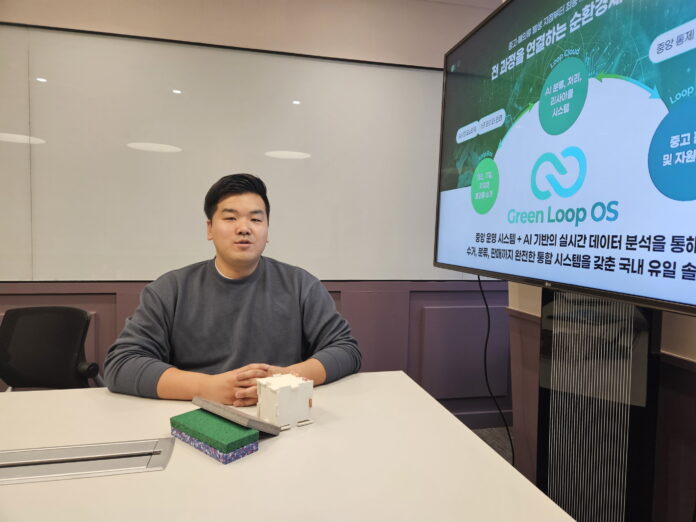
Introducing a system for waste clothing
Once discarded, waste clothing enters a complex distribution maze: collection, transportation, collection, sorting, sale, and distribution. This process is repeated two or three times. The problem is that it's impossible to know where, by whom, and how the waste clothing is reused. The lack of transparency in the collection process also distorts the distribution process.
"To solve these problems, a tracking system was essential. That's why we introduced communications, IoT, user authentication, and rewards based on these technologies."
This is how the "GreenLoop OS (Operating System)" was born. GreenLoop OS is a completely different concept from existing clothing collection boxes. It's an integrated operating system that manages the entire process, from collection to sorting and sales, where clothing waste originates from the IoT collection box, the "Loop Box," is individually tracked in the sorting center, the "Loop Cloud," and then gains new value on the sales platform, the "Loop Market." Through a central control system and AI-based real-time data analysis, it's possible to trace who discarded the clothing and where. Each garment's condition, brand, and market potential are comprehensively assessed to determine its individual value. Most innovatively, this process identifies the collector (consumer) and provides immediate rewards in the form of donations or cash. These rewards can extend beyond simple incentives and develop into local currencies or partnerships with small businesses, ultimately creating a virtuous cycle where waste generators, recycling companies, and local communities all share in the profits.
Collecting clothes in optimal condition
"Existing collection boxes have several problems. Cats sometimes die in the winter, unable to get out. And since there's no compensation for waste disposal, people just throw in any kind of clothing. No one knows how much is collected and how it's distributed."
Using the Loop Box (Payot) is simple. Simply place the clothes you wish to discard in a shopping bag or plastic bag and enter your mobile phone number into the Payot app. If you're already a registered member, your existing information will be immediately linked. Choose whether you want to receive your rewards in cash or as a donation. An encrypted code that identifies you will be printed. Once you attach this code to the bag, the lock will automatically open, completing the donation.
IoT sensors embedded in the Loop Box detect and manage load ratios and temperature and humidity in real time. This ensures that clothing is stored in an optimal environment. By meticulously managing clothing, which is sensitive to changes in humidity and temperature, high quality clothing can be maintained.
Currently, 14 Loop Boxes are installed and operating, primarily in Seoul and Sejong City. In Seoul, there are three locations: a Gangnam apartment complex, the H Department Store Premium Outlet, and the Seoul National University campus, with two more planned. GreenLoop participated in Sejong City's smart city innovation service demonstration project, installing Loop Boxes in residential areas serving approximately 8,000 households.
GreenLoop is discussing installing Loop Boxes with social enterprises, self-reliance organizations, and local governments, and aims to expand nationwide next year.
Valuation based on condition
Clothing collected from Loop Box is moved to GreenLoop's sorting center, 'Loop Cloud', where the value is determined by comprehensively evaluating the condition of each garment (stains, degree of damage, washability, etc.), brand value, market demand, and material composition.
GreenLoop plans to introduce an AI classification system in the future to improve the accuracy of individual garment value assessments. This will enable automatic classification by material type, such as nylon, polyester, cotton, and leather, enabling upcycling companies and material, component, and equipment companies to supply usable materials in a timely manner.
Use for sales, export, and upcycling
Clothing is classified into three grades: S/A (reusable clothing in good condition), B (suitable for export), and C (suitable for material utilization or upcycling). Each grade is assigned to a different distribution channel. S/A is sold through domestic live commerce and direct sales channels, B is exported to Southeast Asian countries like Thailand and Mongolia, and C is upcycled into building materials or interior decoration items or sold as a single material.
S/A-grade clothing is sold through live broadcasts. Operating live studios in Bucheon and Suwon, we provide sellers with a stable environment for their activities. Live commerce sales generate a steady monthly revenue of around 100 million won.
Grade B clothing, tailored to local demand and climate, is exported to Southeast Asian countries such as Thailand, Mongolia, and Malaysia. The company is preparing for a full-scale expansion into the global market.
Unusable Grade C clothing is recycled into upcycled products, materials, components, and equipment. GreenLoop, in collaboration with the Korea Institute of Industrial Technology, has been conducting research on technologies for shredding and compressing waste clothing into interior materials. They plan to receive commercial licenses by the end of this year and launch a full-scale materials business next year.
A leap forward toward a data-driven carbon emissions market
GreenLoop's ultimate goal is to enter the data-driven carbon credit market.
"Once the carbon emissions that can be suppressed by not producing new products are clearly quantified, rewards or credits can be issued accordingly. Currently, the carbon credit market is being formed at the corporate level, but we are increasingly trying to expand it to include individuals."
Just as you receive a refund for returning a soju bottle, in the future, individuals will be able to earn carbon credits for collecting clothing waste. This could also be applied at the corporate level.
Companies manage their carbon emissions from their business activities by dividing them into Scopes 1, 2, and 3. Scope 3 encompasses emissions generated in employees' daily lives. Data on clothing waste generated from dormitories and offices can now be recognized as part of a company's ESG performance.
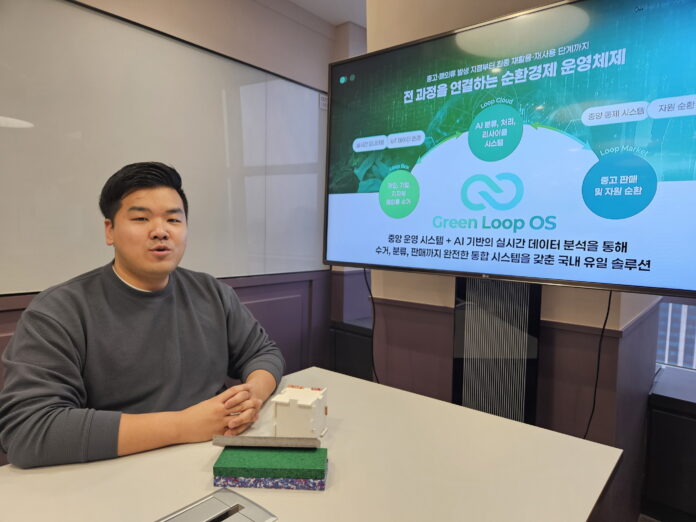
The journey of a garment, starting at the Loop Box, is individually tracked in the Loop Cloud, gains new economic value in the Loop Market, and all data from the process is linked to future carbon credits. This is possible thanks to data and systems.
GreenLoop, which has now completed its seed round, aims to become Korea's first IPO related to clothing waste. In the US and Japan, numerous companies focused on the circular economy in clothing have already gone public.
In a reality where over 100,000 tons of waste clothing are lost each year, GreenLoop's challenge will become a system that opens markets and aligns with the nation's carbon neutrality strategy. GreenLoop's journey will prove this possibility.
You must be logged in to post a comment.