



“15 meters ahead, on the right.”
Navigation apps for the visually impaired repeatedly announce directions with a voice. However, this voice obscures important surrounding sounds, such as oncoming motorcycles. This has been a "market failure" for companies, citing the limited purchasing power of the 250,000 visually impaired people in Korea.
Kim Je-pil, CEO of Aidol, solved this problem with neuromorphic AI. He created an "artificial cerebellum" that guides with touch instead of voice and enables robots to make decisions on their own without the need for massive servers. This year, Aidol won two CES 2025 Innovation Awards for its autonomous guidance robot, "Bediveer," and began joint research with DFKI, Germany's leading AI research institute.
There's a world of difference between holding someone's arm and walking independently, and holding a robot and walking independently. What CEO Kim Je-pil wants to reclaim isn't simply a means of transportation, but "sovereignty over movement."
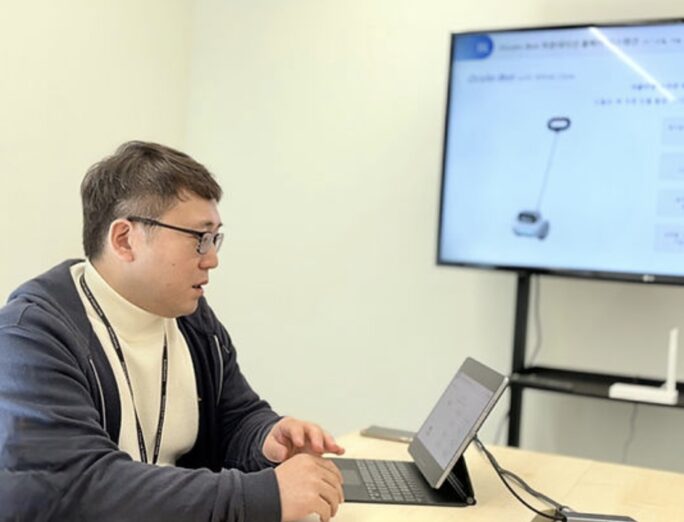
Mother's Eyes and the Market Failure of 250,000 People
CEO Kim Je-pil explains his reasons for starting his business as "two deficiencies." One is a lack of personal time, and the other is a lack of market access.
"My mother has poor eyesight. And I can't be there for her 24 hours a day to care for her. Given her advanced age, time is limited to address this issue. But neither the government nor businesses are currently addressing this issue. At best, there are a few charity services, and those services are meant for the most needy, so my mother's turn is never reached."
CEO Kim Je-pil defines this as a "market failure." As of 2024, there are approximately 250,000 registered visually impaired people in Korea. Of these, approximately 45,000 are severely visually impaired. The market is too small, and funding is limited. Naturally, companies are turning a blind eye.
"I believed that only startups, not large corporations, could turn this unprofitable niche into a profitable and compelling service. It was a kind of arrogance, a kind of arrogance, that I was trying to solve a classic market failure: no one was providing cutting-edge technology to users with limited purchasing power."
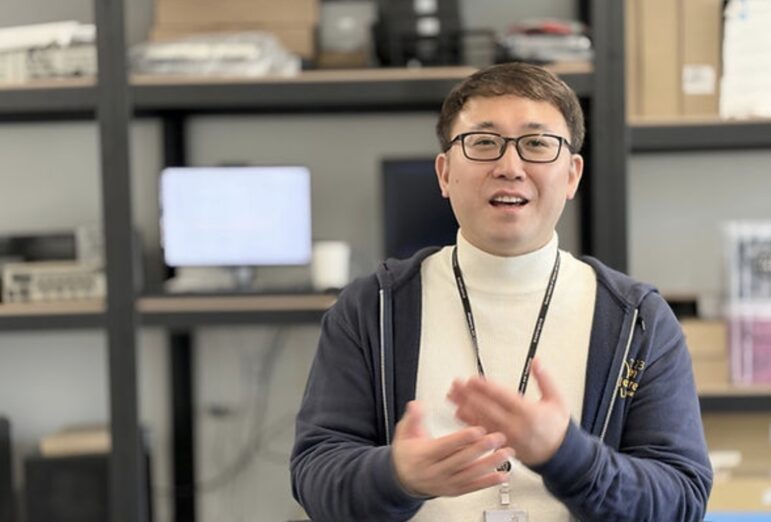
Tactile guidance instead of voice, like a guide dog
The biggest difference between Bedivere and existing services is its user experience. Most existing navigation apps use GPS to determine your location and then provide voice directions, such as "Go 5 meters ahead and turn right."
"But this repetitive voice guidance is problematic. It makes it difficult to hear other sounds, like when you're talking to a friend at a cafe. However, ambient sounds are incredibly important to visually impaired people. They hear things like a motorcycle passing by, a car approaching, and so on. They make these judgments through sound."
So, instead of using words, Bedivere guides us through touch, or more precisely, through "proprioception," the sense that allows our bodies to sense balance and movement.
“We translate the intelligence of human guides into the way guide dogs are used,” explains CEO Kim Je-pil.
The second difference is technology. Aidol uses "neuromorphic artificial intelligence." Most autonomous robots use powerful computers, which consume a lot of electricity. This requires a huge battery size.
"It's like carrying a power plant on your back. Neuromorphic AI, however, is very computationally lightweight. Therefore, it uses less electricity. We're building an 'artificial cerebellum.' When we walk, we don't perform complex mathematical calculations in our heads. Our brains only see split-second moments and constantly adjust their posture. Our robots are similar."
In this way, the robot can predict its own location, surroundings, and future behavior without having to connect to a massive server. It can be used immediately, even in subways with communication interruptions or in unfamiliar buildings.
The most challenging part of the development process was "How can we calculate quickly using inexpensive components?" Initially, a single calculation took 40 seconds. The solution was a change in thinking.
"We abandoned the obsession with calculating the robot's exact location and focused solely on understanding its relationship to its surroundings. We simplified the calculation method and ensured the AI only considered changes, not the overall picture. This significantly reduced the amount of computation."
Aidall may look like a robotics company, but its true core is an "on-device AI inference platform" built into the robot. The platform is called "HARIL."
Bedivere is the name of a loyal one-armed knight from Arthurian legend. It was named with the hope that it would be a faithful guide to its users. Halil is derived from the Korean word "할릴없" (Halyilsseupda). Originally meaning "impeccable," it's now understood as "has nothing to do." Therefore, the name was given to imply "an AI with nothing to do, that is, an AI that efficiently performs calculations."
"This Halil platform is our core. We're being purchased by companies in the heating and cooling system, smart farm, and drone industries. The platform itself is flexible and can be used in a variety of applications. That's why we're already generating revenue, even though we're a deep-tech hardware company less than two years old."
Aidol's initial market strategy is clear: the end users are visually impaired, but the money is coming from governments and institutions.
"It's impossible for me to create a social consensus or market on my own. I need to target places where money is already being spent. There are countries with well-established markets for assistive devices for the visually impaired, and some require them by law. We target those places first. They have solid purchasing power and already have significant money moving in."
Bedivere received two Innovation Awards at CES 2025, one in the Artificial Intelligence (AI) category and one in the Human Security for All category. "The CES Innovation Awards are like a testament to Bedivere's credibility," said CEO Kim Je-pil. "They demonstrate the innovative potential our radical technology can bring to the market."
Recently, we received a joint research proposal from DFKI, Germany's leading AI research institute. "Receiving a proactive proposal from a world-class research institute gives me a sense of relief that our technological development direction has been recognized. This joint research will be the key to unlocking the door to the conservative government procurement market."
Reclaiming Sovereignty of Mobility: Dignity, Not Technology
The technology that CEO Kim Je-pil creates is not simply about supplementing insufficient functions.
"This technology aims to restore the freedom, autonomy, and mobility that humans deserve as human beings. Walking while holding someone's arm is completely different from walking independently while holding a robot with your own hands is a completely different matter in terms of human dignity. Through technology, we aim to restore the sovereignty of mobility—the right to explore the world at your own will, without the assistance of others."
The short-term goal is to establish Bedivere in the US market and establish a mass production system. However, the ultimate goal is to establish it as a standard technology that solves the energy waste problem of intelligent robots.
He emphasized, "The message I want to leave the world is clear: the best technology is the one that saves the most lives with the least amount of energy," and "I will continue to prove this philosophy."
The robot, created by a son who wanted to be his mother's eyes, contains an "artificial cerebellum." This strategy addresses the market failures of 250,000 people with on-device AI and expands from the government procurement market to a universal platform. At its core lies the philosophy of "sovereignty over movement."
What CEO Kim Je-pil seeks to prove is not technology, but dignity. A technology that saves the most lives with the least amount of energy—that's the reason Aidol exists.
You must be logged in to post a comment.