



– Accurately classify and recycle waste clothing using AI spectroscopy technology.
– Recycling discarded clothes into high-performance new materials
"Our goal is to become a leader in the global circular economy."
"In Korea alone, 100,000 tons of discarded clothing are discarded annually. Waste clothing can become a future asset."
Every year, 100,000 tons of clothing are discarded. Only 10% of that is recycled, with the rest ending up in landfills and incinerators. This trend is expected to worsen. The global fashion market is projected to grow from $86.77 billion in 2025 to $164.211 billion by 2033. The problem is that the explosive growth of the fashion market is leading to a shortening of the clothing consumption cycle. As consumption accelerates, the amount of discarded clothing inevitably increases exponentially. This is not just an environmental issue, but also a waste of resources, as discarded clothing still contains usable raw materials and energy.
“Can we turn discarded clothes into assets?”
This simple yet pressing question is where Osllo began. Osllo recycles discarded clothing through two channels: reclaiming wearable garments into wearable pieces, and transforming unusable garments into high-performance new materials. From the clothing collection platform "RE:FIT" to "Slow-nel," which recycles waste textiles into building materials, Osllo has completed the complete cycle of resource circulation. Achieving an 80% profit margin on monthly sales of 20 million won and breaking even in just six months, Osllo is clearly proving that the circular economy is no longer an abstract ideal but a truly profitable business.
"Protecting the environment doesn't mean sacrificing profitability. In fact, it's more profitable. Waste clothing isn't a 'cost,' it's an 'asset.'"
Osllo entered the full-fledged ESG cooperation ecosystem in 2024 when it was selected as "ESG KOREA," operated by SK Telecom. It is conducting research on textile technology and new materials development with the University of Suwon. International collaborations are also actively underway. Osllo is collaborating with the University of Cape Town (UCT) in Africa on fiber compounding and pelletizing technology research, and has signed MOUs with countries in Asia and Africa, including Cambodia, Thailand, and Kenya. Osllo plans to establish a production plant in Cape Town, Africa, in 2026, marking a full-fledged expansion into the global market.
We met with Osllo's CEO, Jeon Ju-han, to talk about the clothing collection platform 'RE:FIT', the new material 'Slow-nel', and the future of resource circulation that Osllo dreams of.
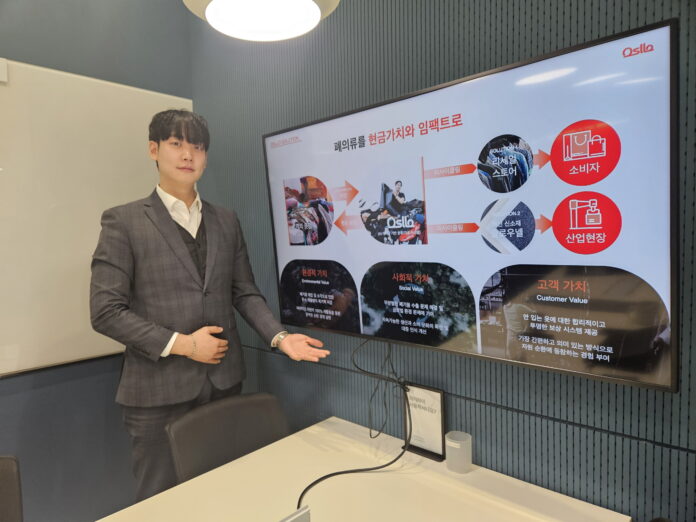
The beginning of the second journey of clothes
“It’s a shame to throw it away, but it’s too much of a hassle to sell it.”
Most clothing consumers face challenges when they attempt to dispose of their clothes. First, they don't know where and how to dispose of them. Because clothing collection systems are fragmented and vary across agencies, official information is lacking and consumers have limited options. Second, the actual collection process is cumbersome. It takes time and effort to collect clothes, find a collection location, and arrange for delivery. Third, there's a disconnect between environmental awareness and apathy. Consumers know that clothes emit carbon dioxide in landfills. While they are concerned about the environment, they lack a clear path to action. Ultimately, they end up throwing their clothes in the trash, feeling guilty. Fourth, there's no economic incentive. There's no compensation for clothes being treated as waste. Consumers only expend time and effort in the disposal process. Without direct benefits for participating in the cycle, motivation is impossible.
Osllo's "RE:FIT" solves all these problems at once. Instead of a complicated collection process, consumers simply open the KakaoTalk Plus Friend app and request a pickup. A pickup vehicle will pick up the item at a designated time, or consumers can visit an offline store to collect it in person. Upon completion of the collection process, consumers receive immediate cash compensation.
The collected clothing is meticulously sorted at Osllo's sorting center. Those eligible for resale are first cleaned to a level appropriate for their condition. After thorough cleaning, they are sorted by size, color, and season. Priced accordingly, they are then sold online and in-store. Meanwhile, clothing in good condition that cannot be preserved or is completely worn out goes a different route. These are recycled as raw fibers into the high-performance new material "Slow-nel," which is then reused in industrial applications such as building materials, automotive parts, and furniture.
To date, RE:FIT has collected 412,000 kg of clothing, equivalent to 1,540,000 pieces of clothing. This represents a carbon reduction equivalent to planting 410,000 trees, preventing 213,000 kg of carbon emissions.
Resale clothing and new materials reborn
The sorting of collected clothing begins with advanced technology. Osllo uses "near-infrared fiber spectroscopy (NIR)" to analyze the fiber composition of clothing using light. Previously, skilled experts had to visually and manually assess fiber composition. Simply holding the spectroscopic analyzer over a garment accurately identifies whether it is a natural or synthetic fiber, and in what proportion. Simultaneously, an "AI-based contamination and damage classification system" is activated. This system meticulously assesses the degree of contamination and damage within the garment, recognizing everything from stains and tears to discoloration. This process determines whether each garment will be resold or converted into textile raw materials.
The data acquired in this way goes beyond simple classification criteria. Osllo has secured a refined dataset of over 260,000 items from the waste clothing collected so far and has been selected as an AI Innovation Data Voucher company for 2024. As this data accumulates, the accuracy of the AI model increases and the classification speed increases. And accurate classification ultimately leads to the creation of better-quality Slow-nel and the acquisition of more resalable clothing. This completes a cyclical structure where data becomes an asset.
"An AI model trained on a dataset of 260,000 items accurately identifies the fiber composition of each garment, while simultaneously assessing the extent of contamination and damage. Typically, this process is performed by hand, but this is less accurate and time-consuming."
After sorting, the waste textiles enter a full-scale transformation process. First comes the fiber shredding stage, where the sorted fibers are uniformly cut into a consistent size and standardized. Next, the fibers are blended. Maintaining consistent raw material quality is crucial by blending similar ingredients. Finally, comes the high-temperature compression stage. A 250-ton hydraulic press machine melts the fibers, transforming the waste textiles into a new material called Slow-nel.
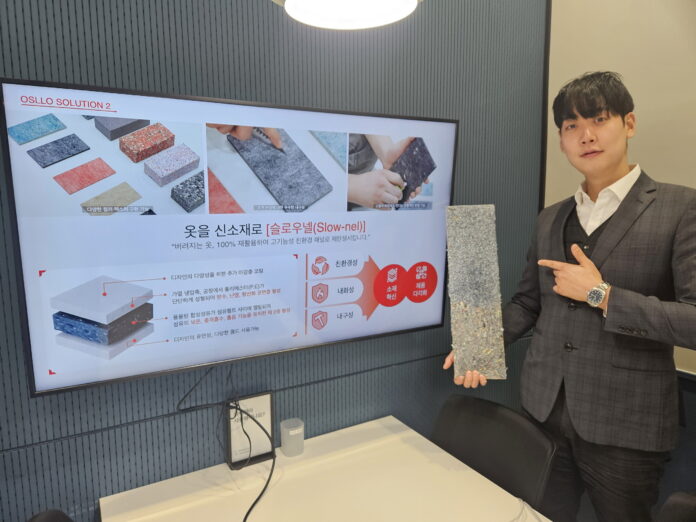
Because Slow-nel originates from discarded clothing, its raw material extraction process generates virtually no carbon emissions. It also boasts exceptional price competitiveness, offering up to 35% cost savings compared to conventional materials. With a sound absorption rate of over 72%, it excels at reducing indoor noise, and its flame retardancy meets fire safety standards. Its waterproof treatment makes it resistant to moisture and mold, and its durability is enhanced by minimal discoloration from UV rays and temperature changes. Its excellent shock absorption makes it resistant to damage when used as flooring or wall coverings. Most importantly, it is 100% recyclable. Wood is difficult to recycle, and plastics deteriorate with repeated recycling. Slow-nel is a truly circular material, capable of endless renewal.
All of these advantages have already been proven in the field. Slow-nel was piloted at the "SAVE THE HERO" pop-up with Company D last November, and as a result, it met ESG certification requirements as an eco-friendly sound-absorbing material. Its durability against wear and scratches was also proven, and the absence of chemical adhesives enabled a truly eco-friendly construction. Most importantly, it was confirmed to be harmless to the human body.
Slow-nel isn't just a simple material. It's the culmination of a technology that transforms waste into something new and valuable. If we hadn't created it, fibers that wouldn't decompose in landfills for 500 years are now used as building materials, car parts, and furniture.
Osllo has an R&D plant in Gyeonggi Province equipped with a 250-ton hydraulic press machine, a fiber shredder, a fiber mixing separator/integrator, a splitter, a Niagara beater, a moisture meter, a left-hand molding machine, and a fiber scanner. This allows the plant to produce 1,500 panels per month, equivalent to recycling 7.5 tons of waste fiber per month.
As a leader in the global circular economy
Osllo's motto is "From Waste to Worth," finding value in what's discarded. "From Material to Movement," it goes beyond simply producing quality materials to fostering a culture where people naturally experience and participate in "circulation." "From Local to Global," it aims to expand the circular economy model, which began in Korea's Gangwon-Gyeonggi region, to Africa, Thailand, and other parts of the world. Ultimately, Osllo aims to become a leader in the global circular economy.
"We believe we're not doing a 'business,' we're doing a 'cultural movement.' We want to create a structure where people naturally participate, create economic value, and protect the environment at the same time." From waste to value, from materials to culture, from local to global. Osllo's mission is to make the circular economy not just an industry, but a way of life.
Osllo found an opportunity in discarded clothing. That choice is now changing the world, little by little. The future of the circular economy is no longer a distant future. It is becoming a reality now at Osllo and for countless other companies in the future.
You must be logged in to post a comment.