



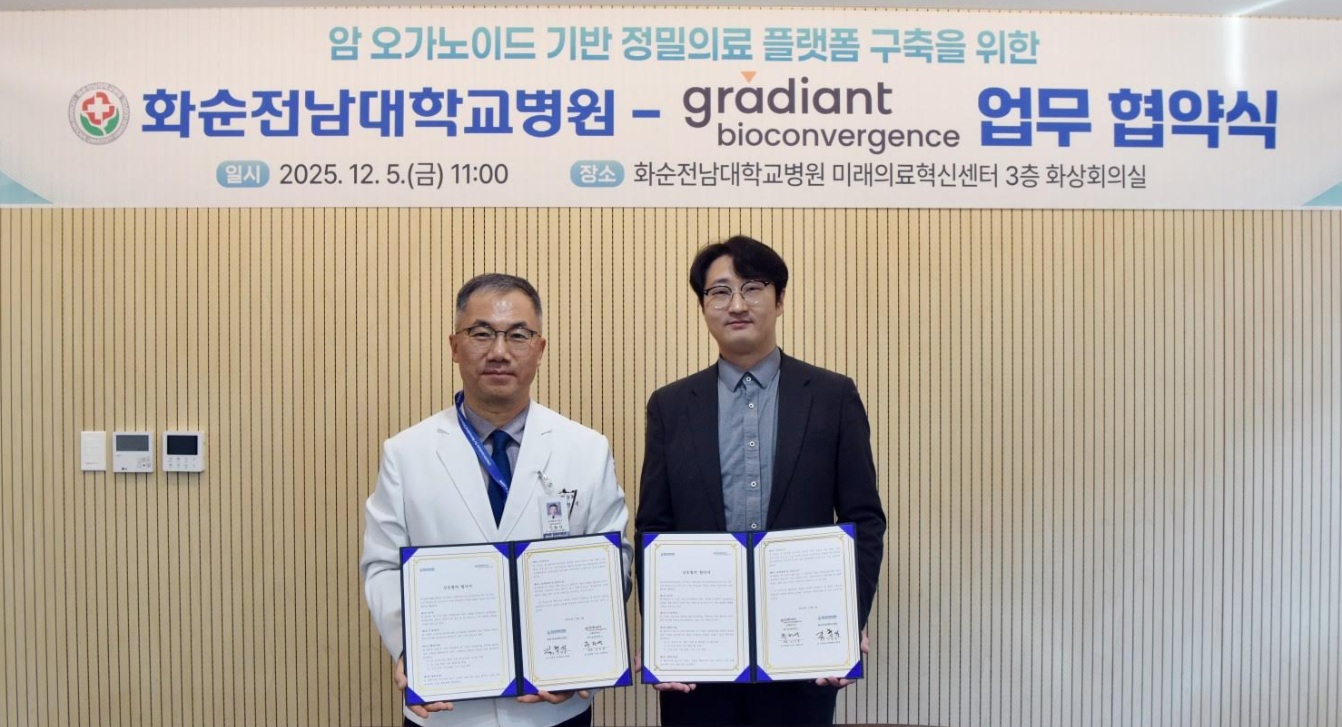
Gradient Bioconvergence (CEO Nam In-bong), a subsidiary of Gradient, announced on the 8th that it signed a business agreement with Hwasun Chonnam National University Hospital (Director Min Jeong-jun) to strengthen precision medicine research capabilities.
This collaboration aims to integrate patient-based clinical information with organoid analysis data to improve the accuracy of predicting anticancer drug response and enhance the execution capabilities of early-stage research. The two organizations plan to jointly pursue precision medicine research, including the establishment of a cancer organoid bank and the identification of anticancer targets, by linking Chonnam National University Hwasun Hospital's clinical research resources with Gradient Bioconvergence's organoid and AI-based analysis technologies.
Under the agreement, Chonnam National University Hwasun Hospital will provide clinical infrastructure, including the provision of cancer patient tissue and clinical information and the consent process for research participation. Gradient Bioconvergence will conduct non-clinical studies, leveraging its capabilities in patient-derived organoid (PDO) production and analysis and AI-based biomarker discovery. This will establish a complementary research collaboration structure centered on clinical-nonclinical linkages.
The two organizations also plan to continue joint research in stages, including establishing PDOs for each major cancer type, establishing standard operating procedures (SOPs), and developing a verification model for next-generation treatment response.
"The combination of clinical data resources and AI-based organoid technology is a key element of precision medicine innovation," said Nam In-bong, CEO. "This collaboration will contribute to expanding the depth and scope of precision cancer medicine research." Kim Hyung-seok, Director of the Biomedical Research Institute at Chonnam National University Hwasun Hospital, stated, "This agreement will help strengthen the competitiveness of precision medicine research and promote the development of innovative medical technologies through industry-academia-research collaboration."
- See more related articles
You must be logged in to post a comment.