



– Major companies, including Naver Labs and Amorepacific, have adopted physical AI, accounting for 65% of the total.
– Trends of increasing use in medical/bio (20%), finance (10%), and logistics/retail (5%)
– Automating the AI data building process reduces average workload by 75% and improves response accuracy by 20%.
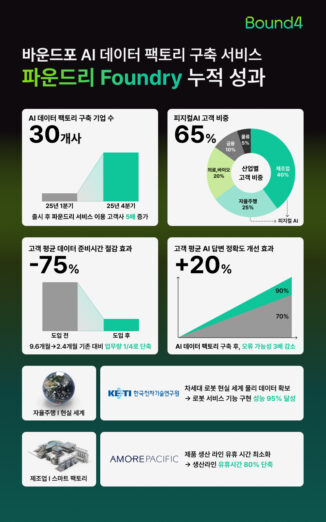
On the 9th, data foundry startup Bound4 (CEO Inho Hwang) announced the cumulative results achieved through its AI data factory construction service, ‘Foundry.’
Founded in 2019, Boundfor is a data foundry company that provides an integrated approach to AI model development, from data design to production and validation. Based on data infrastructure construction and operational automation technologies, it has consistently provided high-quality data required by companies for AI development.
Boundfor's core service, "Foundry," is an AI data factory service that provides end-to-end "foundation data," strategically designed and refined to meet industry-specific needs. By applying a cyclical structure of real-world data collection, simulation, and expert verification, it reliably produces high-quality data with an accuracy rate of over 97%. This reduces the time and cost required for companies to build their own infrastructure, significantly lowering the barrier to entry in the early stages of AI development.
Since its launch in the first quarter of this year, 30 companies have adopted the foundry. By industry, manufacturing (robotics, smart factories) accounted for the largest share at approximately 40%, followed by autonomous driving (25%), and physical AI accounting for 65% of the total. Usage cases are also increasing in healthcare/biotechnology (20%), finance (10%), and logistics/retail/commerce (5%).
Companies that adopted the system automated tasks such as raw data management, quality assurance, and dataset management, establishing a system that consistently secures reliable foundational data. The overall workload for data preparation was reduced by an average of nearly 75% compared to existing methods based on Excel or manual scripts. AI model response accuracy also improved by an average of 20% in the same model and GPU environment. This is significant because it was achieved solely through improved data quality, without adding GPUs or altering the model structure.
The Korea Electronics Technology Institute (KETI) is a prime example of leveraging foundries. KETI adopted foundries to address the "lack of real-world data," a major obstacle to next-generation robot development. This enabled KETI to secure a vast amount of real-world data, boosting robot service success rates to 95% and dramatically shortening R&D timelines.
Amorepacific leveraged its foundry platform to proactively eliminate potential disruptions in its production facilities. Based on high-quality data obtained through the foundry platform, AI automatically detected signs of production process anomalies, reducing production downtime by approximately 80% compared to previous models. Naver Labs and Samsung Electronics have also adopted foundry platforms.
Boundfor CEO Hwang In-ho said, “Our foundry service goes beyond simply building a data factory; it focuses on helping customers successfully develop AI models and create business value.” He added, “We will continue to actively support more companies to achieve innovation through AI adoption through continuous technological development and service advancement.”
You must be logged in to post a comment.