



– Roca101's cumulative investment in franchise and directly-operated facilities exceeds KRW 20 billion.
Since opening its first branch in 2020 , the company has operated over 60 branches and 1,099 rooms in just six years, with a 0% business failure rate and an average annual profit of over 20%.
– “ We aim to become the standard for operating small, privately owned buildings”… Targeting 100 branches next year, expanding our business into a hybrid residential and lodging model.
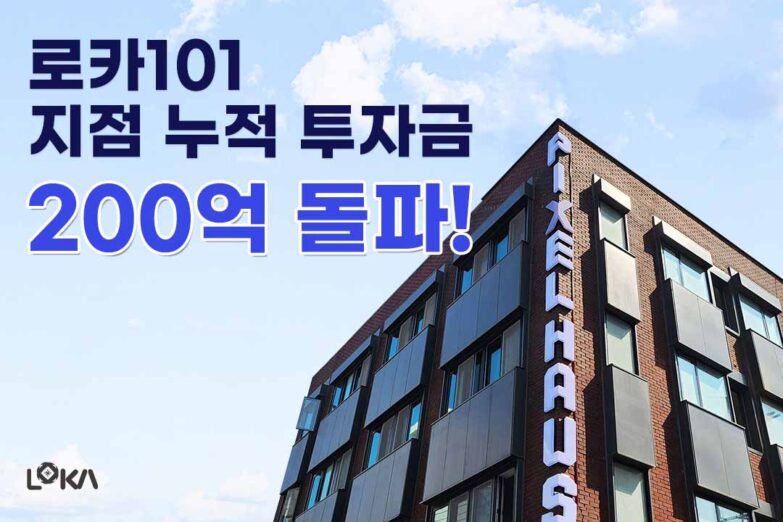
Loca101 (CEO Park Jun-gil), a company that renews small buildings and transforms cities, announced on the 8th that it has surpassed 20 billion won in cumulative investment in branches including franchises and directly-operated stores.
Founded in 2016, real estate proptech company Roca101 develops and operates "PXZ," an AI-based multi-tenant solution for small buildings. This innovative real estate business model, which links the real estate and franchise industries, empowers property owners to maximize their profits through direct management. The company operates approximately 60 "Pixel House" locations, remodeling aging urban buildings into spaces suitable for single-person households. It also maintains and partners with a network of approximately 1,100 real estate-related companies, primarily in the Seoul metropolitan area.
Loca101's growth is rapid. Since the opening of its first Pixel House in February 2020, the number of locations has increased from 15 in 2022 to 35 in 2023 and 50 in 2024. As of October 2025, it operates approximately 60 locations, operating 1,099 rooms in a total space of 5,112 pyeong (16,800 sq ft). Notably, not a single location has closed since its opening, proving its stable business model.
This success was achieved through steady franchise expansion and the continued reinvestment of existing investors after the principal matures. Roca101 offers two main investment models. First, the building owner directly invests, which not only generates monthly rental income but also increases the value of the building, potentially leading to higher sales prices. The second model, where franchisees lease the space and hold operating rights, is ideal for individual investors. Both models offer a "one-stop solution" where the headquarters handles the entire process, including real estate brokerage, permitting, design, construction, and operation, with only capital investment. This approach minimizes the operational burden on investors, generating an average annual return of over 20% without requiring labor.
For a 20-room branch, the initial investment, including deposit and remodeling costs, is approximately 350 to 500 million won. This translates to a monthly net profit of 3 to 8 million won. This translates to an annual yield of 20 to 22%. This figure is five to six times higher than bank deposit rates and four to five times higher than officetel or commercial rental yields. This high return is achieved through the appreciation of undervalued assets and strict cost control.
This profitability is proven by looking at the actual franchisees' cases. While 65% of franchisees started Pixel House as a side job while maintaining their main job, an increasing number are transitioning to it as a full-time business after seeing stable income. Currently, 49% of franchisees are starting Pixel House while maintaining their main job, while 20% are transitioning from a side job to a full-time business. Following this, 12% started as a full-time job from the beginning, 11% started as building owners, and 8% started after retirement. Franchisees' occupations also vary, including company employees (40%), self-employed (20%), building owners (15%), and medical professionals (12%).
Loca101 aims to open 100 locations nationwide next year. In addition to Pixel House, the company plans to expand its hybrid model, "Pixel Stay," which blurs the lines between residential and lodging, to tourist hotspots like Myeongdong, Jongno, and Hongdae. Furthermore, the company is pursuing a strategy of enhancing the building's value through a "multi-tenant system," where the upper floors will house Pixel Houses and the lower floors will house laundry services, a gym, and shared offices tailored to the lifestyles of single-person households.
CEO Park Jun-gil stated, "We will create offline solutions that satisfy investors and users, and ultimately, make cities healthier. We want to become the standard for operating small, privately owned buildings efficiently and transparently."
You must be logged in to post a comment.