



In real estate development, the first step is crucial: what can be built on the land, and what kind of structure will generate profits.
However, judgment was always slow. Legal information was scattered everywhere, and data had to be collected manually. Relying on the experience of a small number of experts, similar mistakes were repeated.
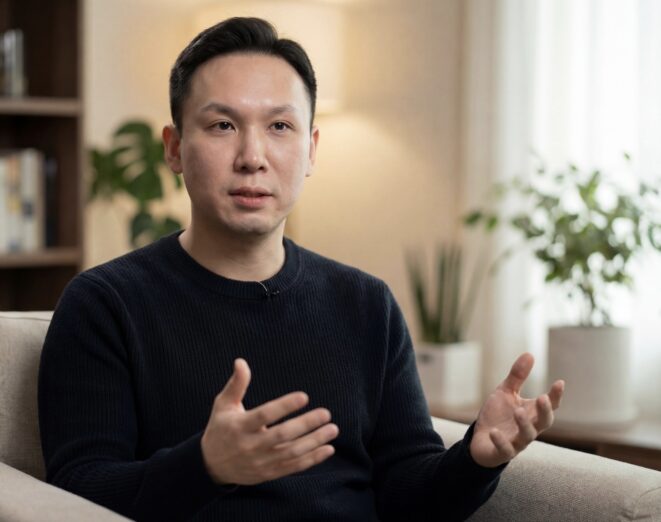
Now, developers and institutions can assess a land's development potential and profitability within two to three minutes. This is happening at a site where "Flexity," an AI-based automated planning, design, and feasibility analysis solution, has been implemented. Planning and design reviews, which used to take weeks, have been reduced to minutes. Real estate development is shifting from experience to data. Leading this shift is Jeon Ju-hyung, CEO of Edit Collective.
Questions posed by the scene
CEO Jeon Ju-hyung began his career as an architect. He studied architecture at the University of Edinburgh and completed his master's degree at the UCL Bartlett School of Architecture. After returning to Korea, he worked at a general architecture firm, participating in the planning and design of urban development projects. However, he was constantly confronted with inefficiency.
"The planning and design process was overly labor-intensive. Important decisions were made early on, but the process was slow and disorganized."
The architect's drawings and the developer's figures described the same building in completely different terms. One side discussed layout and traffic flow, while the other considered sellability and profitability. It took time to reconcile the two, and the final decision was reached in a rushed manner.
"Wouldn't it be more efficient to translate the design flow in an architect's head onto an algorithm and analyze it based on data? That was the starting point."
Initially, I developed the software for personal use. Applying it to actual projects, the review process significantly accelerated. Meeting my co-founder, engineer Bong-cheol Kim, gave me a clear direction: to grow it beyond a tool used only by architects into a service used by the entire real estate market. That's how Flexity began.
3 bottlenecks
The problems with existing planning and design can be summarized into three points.
First, data is fragmented. Maps, building codes, district plans, and market information are all located in different places, requiring research from scratch for each project.
Second, there were limited alternatives to consider. Due to time and personnel limitations, only a small number of scenarios were examined before making a decision.
Third, the languages are different. The design team looks at drawings and floor plans, while the investment team looks at development yields and cash flow. This wastes time coordinating the same project.
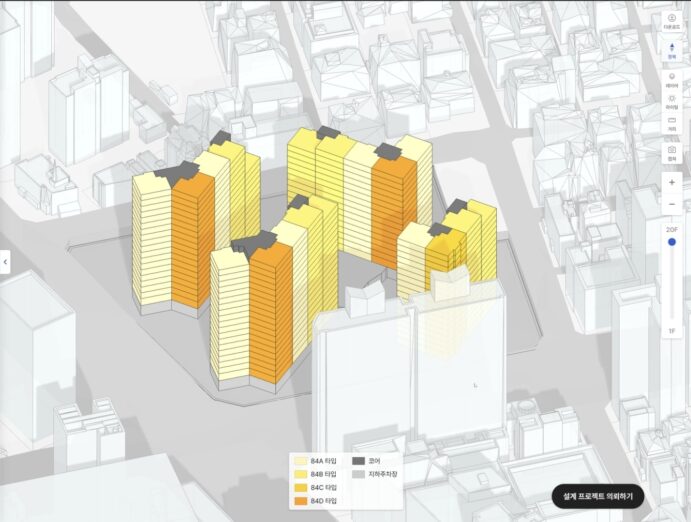
Flexity solves these three problems simultaneously. It integrates land information, building codes, and market data to automatically generate development scenarios and analyze feasibility. Algorithms and AI that reflect the architect's thought process generate multiple 3D design proposals, displaying each proposal on a single screen with 3D models, sales and rental area information, and basic feasibility indicators. This is where the languages of architecture and finance converge.
"We aim to be the 'Bloomberg Terminal' of the real estate development market. For developers, it serves as an early decision engine, for landowners, it serves as a tool for explaining potential value, and for public institutions, it serves as a solution for comparing potential sites."
Since its launch in 2021, Flexity has expanded its client base to include architectural firms, developers, trust companies, asset management companies, and public institutions.
Recently, we launched a specialized solution for small-scale housing maintenance projects, which LH and SH have officially adopted and are using to review potential sites for maintenance projects. This module is designed to automatically generate apartment layout plans and basic feasibility analysis results for individual project sites within two to three minutes. KT Estate, Korea Land Trust, and KAMCO also utilize Flexity for land development feasibility analysis. The changes users are reporting are clear.
Speed has changed. Initial site review has been reduced from weeks to minutes. Risk management has become easier. Quickly comparing multiple scenarios allows for early screening of unprofitable projects. Communication has become simpler. Unlike the past, when drawings, Excel spreadsheets, and reports were circulated separately, stakeholders now see 3D planning and design plans and figures on a single screen for discussion.
A team of 14 and an investment of 5.5 billion won
Edit Collective is a 14-person team, operating on three axes: Product, Architecture, and Business & Operations. Blending the disparate languages of real estate, architecture, and software into a single product proved challenging. Prioritization is based on "problem definition," not functionality. The three teams meet from the beginning to discuss and discuss before beginning development.
The investment amount is 5.5 billion won. Starting with a seed investment from BonAngels, Hashed, Lotte Ventures, and Strong Ventures participated in the Series A round. KT Estate joined as a strategic investor to assess on-site demand. Based on 2025 performance, the company is preparing for the next round early next year.
AI doesn't make decisions for you.
He clearly distinguishes the role of technology.
"Flexity isn't a solution. It's a tool that presents development scenarios based on input from regulations and conditions. The final decision is made by a human."
Market changes, public consultation, and policy risks remain the domain of expert judgment. AI can only quickly present multiple scenarios under complex conditions.
"While repetitive calculations are automated, humans still have the responsibility to prioritize certain values. AI should be used to enhance the quality of decisions, not to lower the level of decision-making."
The goal for the next five years is for Flexity to be responsible for the first phase of new real estate development.
"Whether developers or public institutions, when considering a new project, I want to create a trend where they first open a flexi-center before gathering data."
The final question was: What kind of company do you want to become?
"I don't want to be an AI company that follows trends. In a highly regulated market, it's more important to create 'everyday tools'—to make it difficult to work without them."
An architect who studied architecture in the UK and witnessed inefficiencies in the Korean field is now developing AI solutions adopted by public institutions and large corporations. What is possible in this country?
Scattered data began to converge on a single screen. An architect stood at the starting point of real estate development.
You must be logged in to post a comment.