



– Content expert founder, at the center of the 20 trillion won outdoor market.
– Flywheel strategy proven by Space Eight, Seoul Vibes, OUTSITE, and The Out Studio
2026: Growing alongside outdoor brands. Becoming a leading K-outdoor company.
Running, camping, and trekking are some of the most popular hobbies these days. The domestic camping market has surpassed 10 trillion won, and the number of people who enjoy camping has reached approximately 7 million. Running is also a popular outdoor hobby, with an estimated 10 million runners in Korea alone. What these activities all have in common is that they involve outdoor activities. Outdoor activities are considered healthy hobbies that satisfy both the body and mind. Camping, trekking, and running naturally combine aerobic exercise and strength training, and the natural environment lowers stress hormones and helps restore focus. When enjoyed alone, they provide a time for immersion and organization, while when enjoyed together, they foster connection and build relationships.
In this trend, outdoor activities have transcended mere leisure and become a social phenomenon. However, despite the rapid growth of the market, the supporting structure remains incomplete. Even for those seeking to get started in the outdoors, information is fragmented, including which activities are right for them, where to purchase equipment, where to learn systematically, and how to find a community to join. Ultimately, many people seek out information about outdoor activities in their own unique ways. The problem is that inaccurate information often leads to the purchase of expensive equipment that doesn't fit their needs, or a lack of understanding of safety rules, leading to injuries.
The solution suggested by Clueight is the "flywheel strategy." A flywheel strategy requires significant initial effort, but once it begins to spin, inertia generates sustained energy. Applying this to business, it becomes a model where content, commerce, and community mutually support each other, generating cumulative growth.
When successful, a flywheel strategy can fuel explosive growth for a company. Indeed, companies that have established a flywheel structure have achieved remarkable success in the global market. However, designing and implementing this structure from scratch is a daunting task for a startup. Nevertheless, judging by the current progress of Clueight (hereafter "clueight"), it can be assessed that a significant portion of the strategy has already been implemented.
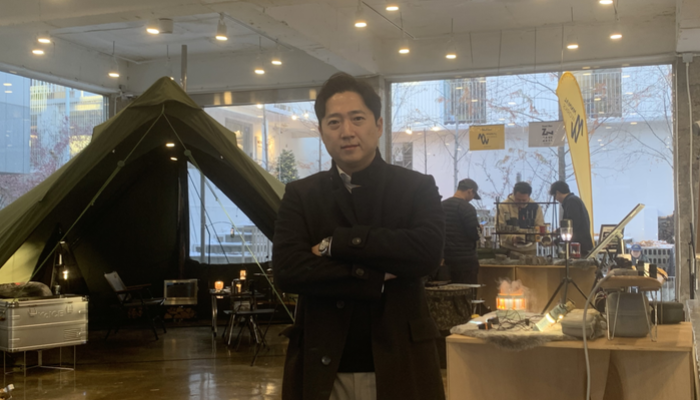
To hear more detailed stories, we met with CEO Jeong Gyeong-min, who is running the outdoor camping pop-up store 'Seoul Vibes' located in Seodaemun-gu, Seoul, and conducted an interview.
■ Why doesn't Korea have a leading outdoor platform?
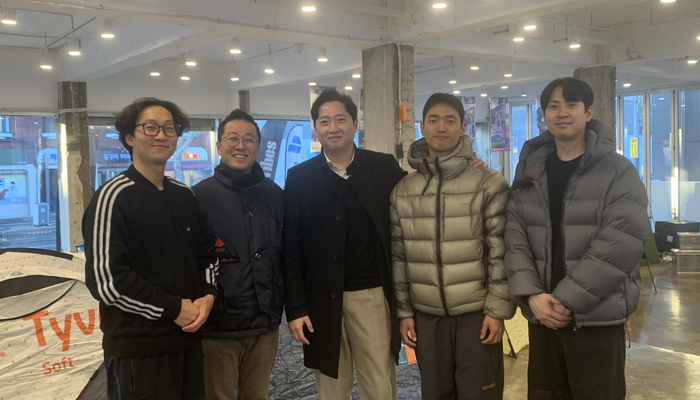
Clueight CEO Jeong Kyung-min's career spans broadcasting and advertising. Starting his career in broadcast production at MBC, he worked as an AE at Cheil Worldwide before joining JTBC as a founding member, gaining extensive experience in program production, annual business planning, and ancillary business planning. Through his time at both broadcasting and advertising agencies, he learned how to attract people through content and accumulate capital through commerce. Jeong said, "I constantly pondered the market where content and commerce could most naturally combine." The answer, however, was surprisingly close at hand. He has been a heavy user of outdoor activities such as camping, backpacking, running, trekking, and snowboarding for 20 years.
As a heavy outdoor user, combined with his practical experience at broadcasting stations and advertising agencies, CEO Jeong's perspective clearly revealed a structural gap in the domestic outdoor market. While the domestic market is worth approximately 20 trillion won, it lacks a "main platform" that drives the entire industry, unlike the US or Japan. Numerous brands and distribution channels are fragmented, but no company has managed to unite them into a virtuous cycle.
CEO Jeong repeatedly asked, "Why isn't there a leading outdoor platform in Korea?" This thought led him to the question, "Why not create one myself?" Because it was an experiment and a challenge difficult to attempt at his previous positions at broadcasting stations or large corporations, he decided to start a business. In April 2021, he founded Clueight with the goal of "providing unique experiences and value to everyday life through creativity." CEO Jeong recalled, "Clueight is a company that combines content and commerce to become a growth engine for the outdoor market. I was able to launch this business by leveraging my extensive experience in broadcasting, advertising, and distribution."
■ Numerous crises experienced after starting the business
CEO Jeong Kyung-min stated, "I resolved to prove my vision through results, rather than just verbally explaining it." The model he envisioned involved content, commerce, and community supporting each other to become a growth engine for the outdoor market. He believed that if this structure worked properly, the company could grow into a leader in the 20 trillion won domestic outdoor market. The vision was sound. However, the process of realizing it in practice proved incredibly challenging. Jeong recalled the period since founding the company, saying, "It's been a continuous process of challenges, crises, and growth."
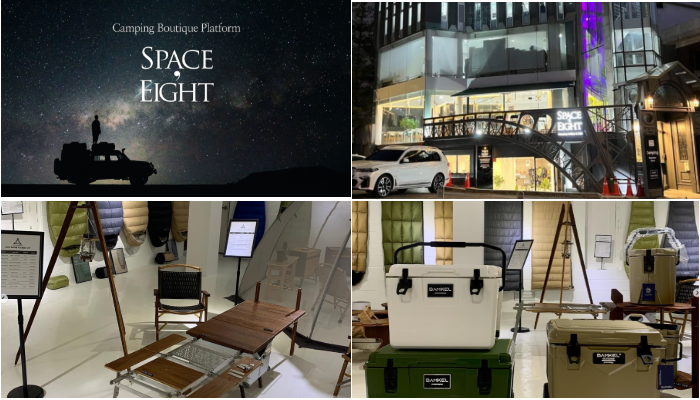
The business began with commerce. Clueight defined all future outdoor services under the brand name "Space 8." To begin, they leased an entire five-story building in Samcheong-dong. This decision, made without external investment, was intended to create an experimental space where brands could freely host pop-ups and directly gauge consumer reactions. While the space was a success, it faced numerous crises. CEO Jeong confessed, "We were scammed several times by those who approached us with the sole purpose of obtaining valuable items." Investment proposals from listed companies and investment firms fell through, and there were repeated attempts to destabilize the company through unclear structures. The aftermath resulted in financial losses and even the need for organizational downsizing. Clueight was on the brink of collapse. Through these crises, it was the outdoor brand partners that had grown alongside Clueight that sustained it.
■ “Partner is a colleague” 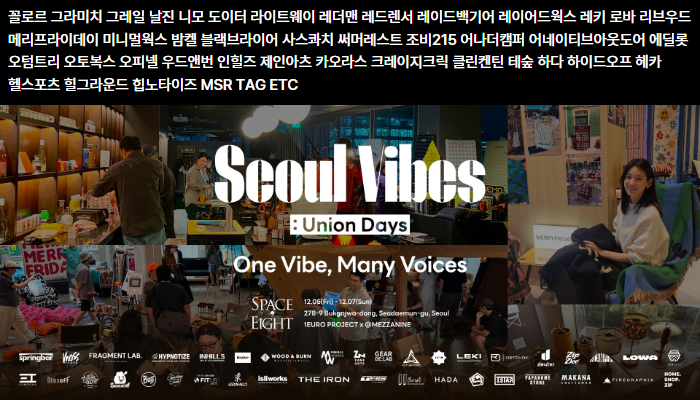
Clueight currently has a consignment sales structure with over 100 outdoor brands. To Clueight, partner brands aren't just vendors or business partners. They're colleagues who are the first to lend a helping hand in times of crisis, and they're the driving force behind the company. CEO Jeong Kyung-min emphasized, "Clueight's partner brands are closer to colleagues than customers," adding, "The power they create together is Clueight's greatest competitive edge."
What sets clueight's partnerships apart is its symbiotic structure. Unlike typical distribution platforms that focus on transactions, clueight views brands as partners who grow together. Indeed, when the company was facing financial difficulties and nearing closure, several partner brands voluntarily launched a discount event for clueight, resulting in 48 million won in online sales in just five minutes. Thanks to these partner brands, clueight overcame the crisis. CEO Jeong stated, "This relationship isn't built on contracts alone. It's the result of trust and the experience of growing together."
■ Clueight's Flywheel Strategy 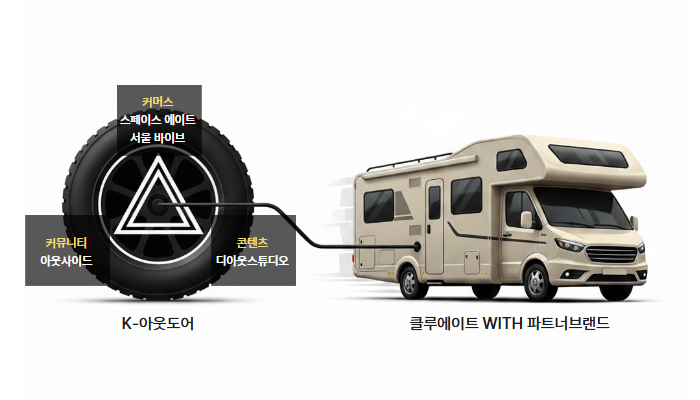
"There's no point in saying you're good at something. Ultimately, I had no choice but to convince with results," said CEO Jeong Kyung-min, reflecting on the past few years. While the domestic outdoor market is worth approximately 20 trillion won, CEO Jeong believes, "Korea still has no first, second, or third place." While major players in the US and Japan have integrated experiences, commerce, and communities on a nationwide basis, the domestic market remains fragmented. Large-scale exhibitions and fairs remain stuck in the traditional model of explaining and displaying products, and while online shopping malls are powerful purchasing channels, their integration with experiences and communities is relatively weak. As a result, outdoor brands and distributors, each with their own competitive edge and unique identity, are scattered without a central hub to connect them. CEO Jeong sees this structural gap as his greatest opportunity.
Clueight's core strategy is the "Flywheel." CEO Jeong Kyung-min believes that the growth engine of the outdoor market lies in the organic growth of content, commerce, and community. People naturally gather through content, and the resulting interest leads to commerce. Through this process, learning and interaction accumulate, fostering a community. This accumulated experience and data then feeds back into new content, reinforcing the structure. As this cycle repeats, the market gains the power to grow beyond mere transactions. CEO Jeong emphasized, "Once the outdoor flywheel begins to turn properly, it generates a powerful energy that is difficult to predict at what speed and scale it will expand." This is why Clueight prioritizes short-term results over building a virtuous cycle by simultaneously building content, commerce, and community.
■ Commerce. A space for observation and verification.
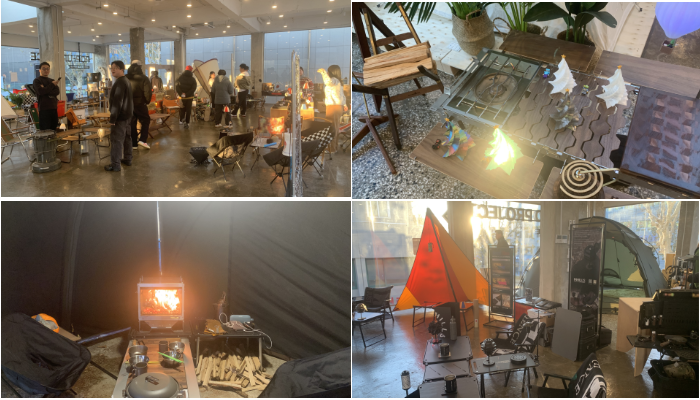
Clueight's starting point was commerce. To create an ecosystem where content and community function organically, we believed it was necessary to first establish trust with brands and verify the proper functioning of distribution. Distribution experiments, firsthand, were crucial to understanding how brands and consumers interact and react. Space 8 is also the collective name for all of Clueight's current services. If we narrow it down to the Samcheong-dong building, we can say it's a space where pop-ups can be freely hosted. Initially, Space 8 primarily housed one-person brands, garage brands, and domestic importers of renowned international brands, rather than large brands. While these teams lacked the capacity to operate permanent stores, they possessed a strong commitment to their products and philosophies. Clueight provided these teams with not only space but also content creation, pop-up planning, and exhibition staging, all at virtually no cost.
During this process, one key criterion emerged: "Does it sell well?" rather than "Does it convince and persuade users?" Data was collected on-site to determine which products kept people lingering, which descriptions prompted questions, and which brands led to repeat visits. Space 8 served as an observation space for commerce design. However, Space 8 alone had its limitations. The platform needed to expand to central Seoul. A structure was needed that allowed more brands and users to connect simultaneously, rather than confined to a limited space. This is how "Seoul Vibes" was born.
Seoul Vibes is a short-term outdoor pop-up. It takes a completely different approach from existing large-scale fairs. While typical fairs are more like real estate businesses, selling zones by dividing the space, Seoul Vibes starts with brand selection. The criteria for participation are clear: whether the customer service has been sufficiently proven, whether the originality is clear, and whether the event has a compelling narrative that can be communicated to users. Those who fail to meet these criteria are excluded. As a result, Seoul Vibes brings together brands not easily found in offline stores, limited-edition products, and teams with distinct brand philosophies.
This is why Seoul Vibes insists on short-term pop-ups. Long-term, month-long pop-ups struggle to generate excitement for both users and brands. On the other hand, "three-day events" maximize engagement. The premise of offering products and brands that can only be found now drives commerce density. Focusing all resources on short, impactful events ensures both brand success and clear results. Seoul Vibes consistently achieves high turnover and customer satisfaction through this structure.
Celebrities also flock to Seoul Vibes. They aren't simply promotional models who show up; they are content creators and participants in the experience. Within the compressed timeframe of a short-term pop-up, the process of experiencing and learning about the brand, equipment, and people becomes content itself. It's not a staged event; the very act of participation creates a story. Official participation in Seoul Vibes goes beyond mere exposure and serves as a form of validation, revealing the celebrity's tastes and attitudes. While clueight also operates an online commerce platform, it doesn't prioritize it. This is because they believe distribution is not the starting point, but the outcome. Clueight's commerce strategy is to observe at Space 8, verify at Seoul Vibes, and then expand to various platforms.
■ Community Outdoor Education and Experience Program 'OUTSITE'
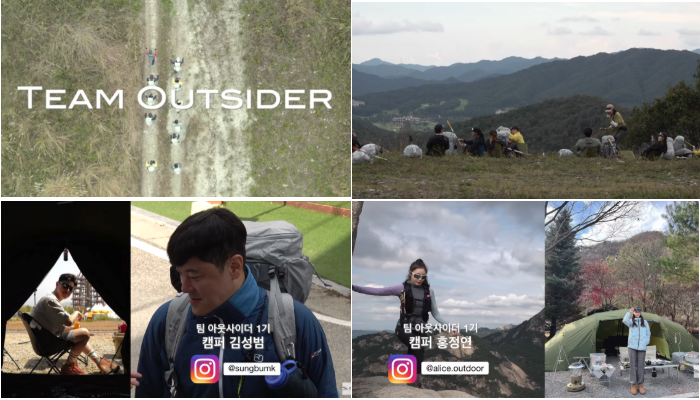
Clueight operates "OUTSITE," an educational and experiential program. This paid outdoor education program takes place at various outdoor locations. Clueight utilizes diverse spaces as educational venues, including the 3.4 million pyeong (approximately 11.5 million square feet) Oak Valley site, the Homes Red Hotel near Namsan Mountain, and a running and trail running school utilizing trails. What these locations have in common is a focus on nature over facilities, as the outdoors industry doesn't require large-scale facilities. With a minimal management building, programs can be implemented for activities like kayaking and fishing on rivers, trekking and climbing in the mountains, and camping and backpacking in the forest.
Representative Jeong emphasizes, "The problem isn't space, but management and education." He explains that the reason many natural spaces have been closed until now was due to concerns that people might misuse them. If sophisticated educational programs and content are combined, nature can be transformed from an object of control to a place for learning and experience, and even a tourism resource. At this point, OUTSITE becomes a community that breathes together with celebrities. Outdoor experts and those seeking to learn about the outdoors come together as the main actors in education and experience. Celebrities lead the program based on their expertise and experience, and the real-life experiences created during the process become a narrative that naturally expands into broadcasts, social media, and personal branding.
The real-life experiences created by the invited celebrities were then spread as content, leading to a voluntary flow of participation from other celebrities and creators. Currently, Clueight manages or connects with approximately 100 celebrities directly, most of whom share a common characteristic: they are heavy users deeply immersed in outdoor activities, not mere exposure. This virtuous cycle was further strengthened by the network of CEO Jeong, who has extensive broadcasting experience.
Outdoor content production 'D-Out Studio'
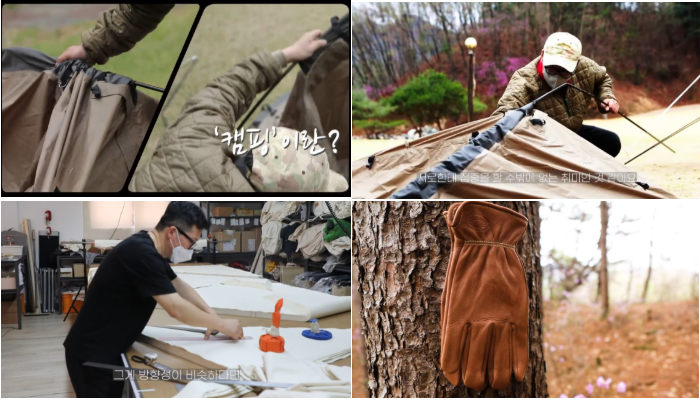
CEO Jeong knows better than anyone that content has the power to bring people together. Clueight operates "Deeout Studio," a content creation studio. While it's a lean structure, with CEO Jeong and a small team handling filming and appearances, they leverage their expertise from the broadcasting and advertising industries to create high-quality content. This content then fuels community growth by promoting events, educational programs, and participating brands. Clueight's content differs from typical marketing videos or promotional materials. CEO Jeong defines "education" as the core of outdoor content. He explained that Deeout Studio's content strategy began with the question, "Health, yoga, and personal training can be learned anywhere for a fee, so why isn't there a systematic learning system for the outdoors?"
Indeed, looking at the domestic outdoor environment, aside from skiing and some water sports, there's virtually no educational infrastructure for systematic learning about backpacking, trekking, and trail running. This gap quickly leads to danger. Repeated incidents of illegal camping and accidents stemming from insufficient knowledge or improper equipment use lead to mountaineering. CEO Jeong points out, "The outdoors is the only area where education is lacking." Clueight's content is less about well-shot videos and more about accessible explanations. It leverages the power of broadcasting to convey information and immerse viewers, calmly unraveling the structure, risks, and proper approaches to outdoor activities. CEO Jeong emphasizes, "Understanding comes before entertainment in outdoor content."
The cast's roles also differ from those of traditional broadcasts. Celebrities and influencers appearing on the show aren't MCs or panelists, but "participants." The process of learning from a previous experience and developing a deeper understanding through trial and error becomes the content itself. This structure encourages viewers to empathize with celebrities by projecting themselves onto them rather than viewing them as objects of admiration. Scenes where celebrities interact with instructors, local guides, and brand experts foster a sense of trust, believing, "They're learning, too."
■ “The structure is proven, now it’s time to scale.”

"The structure is proven, now we build scale." This is how Clueight defines its vision for 2026. Since its founding in 2021, Clueight has proven the effectiveness of its business structure before capital. Without large-scale investment, it has operated a variety of services and built a network of over 100 outdoor brands. 2026 is set as the first year to fully expand and accelerate this structure.
To ensure the stable operation of this structure, clueight is preparing to secure a Series A investment in 2026. This funding will not be used to validate the idea, but rather to fuel the expansion of the already operational system. Since content, commerce, and community should operate organically rather than independently, the Series A investment will focus on expanding human resources, improving operations, and building the technological infrastructure to support this. With this investment, clueight plans to further solidify the structure of each flywheel.
Seoul Vibes is evolving from an event-centric structure to a platform. Clueight aims to develop it into a regular platform representing the Asian outdoors scene. Rather than expanding regionally, the strategy is to maintain a fixed Seoul location and establish Seoul as a central hub for Asian outdoor activities. While the basic structure of celebrities, influencers, brands, and users participating in their respective roles will be maintained, the brand selection criteria will be more stringent. Simultaneously, the educational and experiential program "OUTSITE" will expand nationwide, standardizing the outdoors as a "learnable activity" based on Oak Valley, Namsan, regional resorts, and idle spaces. Starting in 2026, the content will expand beyond a simple promotional tool to a long-term IP. A seasonal content structure is also in development, spanning from beginners to intermediate users, and eventually to global outdoor experiences. After Series A, the strategy is to standardize production methods to ensure both content production and repeatability.
CEO Jeong explains this vision with a simple calculation: "If there are 100 brands, each with annual sales of 1 to 20 billion won, then generating just 100 million won in transactions per brand annually would generate 10 billion won." This model doesn't rely on a single event or hit product. It's a collective growth structure that naturally grows as the network expands.
■ To the center of K-outdoor
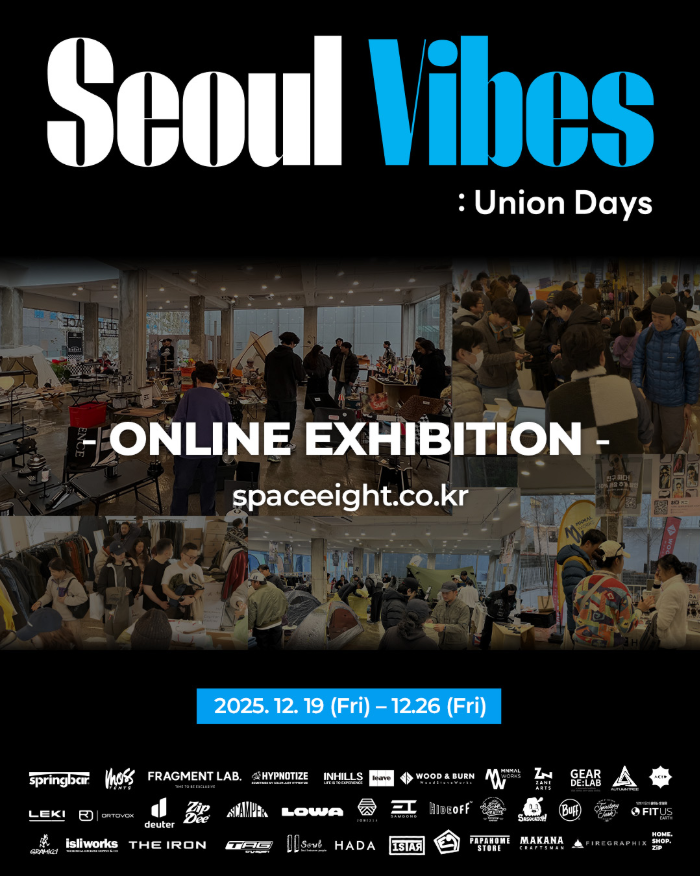
Clueight successfully concluded the outdoor fair "Seoul Vibes" on December 5, 2025. The company is currently hosting an online exhibition of Seoul Vibes for campers unable to attend in person. Participation in the exhibition can be found on the official Space Eight website (https://spaceeight.co.kr/).
Clueight's ultimate vision is to stand at the center of the K-outdoor trend. The plan is to establish Korea as a hub for Asian outdoor activities, establish Seoul as a hub for leading outdoor shows and fairs, and then connect the nation with a nationwide network of education and experiences, establishing a global node connecting to overseas platforms. CEO Jeong explains this vision by linking it to Korea's unique geography. "Korea is a rare country in the world where mountains, sea, rivers, and four distinct seasons are all within a short distance. We want to leverage this environment through content and education to create a new market called 'K-outdoor.'"
The structure for becoming the center of the K-outdoor ecosystem has been proven, and the remaining challenge is scale. Soon, people from all over the world will flock to Seoul to learn about and experience "K-outdoor"—a common sight. Through Clueight's vision, we look forward to a future where K-outdoor establishes itself as a leading force in the global market.
You must be logged in to post a comment.