

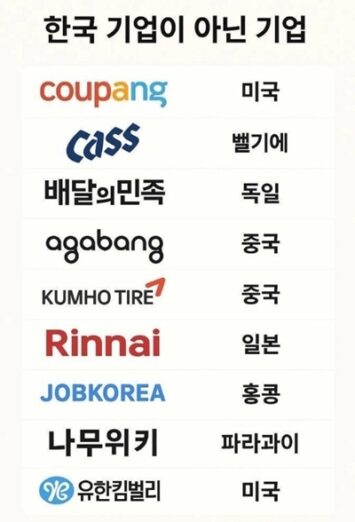
Coupang is facing public criticism for its personal information leak. With the company's founder, Chairman Kim Beom-seok, facing questions about his attitude, netizens are creating a list of companies they thought were Korean but are actually owned by foreigners.
From the coffee we drink every day, to the burgers we eat for lunch, to the delivery boxes we order on our way home from work—the familiar brands that dominate the daily lives of Korean consumers are, in fact, owned by "foreigners," leaving netizens feeling bitter.
Currently, foreign capital dominance in Korea's core domestic industries, such as food and beverage, distribution, and IT, is at an all-time high. Since the 1997 Asian financial crisis, a borderless capital war has intensified. Criticisms of foreign companies disguised as Korean companies monopolizing market profits have clashed with defenses of the natural flow of global investment. Recently, capital flows have reached another turning point. These include not only the overseas sale of Korean companies, but also Coupang, a foreign company founded from the beginning with a focus on the Korean domestic market; the recent scandal of Singapore's Qoo10, which caused problems through a reckless merger and acquisition; and Homeplus, run by a Korean-born foreigner known as the "black-haired foreigner." These cases, among others, have drawn attention to disputes stemming from the raiding of Korean companies.
For example, McDonald's Korea left its US headquarters after 38 years and is now under the wing of Qatari capitalist Kamal Al Mana. Burger King, also controlled by Hong Kong-based private equity firm Affinity Equity Partners, is eyeing an exit. Domestic chicken powerhouse BHC and coffee franchise Twosome Place are also under the control of US-based private equity firms MBK Partners and Carlyle Group, respectively. Job Korea, which acquired Albamon, is wholly owned by a Hong Kong-based private equity firm and an Australian global recruiting firm. Kumho Tire's largest shareholder is China's Doublestar, with a 45% stake.
In the distribution market, Coupang is effectively an American company with its Delaware-based parent company, listed on the New York Stock Exchange. Meanwhile, the leading delivery app, Baedal Minjok, is 99% owned by Germany's Delivery Hero (DH). Even Yogiyo, the third-largest delivery app, is 70% owned by British and Hong Kong investors. In Korea, the delivery industry is comprised of more than 90% foreign-owned companies.
Strengthening capital dependence and low domestic capital dynamism are also contributing factors.
This encroachment of foreign capital into the domestic market attests to the "openness" of the Korean economy, but also reveals a serious "capital dependence." In particular, in the food and beverage market, dominated by private equity funds (PEFs), there are persistent criticisms that excessive price increases and cost reductions aimed at achieving short-term profits are leading to a decline in consumer welfare.
The IT platform sector is embroiled in a heated debate over tax evasion. Analysts suggest that not only big tech companies like Google and Netflix, but also some foreign distribution companies are using the legal guise of limited liability companies to increase their cost of sales or maximize dividends, thereby evading Korean tax burdens. Meanwhile, in the automobile industry, Tesla is targeting the Korean market with its autonomous driving data and artificial intelligence (AI) technology. The global autonomous driving market is experiencing a surge in investment in AI-based mobility as competition for the commercialization of robotaxis intensifies by 2025. Meanwhile, in Korea, restrictions on the activities of domestic companies, such as the Tada ban, have been strengthening.
On the other hand, there are also positive reviews. Citing the case of Asung Daiso, an industry insider said, "Acquiring all Japanese shares and transforming into a 100% Korean company is a rare feat that has bolstered the pride of domestic capital."
The growing influence of foreign capital is an unstoppable trend, but the cases of Asung Daiso and Timon (acquired by Oasis), which achieved "national reintegration" amidst this trend, are instructive. Ultimately, this underscores the need to overcome the lack of dynamism and regressive trading practices in the domestic capital market.
Only when domestic capital moves beyond a mere defensive stance and presents a transparent governance structure and long-term investment vision aligned with global standards can the "uneven playing field" be rectified. Unless information transforms into a creator of a fair environment, consumers into wise watchdogs, and companies into responsible actors, the Korean domestic market may forever remain an ATM for outsiders.
You must be logged in to post a comment.