



Screening for mild cognitive impairment is as simple as answering a few questions… Easy diagnosis anytime, anywhere.
-This year, Bucheon City and 12% of the suspected dementia patients were screened.
Designated as an innovative medical device last month… to be distributed to medical institutions starting next year.
According to the Ministry of Health and Welfare's 2023 Dementia Epidemiology Survey, the prevalence of dementia among those aged 65 and older in 2023 was 9.25%, and the prevalence of mild cognitive impairment was 28.42%. Based on the 2025 population, the number of dementia patients is projected to reach 970,000 and the number of mild cognitive impairment patients to reach 2.98 million. The number of mild cognitive impairment patients is projected to reach 4 million by 2033.
Mild cognitive impairment (MCI) refers to a cognitive condition that falls between normal aging and dementia. This condition manifests as a marked decline in memory and other cognitive functions, as evidenced by objective tests. However, the ability to perform daily activities is preserved, precluding a diagnosis of dementia. Mild cognitive impairment (MCI) is clinically significant because it represents the earliest stage of dementia detection, maximizing the effectiveness of treatment.
In Korea, seniors aged 60 and older can receive free dementia screening at Dementia Care Centers. If the screening results indicate a suspected cognitive decline, they undergo diagnostic and differential testing at a hospital affiliated with the center. However, if diagnosed with mild cognitive impairment, they must undergo annual testing to determine whether they are progressing to dementia or recovering to normal levels. Currently, the Mini-Mental State Examination (MMSE), the most widely used primary dementia screening tool worldwide, is a paper-based test with low screening accuracy.
The cost of testing is also a burden. Accurate diagnosis requires a comprehensive approach, including clinical evaluation, cognitive function testing, imaging, and blood tests, which makes diagnostic costs substantial. Consequently, it takes an average of 3.52 years from the onset of dementia symptoms to diagnosis. According to a 2023 survey by the Ministry of Health and Welfare, the annual cost of managing dementia patients was 17.339 million won for community-dwelling patients and 31.382 million won for patients residing in facilities or hospitals.
One company is using AI technology to prevent millions of seniors from falling into the swamp of dementia. Able Therapeutics is the developer of "Spick," a voice-based dementia diagnosis solution.
Able Therapeutics is currently conducting various proof-of-concept (PoC) projects. It is currently working with a global home appliance company to integrate Speak into TVs, and is also exploring ways to utilize Speak in the insurance underwriting process with an insurance company. This year, Able Therapeutics was selected by SKT as an ESG Korea, recognizing its status as a company that combines social value and technological innovation. Able Therapeutics has so far raised KRW 800 million in funding and is currently raising pre-A round funding.
We met with Hyungjun Kim, CEO of Able Therapeutics, to learn about Speak's market entry and Able Therapeutics' blueprint, from its innovative approach of voice-based cognitive assessment to clinical validation and innovative medical device designation.

Speak identifies 12% of suspected dementia patients
Able Therapeutics conducted a meaningful project this year. In collaboration with Bucheon City, we conducted AI-based screenings for approximately 3,000 seniors. Those classified as suspected of cognitive decline after the initial, abbreviated, AI-based screening were referred to the second-stage screening at administrative welfare centers. Including the standardized, app-based screening, the two-stage screening resulted in approximately 370 individuals (12%) being identified as suspected of cognitive decline. Some of these individuals were referred to the Dementia Care Center for further testing.
Early detection of dementia can save enormous healthcare costs. It serves as a model for how medical technology should be integrated with public policy in a hyper-aging society.
"This is an example of how our solution achieved social value. Above all, by simultaneously performing and screening a large number of tests using AI Call, we were able to save on administrative costs."
Reading the brain with voice data
So how can we screen for mild cognitive impairment by voice?
The voices of patients with mild cognitive impairment or early-stage dementia exhibit subtle changes. Dozens of vocal characteristics change, including speech rate, vocal tremors, changes in vocal intensity, and spacing between syllables. Speak quantifies the differences in the voices produced by healthy and damaged brains. "The AI algorithm detects subtle changes that are difficult for humans to detect," explained CEO Kim. "These subtle changes accumulate to produce results." Accessibility is key. Speak can be tested anytime, anywhere, using just a mobile device like a smartphone or tablet.
"Speak is very simple. You answer about ten questions we present, and an algorithm analyzes your voice and displays the results instantly. It takes about 10 to 15 minutes."
The core of Speak lies in spectral imaging of voice data and a deep learning algorithm. This method converts the user's voice into a visual image through frequency analysis, then compares it to learned patterns. To achieve this, Able Therapeutics trained the algorithm on 12,500 samples of elderly voice data.
Because Speak converts voice into images and then recognizes patterns, it can quickly develop foreign language versions without redesigning the algorithm for each language. Able Therapeutics' Chinese version, currently under development in Taiwan, also uses the same algorithm as the Korean version, highlighting Speak's strong potential for global expansion.
Designated as an innovative medical device
Since the end of last year, Speak has been offering its healthcare version in approximately 200 daycare centers, nursing homes, and senior centers. The healthcare version is available through various channels, including mobile apps, the web, and AI calls.
Able Therapeutics successfully completed a confirmatory clinical trial this year involving 399 subjects. In the combined "abnormal" identification of patients with mild cognitive impairment and dementia, Speak showed a sensitivity of 85.7%, which is the probability of accurately diagnosing a person with an actual disease as having the disease (sensitivity for mild cognitive impairment: 79.6%, sensitivity for dementia: 92.0%). Sensitivity refers to the probability of diagnosing a person with an actual disease as having the disease, meaning that it is 85.7% accurate compared to a doctor's final diagnosis. Compared to the MMSE-2, Speak's sensitivity for mild cognitive impairment (79.6%) was 17% higher than that of the MMSE-2 (62.7%). In addition, the specificity of correctly classifying normal people as normal was 74.3%.
Based on these results, Speak was designated as an "Innovative Medical Device" by the Ministry of Food and Drug Safety in November of last year. Once Speak receives medical device certification from the MFDS, it will be able to provide services to hospitals.
Development of LLM and biomarkers for screening for mild cognitive impairment
Able Therapeutics has been conducting joint research with MIT Media Lab in the United States since April to develop a new algorithm based on LLM (Large Language Model), and has also started research with JAIST (Japan Advanced Institute of Science and Technology), a national graduate school in Japan.
Speak plans to add "drawing" and "eye tracking" technologies in the future. Drawing allows for analysis of not only the characteristics of the drawing, but also pen speed, tremors, and airborne time. Eye movement is also an important biomarker for screening for mild cognitive impairment. The time spent fixating on a specific area of the screen, the speed of gaze movement, and gaze patterns all reflect cognitive function. Combining these three biomarkers—voice, drawing, and eye tracking—can significantly improve diagnostic accuracy. The integration of multimodal biomarkers is expected to be completed by the end of next year.
A solution for diagnosing and treating depression in children and adolescents is also being developed, with a launch scheduled for 2027. A cognitive motor training program is also under development. A 12-week clinical trial involving 66 patients with mild cognitive impairment demonstrated an 11.7% cognitive improvement. These results were published in the Journal of the Korean Neuropsychiatric Association in June.
"The capabilities we've gained through research on childhood and adolescent depression can be extended to address depression in older adults and young people. In particular, since depression is the most common behavioral and psychological symptom (BPSD) in dementia patients, this technology will become a crucial part of dementia management."
We are also working with air purifying robot manufacturers to equip their robots with Speak.
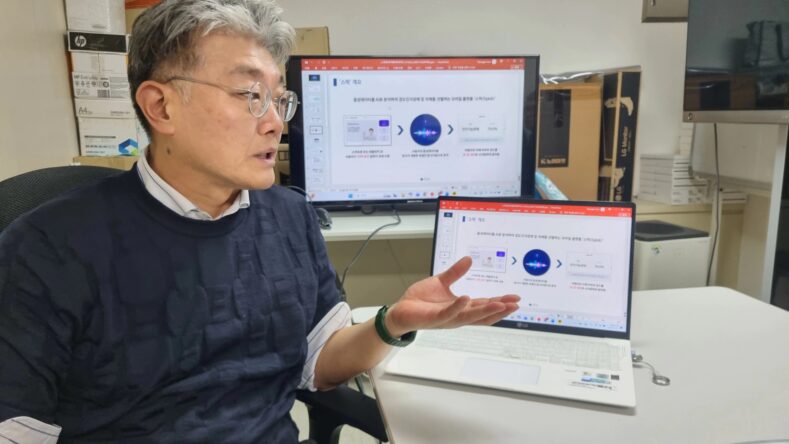
"While our company is a for-profit entity, we believe contributing to society is just as important as making money. Through digital and AI-based healthcare, we aim to create an environment where everyone—the elderly, the socially disadvantaged, the medically vulnerable, and those with low incomes—can easily access and manage their own care."
In a hyper-aging society, health inequality is a pressing social issue. While those with financial means have access to the latest medical technologies, those in vulnerable groups struggle to access even basic healthcare. Speak is an attempt to reduce this inequality.
The idea of early detection of dementia with just a few words is simple, but making it a reality required a massive amount of voice data, countless clinical trials, and, above all, a commitment to reducing healthcare inequalities in a super-aging society.
Able Therapeutics' ultimate goal is to create a world where everyone can easily manage mental and neurological disorders, including cognitive health, using AI and digital technologies.
Going forward, Speak will become a tool for maintaining cognitive health. Creating an era of cognitive health accessible to everyone will be Able Therapeutics' next chapter.
You must be logged in to post a comment.