



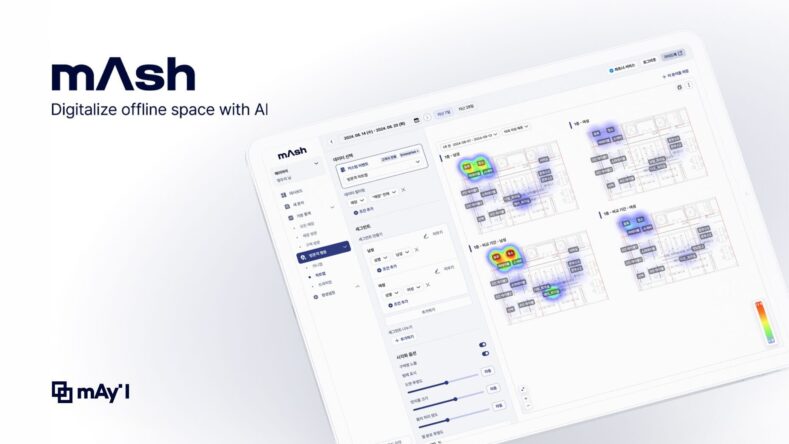
"Offline Google Analytics," Mayi, revolutionizes retail with mAsh , a CCTV-based AI analytics solution.
Diagnosing sales bottlenecks through funnel and factor analysis, achieving a 90% contract renewal rate.
-Selected as a TechCrunch Startup Battlefield 200, the company is actively targeting the global market.

“Data analysis, once taken for granted online, is now available offline as well.”
The retail industry remains centered around offline stores. However, much of store operation relies on experience and intuition. While online conversion rates, from clicks to payments, are quantifiable, offline it's difficult to determine how long customers stay and where they leave. A startup has emerged to fill this void. mAy-I, an AI video analytics company, developed mAsh, a solution that uses existing CCTV footage to track visitor movements and conversion rates, proving offline store performance with data. CEO Kim Chan-gyu stated, "We will usher in an era where offline stores are operated based on data, much like Google Analytics is for online stores."
May.I's origins were unexpected. The founding team, having previously planned offline events, recognized the lack of a way to prove success. Data from existing counters and Wi-Fi sensors was inaccurate, and the cost of employing consultants to analyze movement patterns was prohibitive. Realizing these limitations, the team realized that offline events, like online ones, needed to be explained with data. Building on the ideas of an AI specialist within the team, three co-founders—the CEO, CTO, and lead researcher—joined, launching May.I. Each of them leveraged their expertise to solve technical challenges, laying the foundation for the company, which has now grown to approximately 40 employees.
Offline Stores Use CCTV Data to Understand Customer Journeys
There are three main reasons why clients choose Mayi. First, it offers zero-installation implementation. Existing counters or sensor-based solutions require installation and wiring, resulting in significant costs and time. In contrast, mAsh utilizes existing CCTV cameras installed in the store, eliminating the need for additional equipment or construction. This minimizes installation overhead while providing immediate data acquisition, resulting in high customer satisfaction. Second, it offers deep learning-based accuracy. Unlike existing methods that simply count movement through the entrance, mAsh precisely identifies objects in the video, distinguishing between employees and actual visitors. This significantly overcomes the limitations of existing counters, which typically offer 70-80% accuracy, providing highly reliable data tailored to the store's specific needs. Third, it provides individual movement data. Beyond simply counting visitors, it tracks their journey from entry, experience, and exit, revealing where customers spend the most time and where they lose interest and leave. This goes beyond simple numbers and provides practical insights for developing store strategies.
May.I's analytical system can be summarized as funnel analysis and factor analysis. Funnel analysis demonstrates the customer journey, from foot traffic, entry, experience, consultation, and purchase, with conversion rates at each stage. It goes beyond simply reporting a decline in sales and allows for a specific diagnosis of whether the cause is a "decline in visitors," a "disengagement from the experience stage," or a "sluggish transition from consultation to purchase." It serves as a powerful tool for executives and store managers, identifying bottlenecks in sales declines and suggesting improvement strategies. Factor analysis goes a step further, quantitatively inferring the impact of internal and external variables, such as visitor gender and age, visit time, weather, promotions, and surrounding commercial areas, on KPIs. Moving beyond marketing reliant on intuition and guesswork, it provides data-driven answers to questions like, "How does sales change when the dwell time of female customers in their 20s increases?" This provides practical assistance in efficiently allocating limited resources and developing optimal targeting strategies.
Recently, demand for short-term events like pop-up stores and exhibitions is rapidly increasing. For events that prioritize brand experience, gathering visitor satisfaction and traffic data can go beyond simple performance reporting and yield improvements that can be immediately applied in the next planning stage. CEO Kim Chan-gyu emphasizes, "Data doesn't just determine what went well or poorly; it serves as a compass that indicates what needs to be strengthened and what needs to be changed."

From data verification to security, Mayi's trust strategy
Mayi's technology has already been proven in various fields. A major domestic entertainment chain A/B tested the effectiveness of pre-screening events, increasing ad viewership by over 16 percent. This data served as objective evidence for determining ad rates. A global automobile brand's pop-up store analyzed the effectiveness of its experiential space and visitor satisfaction, influencing future pop-up strategies. Furthermore, a successful online retailer optimized its strategy for offline stores by validating its kiosk and photo zone traffic patterns with data.
In this way, funnel analysis and factor analysis have become tools that go beyond simply recording data, identifying bottlenecks in store operations and suggesting improvement directions based on visitor experience. While clients in the past often responded, "I don't know how to utilize the data," now project managers and data analysts are involved from the initial stages, designing customized interpretations and utilization plans together. This support structure has resulted in high client satisfaction, and this year's contract renewal rate is approximately 90 percent. CEO Kim Chan-gyu emphasizes the process by which data translates into actual results, stating, "No matter how sophisticated the technology, it is meaningless if it doesn't lead to actionable solutions in the field."
Security is also a core principle for May.i. During the analysis process, only pseudonymized data, such as gender, age, and dwell time, is stored, and the original video is immediately deleted. Furthermore, edge computing has been adopted to enhance security by preventing video footage from leaving the store. This process complies with the EU's General Data Protection Regulation (GDPR), the most stringent international privacy standards, and has been proven reliable enough to be tested in actual overseas stores. May.i's unique competitive edge lies in its comprehensive system, which goes beyond simply enhancing data accuracy and encompasses the entire process of utilization, support, and security.
Fueling growth through global expansion and industry diversification
May.i's expansion strategy is three-pronged. First, it is expanding into overseas markets. It is pursuing partnerships and demonstration projects in key locations such as Europe, Japan, the US, and Southeast Asia, with tangible results in Japan targeted for the second half of this year and early next year. Exploring overseas markets goes beyond simply increasing sales; it aims to establish data analysis standards applicable to the global retail environment. In this regard, May.i has recently garnered attention on the global stage. In August, it was selected for Startup Battlefield 200, a global startup competition hosted by TechCrunch, securing the opportunity to pitch in the US in late October. This represents official recognition of its technological prowess and growth potential from global investors and industry insiders. Second, it is expanding its industry portfolio. Beyond retail, it is expanding its technology into safety and security, developing congestion management and abnormal behavior detection modules, with the goal of commercialization by 2026. This could open up new opportunities in disaster safety, large-scale facility operation, and industrial site management. The third goal is to enter the small and medium-sized retail market. The plan is to bridge the digital divide across the offline industry by streamlining and distributing analytical templates proven in large corporations to smaller stores like neighborhood stores and franchises.
Having secured 6 billion won in Series A funding from Samsung Venture Investment and others late last year, May.I is currently preparing for its Series B round. The goals of this round are to accelerate overseas expansion, secure profitability, and improve its structure for a future IPO. Specifically, the company is focusing on optimizing server costs and improving cloud infrastructure efficiency to create a stable revenue structure. It is also accelerating the development of local networks and partnerships necessary for global expansion.
CEO Kim Chan-gyu emphasizes, "Startups must find what customers truly want, even amidst uncertainty," and "Offline will soon become a world driven by data." May.i defines itself as "Google Analytics for offline," and is filling the gaps in the retail industry with data. The moment intuition in store operations is transformed into numbers, the offline industry's paradigm is already shifting, and May.i stands at the center of this transformation.
You must be logged in to post a comment.