


LaonSecure concluded the '2025 Secure Up & Hackathon' by presenting a vision of data sovereignty and a hyper-connected society through the convergence of the Web3 ecosystem and AI.
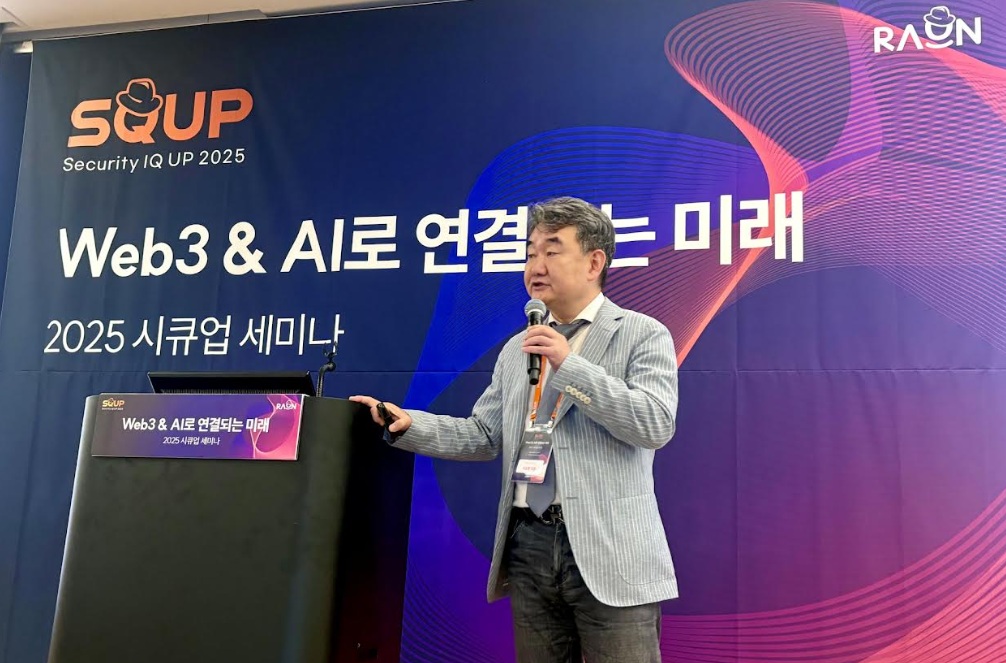
IT security and authentication platform company Laonsecure (CEO Lee Soon-hyung, Lee Jeong-ah, 042510) concluded the "2025 SecureUp & Hackathon," held on the 23rd at COEX in Seoul under the theme of "The Future Connected by Web3 and AI." This event was the largest ever, with a large number of domestic and international security and authentication industry experts, academics, and industry representatives in attendance.
At the 13th annual SecureUp seminar, RaonSecure shared the new changes and development directions for the information security industry brought about by the convergence of Web3 and AI technologies.
In his opening remarks, Lee Soon-hyung, CEO of Raonsecure, emphasized, "Data sovereignty is a fundamental human right in the digital society, and it is essential to establish a digital identity infrastructure that encompasses the entire life cycle, from birth to old age." He continued, "Web3 plays a role in alleviating concerns about AI's monopoly on big data and misuse and completing a trust-based framework. AI complements Web3 in a decentralized environment, enabling rational and autonomous decision-making. They are mutually complementary." He added, "The convergence of these two technologies will create a new trust system and social value."
At the event, Laonsecure also unveiled its roadmap for its Web3 and AI-based hyper-connected platform service. The company plans to expand the Web3 ecosystem based on blockchain-based digital authentication technology and contribute to the advancement of the information security industry through security and authentication services that combine integrated information protection solutions with AI technology.
To this end, the company presented a future-oriented, hyper-connected platform that transcends online and offline, and the metaverse's time and space, including a Web3 token economy platform featuring NFTs and stablecoins, a DID and AI-based healthcare, education, public, and financial data platform, and a digital authentication platform based on quantum-resistant cryptography (PQC) and zero-knowledge proofs (ZKP).
In the following session, RaonSecure presented key security issues and response strategies for the Web3 and AI era, including strong user authentication and access control, a zero-trust strategy for data and information assets, the National Security Network System (N2SF) Guideline 1.0 recently announced by the National Intelligence Service, AI security, and information protection based on quantum-resistant cryptography. Professor Yongseong Kim of Wonkwang University explained ways to protect sensitive data and ensure trust using the case of DID identity authentication in the medical field, and Professor Seonkyo Kim of Konkuk University shared his practical experience in operating digital badges.
RaonMeta, a subsidiary of RaonSecure, introduced the direction of metaverse innovation based on Web3 and AI, a practical metaverse platform, and contents such as powerboat operation, forklift operation, and job training for the disabled through the Metademi track. In his keynote presentation, Professor Woo Woon-taek of KAIST predicted the future of the metaverse with the topic of K-Metaverse opened by spatial intelligence and extended reality (XR), and SK Telecom Vice President Chae Jae-byeong predicted the trend of metaverse practice devices and the possibility of groundbreaking changes in the future device environment. In the panel discussion that followed, Professor Woo Woon-taek, Vice President Chae Jae-byeong, and Vice President Choi Yong-gi of the Korea Metaverse Industry Association (K-meta) had a heated discussion about the future growth potential of the K-metaverse industry according to technological changes in content, platforms, and devices.
Global speakers also attended and shared current global security and authentication issues. Itsunobu Mizuma, CTO of Cyberlinks, introduced Raonsecure's strategy to enter the Japanese credential market using 'OmniOne Digital ID', and Professor Kevin Garcia of the University of Costa Rica emphasized the need for cooperation between Korea and Costa Rica to strengthen digital sovereignty and build a trustworthy identity system based on OpenDID. Benjamin Benjamin, Head of Android Enterprise Development at Google, garnered attention by presenting the necessity of a zero-trust security model and global application cases.
The hackathon finals, held alongside this event, concluded successfully with the ten finalist teams presenting realistic and creative business ideas utilizing blockchain and AI technologies.
CEO Lee Soon-hyung said, “The 2025 SecureUp & Hackathon was a meaningful event that presented a future vision of a hyper-connected society created by the convergence of Web3 and AI,” and added, “Laonsecure will take the lead in securing data sovereignty, which is the core of the sovereign AI era, and will leap forward as a company that leads the establishment of a global digital trust infrastructure through continuous technological innovation.”
- See more related articles
You must be logged in to post a comment.