



A startup is attracting attention for its innovative "black background" solution to the fundamental limitations of rapid antigen kits, which have remained unchanged for 60 years. On Nano Biolab (CEO Kim Ki-hyun) aspires to become a game-changer in the diagnostics market with its "black background rapid antigen kit," which boasts detection sensitivity over 200 times higher than previous models.
CEO Kim Ki-hyun received his Ph.D. in chemistry from the Gwangju Institute of Science and Technology (GIST) and worked as a postdoctoral researcher at Harvard Medical School and Massachusetts General Hospital. He currently serves as a Senior Researcher at GIST and Director of On Nano Biolab. He is an expert in the development of point-of-care biosensors, with ten patent applications and three technology transfers (worth 225 million won).
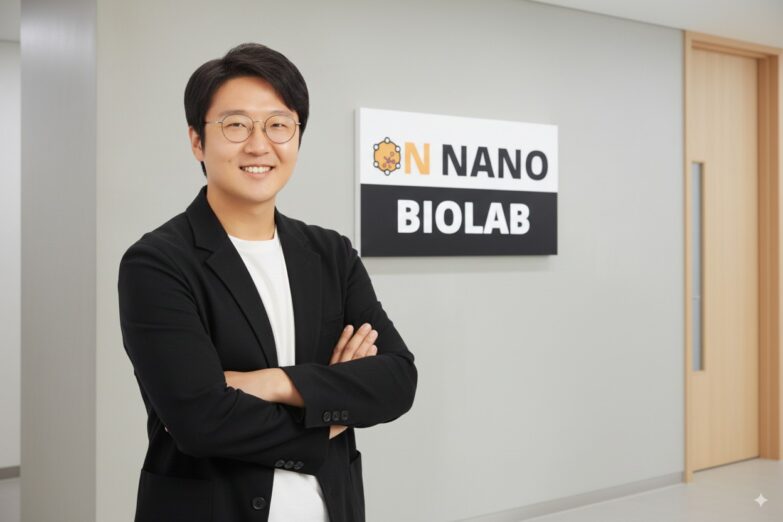
The motivation behind his rapid antigen kit development was simple yet clear: "I wanted to develop a diagnostic kit that would allow anyone to check their health status without having to go to the hospital."
The solution found for why the 'stars in the daytime sky' are not visible
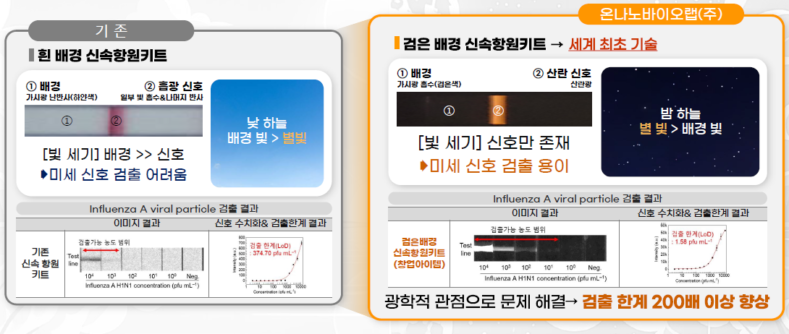
On Nano Biolab's core technology stems from a completely different perspective than the existing industry approach. CEO Kim explains that the idea came from "the reason why stars in the daytime sky are invisible."
"For the past 60 years, most efforts to improve the sensitivity of rapid antigen test kits have focused solely on developing biomaterials. However, I have introduced a novel approach from an optical perspective on materials."
Existing rapid antigen kits detect absorbance signals against a white background, making it difficult to detect subtle signals because the background signal is larger than the detected signal. On Nano Biolab changed this by detecting scattered light against a black background, ensuring that only the signal remains.
In actual clinical sample testing, while existing products have shown sensitivities of 40-60%, On Nano Biolab's black background rapid antigen kit demonstrated a sensitivity of 92%. This figure closely matches the results of PCR tests, improving the detection limit by more than 200 times.
Same manufacturing process, same cost
Just as noteworthy as the technological innovation is its commercial viability. The black background rapid antigen kit has the same structure as existing products, allowing it to utilize existing manufacturing facilities, and its manufacturing cost is similar to that of existing products.
CEO Kim emphasized, “Our biggest competitive edge is that we can achieve performance that is 200 times better than before using the same production process, while maintaining the same manufacturing cost.”
On Nano Biolab is expanding its business through a B2B strategy. With the number of rapid antigen kit developers rapidly increasing from 10-20 to over 100 following the COVID-19 pandemic, the company is supplying its kits in uncut sheet form, enabling existing companies to commercialize them under their own brands.
In just over a year since its founding, On Nano Biolab has achieved remarkable results. It won the Encouragement Award at the 2024 K-Deep Tech King of Kings Competition and the Gold Award at the KEPCO Faculty/Student Entrepreneurship Competition. In April 2025, it published a paper in Nature Communications. Furthermore, its technological prowess has been recognized, with the company being selected for the Youth Entrepreneurship Academy program.
Going forward, On Nano Biolab plans to raise a total of 2 billion won by 2029 to launch a variety of diagnostic kits, starting with a Flu A diagnostic kit, followed by those for acute myocardial infarction, residual antibiotics, and sexually transmitted diseases. Furthermore, the company plans to diversify its revenue streams by expanding into raw materials businesses, including gold and silver nanoparticles for high-sensitivity signal detection.
CEO Kim Ki-hyun stated, “The key to preventing diseases such as cancer, respiratory viruses, Alzheimer’s, myocardial infarction, and sexually transmitted diseases is early diagnosis,” and expressed his ambition, saying, “By developing a rapid antigen kit with PCR-level performance, we will implement individual-centered healthcare that allows people to check their health status anytime, anywhere.”
You must be logged in to post a comment.