



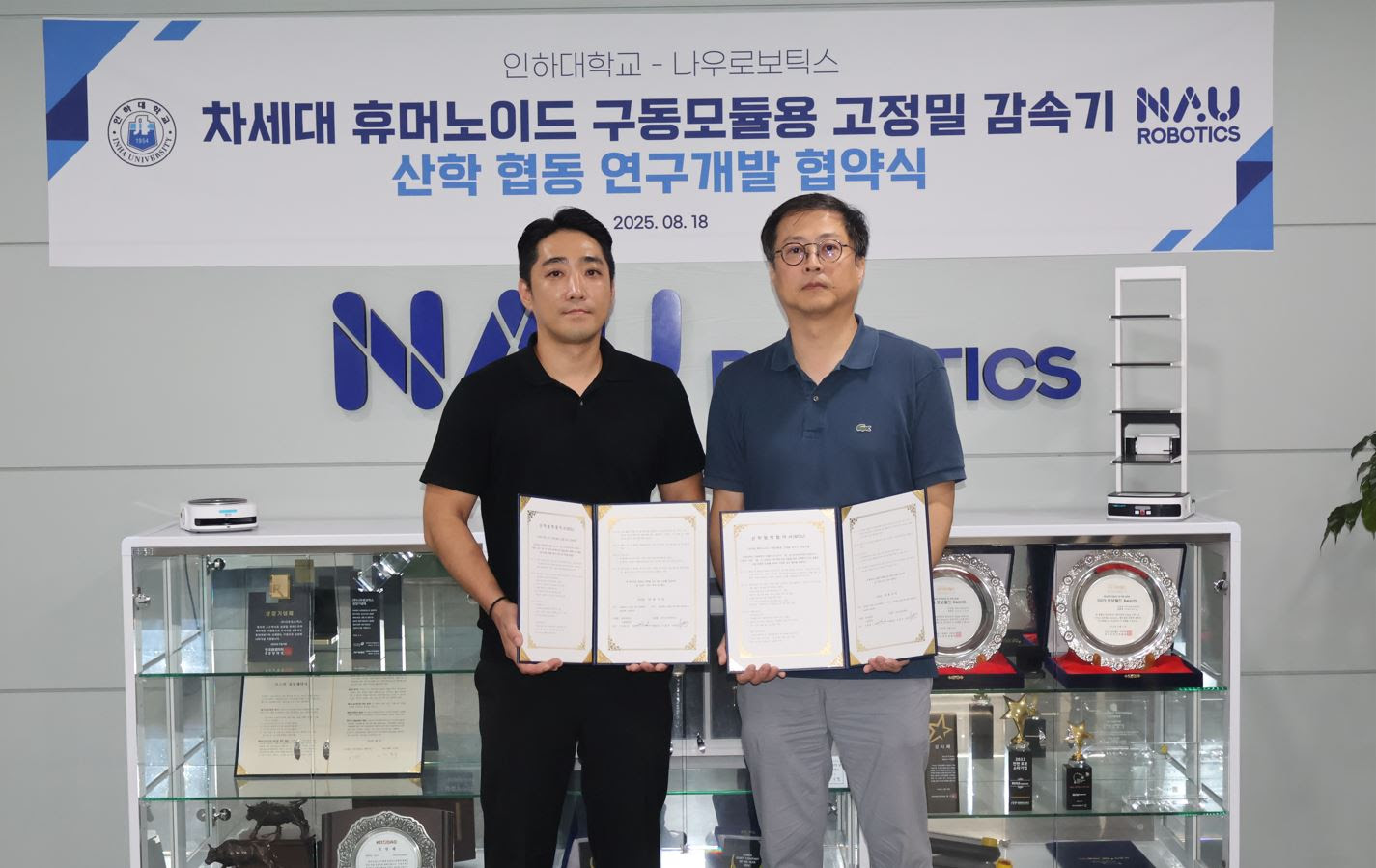
Robotics company Now Robotics (CEO Jong-ju Lee) announced on the 18th that it has begun joint development of a new concept reducer for high-precision drive modules to be applied to next-generation industrial humanoid robots with the research team of Professor Cheol-hee Lee of Inha University.
This industry-academia collaboration aims to develop a reduction gear that overcomes the structural limitations of existing precision reducers and offers enhanced performance in terms of precision, durability, and lightweight design. Future development will expand this reduction gear into an integrated drive module integrating the drive motor and controller, creating a drive system platform applicable not only to humanoid robots but also to a wide range of industrial applications.
In development, Nowrobotics will lead the design of a next-generation reducer capable of stable and precise control even in high-speed, high-torque environments based on its own mechanism design capabilities, while Inha University will provide theoretical support, including structural analysis, motion characteristic analysis, and performance verification.
This reducer is expected to be able to replace existing high-precision reducers based on structural differences such as ▲elimination of backlash phenomenon that affects positional accuracy during repeated use ▲improvement of precision and torque rigidity ▲improvement of vibration and micro-shaking problems in the mid- to low-speed range ▲ensuring stability in the low reduction ratio range.
A Nowrobotics official stated, “Existing reducers had limitations in repetitive durability and ultra-precision control,” and added, “Through this joint development, we plan to implement a high-precision reducer based on a new principle and enhance the technological competitiveness of robot drive systems.”
The reducer is designed for use in fields requiring high-precision operation, such as industrial robots, collaborative robots, electric vehicles (EVs), semiconductors, and display equipment. Through this, the strategy is to secure technological independence and market substitutability in the global reducer market.
In addition, the integrated drive module being developed this time will be applied to the industrial humanoid robot platform that Now Robotics is jointly developing with DGIST, and the plan is to increase the localization rate of robot systems and strengthen global competitiveness based on the highly reliable drive technology that integrates reducers, controllers, and servo motors.
Professor Lee Cheol-hee of Inha University said, “This joint development will be a case that presents a new standard for next-generation robot drive systems by integrating reduction device design, control, and analysis technologies,” and added, “We will conduct research with the goal of commercializing high-performance core components that can be practically applied in manufacturing sites.”
- See more related articles
You must be logged in to post a comment.