



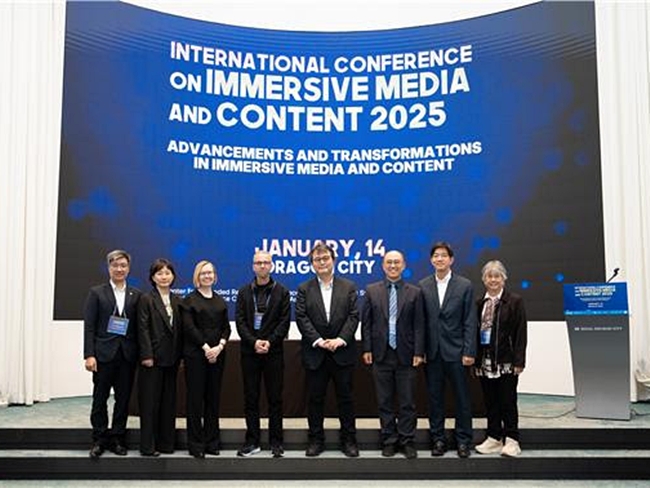
The Chung-Ang University Real Media Innovation Convergence University Project Group (Director Wi Jeong-hyeon) and the Chung-Ang University Virtual Convergence University (Dean Wi Jeong-hyeon) held the 2025 International Conference on Real Media and Contents at the Seoul Dragon City Hotel on the 14th with the theme of ‘Development and Transformation of Real Media and Contents.’
This conference was sponsored by the Ministry of Education, the National Research Foundation of Korea, the Convergence and Open Sharing System (CHS) Real-World Media Innovation Convergence University Project Group, the Korea Culture and Information Service, the Korea Game Society, the Korea Metaverse Industry Association, the Content Management Research Institute, the Content Future Convergence Forum, the Virtual Convergence Economy Activation Forum, and the Korea Venture Startup Association.
This conference, which is in its second year following 2024, began with keynote speeches by Professor Kiyoshi Shin, CEO of AI Prog Interactive in Japan and Professor of Digital Hollywood Graduate School, and Director Wi Jeong-Hyeon, followed by lectures and panel discussions.
In his welcoming speech, Wi Jeong-hyeon, the director of the Realistic Media Innovation Convergence University Business Group at Chung-Ang University, said, “The development of realistic media technology is redefining and transforming the ways in which industries connect, create, and collaborate, but it also faces various challenges. In order to overcome these challenges, we need to create the future by seeking creative and sustainable solutions and strategies with transnational cooperation and experts. In his keynote speech, under the theme of “Global Cooperation between Korea and Developing Countries through Virtual Technology to Solve the Environmental Crisis,” he said, “Immersive technology must meet the social needs of humanity and create value.” He cited the “Attractive Laos Ecotourism Project,” which implements Laos’ nature and culture into realistic content to reduce environmental impact without the movement of tourists, as an example, and suggested ways to utilize virtual technology to resolve the conflict between economic development and environmental protection in developing countries.
In his presentation titled “The Impact of AI on the Game Industry: Perspectives on Japanese Game Development,” Kiyoshi Shin, CEO of Japan’s AI Frog Interactive and professor at Digital Hollywood Graduate School, said, “Recently, game companies have been actively utilizing generative AI in the development process, which allows them to achieve high economic efficiency and efficiency, and increase the probability of success through faster and more trial and error.” He also said in a panel discussion that “since it is difficult to predict the success of immersive content, it is important to support it so that it does not lose its potential in the early stages, and a key factor for success is providing a strong experience to users.”
In a keynote speech at the conference, ▲Professor Hanna Wirmann from IT University of Copenhagen, Denmark, explained the impact of the characteristics of the platform on an individual's gaming experience using mahjong as an example in 'Understanding XR through Games', saying, "Mahjong games using virtual reality technology are not perfect simulations because they can be modified by adding or removing specific features, so the user's experience is completely different, and it can change the sense of presence, sense of space, relationships with others, interaction, and even social context beyond disabilities, generations, and space."
▲Professor Markus Wimker of the Department of Game Design at the University of Applied Sciences Cologne in Germany said in his presentation, “Overview of the German Game Market with a Focus on Realistic Media,” “Germany’s realistic content industry is not only focused on games, but also provides services such as consulting and infrastructure construction, and is operated by a small number of people. They are developing experience-oriented realistic content through collaboration with real content, such as combining automobiles and virtual reality, or allowing people to experience what Cologne was like in the 1920s.”
In addition to the game field of realistic media technology, ▲ Professor Cha Hoon-sang of the Department of Information Systems and Operations Management at Salisbury University in the U.S. stated in his book 'Understanding Factors Influencing the Acceptance of Virtual Reality: An Integrated Approach of the Stimulus-Organism-Response (SOR) Framework and the Technology Acceptance Model (TAM)' that "Perceived enjoyment was found to be positively influenced by vividness and realism, while perceived usefulness was found to be solely influenced by realism, and perceived ease of use was entirely influenced by interactivity." He continued, "Perceived usefulness, ease of use, and enjoyment were all found to have a direct positive effect on users' intention to adopt VR. These results will provide researchers and industry experts with insight into the development of VR systems and increase the possibility of industrial success by improving user satisfaction and acceptance through strategies according to applications."
▲Kakao Healthcare Director Eun-kyung Kang introduced the use and innovation cases and directions of immersive media technology in the digital healthcare field, saying, “The concept of object-centered digital twin is changing the paradigm of healthcare through the evolution to human digital twin based on human physical and mental data and intelligent digital twin that integrates AI technology.” She also concluded by saying, “The healthcare industry is directly and indirectly connected to various industries, and can pursue better health and well-being through cooperation, and ultimately, the goal is to improve our health by feeding back data obtained from the digital world to the real world.”
▲Paulina Pinnen, Senior Expert at ICE Institute in Indonesia, also explained the role of immersive media in the development of higher education in Indonesia, as well as the implementation of educational technology, policy, and support ecosystem.
▲ Professor Trung Anh of Vietnam University of Posts and Telecommunications Technology pointed out that “Immersive media technology is emerging as an innovative technology in Vietnam’s digital economy, and he shared the current status of technological development and XR education programs provided by universities, as well as cases of use in various fields such as healthcare, real estate, entertainment, and e-commerce, and that Vietnam, with such technology and a young workforce, is receiving attention from many global investors, but high implementation costs, infrastructure limitations, and consumer awareness remain as challenges.”
In the panel discussion that followed, it was suggested that realistic media technology is further developing through cutting-edge technologies such as AI, and that the level of content is also continuously improving. It was also suggested that technology should be approached from the user's perspective, and that, in a situation where the application of technology changes every day, it should not be limited to a specific platform or industry, but should be approached broadly to create synergy effects with various fields and create social and industrial values. In addition, it was discussed that although realistic media technology has not yet found a completely meaningful application in reality, significant changes are occurring in developing countries, and that it is difficult for actual experts to use advanced technologies.
Wi Jeong-hyeon, director of the Real Media Innovation Convergence University Business Group at Chung-Ang University, said, “I hope that this conference will provide the industry, government, and academia attending the conference with the latest information and knowledge on real media technology and content, and that this will be a practical help in designing future plans such as career paths, work, and businesses, and contributing to the activation of exchanges and the industrial ecosystem.” He added, “We will plan more substantial, detailed, and specialized conferences in the future and do our best to fulfill the university’s role in fostering global talent.”
- See more related articles
You must be logged in to post a comment.