



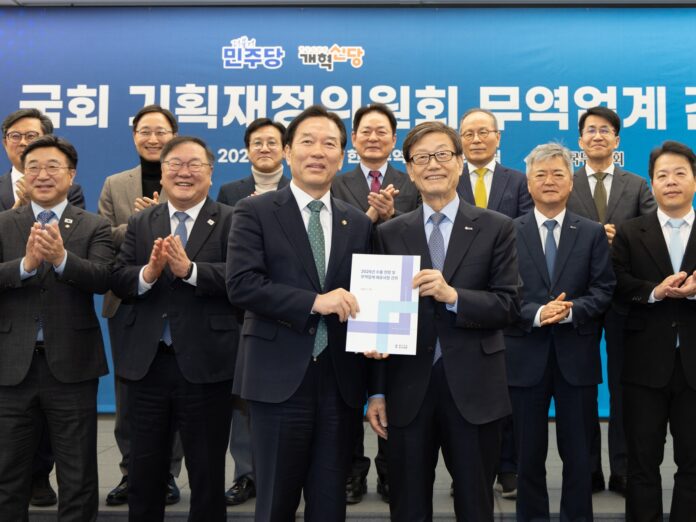
The Korea International Trade Association (KITA, Chairman Jin-sik Yoon) held the 'National Assembly Planning and Finance Committee Trade Industry Meeting' at the Trade Tower in Samseong-dong, Gangnam-gu, Seoul on the 16th and shared export issues and difficulties.
Nine opposition lawmakers from the National Assembly's Planning and Finance Committee, including Rep. Jeong Tae-ho, Rep. Kim Tae-nyeon, and Rep. Yoon Ho-joong of the Democratic Party of Korea, and 11 representatives and related personnel from export companies attended the meeting, where they discussed ways to expand tax support and detailed support measures to enhance the competitiveness of our companies, as well as regulations and difficulties in the export field.
In his opening remarks, Korea International Trade Association Chairman Yoon Jin-sik emphasized, “The trade industry is very concerned due to the internal and external uncertainties surrounding our economy,” and “In order to deal with the crises our companies are facing, such as the new U.S. administration’s trade pressure, China’s low-price offensive, and its pursuit of cutting-edge industries, and to secure competitiveness in the global market, support through tax legislation from the National Assembly is essential.”
In response, Rep. Jeong Tae-ho, floor leader of the Planning and Finance Committee, said, “We must focus our policy capabilities to find a breakthrough for the export crisis,” and added, “We will listen to the outlook for the export environment and the difficulties and suggestions of the trade industry and find practical measures to support export companies.”
The trade association requested ▲extension of the tax credit period for national strategic technologies to 2030, ▲gradual expansion of tax credits for overseas resource development investments, and ▲additional designation of promising fields such as bioenergy for national strategic technologies in order to strengthen tax support for national strategic technologies. At the same time, in order to improve the accessibility and effectiveness of tax financial support policies that have already been introduced, it suggested ▲extension of the temporary investment tax credit period for facility investment by SMEs to 2026 and expansion of its application to large corporations, ▲easing of requirements for maintaining business lines when transferring export companies, and a reduction in the maximum inheritance and gift tax rate.
In addition, we proposed tax support policies to strengthen the competitiveness of our export companies, such as ▲simplifying the current four-stage progressive corporate tax structure and lowering the top rate (24%), ▲gradually raising the tax deduction rate for large corporations' research and development expenses (currently 2%) to the OECD average (17%), and ▲introducing a global minimum tax exemption.
Chairman Yoon Jin-sik said, “In the history of Korea’s economic development, the key to overcoming crises has always been exports,” and added, “The trade industry will repay legislative activities to remove corporate regulations with export performance and contributions to economic growth.”
At the meeting that day, Chairman Yoon delivered a regulatory and difficulty suggestion containing the voices of the trade industry to the members of the Planning and Finance Committee who attended the event that day. Last year, the trade association suggested 213 regulations, difficulties, and suggestions from the trade industry to the National Assembly and relevant government ministries, and a total of 44 policy improvements and reflections, including 5 revisions to laws, were made.
- See more related articles
You must be logged in to post a comment.