



A 20-year challenge for a Korean who started a quantum computer company with a market cap of 10 trillion won
“Disruptive innovation starts with what the market doesn’t know.”
[Silicon Valley, USA] “Just six days ago, the market cap was $10.7 billion, but half of it disappeared overnight. This is actually evidence of the destructive power of quantum computers.”
Professor Jeongsang Kim of Duke University and co-founder of IonQ, the world’s leading quantum computer company, revealed his 20-year innovation journey at the UKF 2025 Startup Summit held in Silicon Valley on the 10th. The lecture was held right after NVIDIA CEO Jensen Huang said at CES 2024 that “it will take 15 to 20 years to commercialize quantum computers,” so the audience’s attention was heated.
“In 2004, experts said it would take 50 to 100 years to realize a quantum computer. That’s when we started the challenge.”
It was the moment when he, who had entered Seoul National University's Department of Physics in 1988, received a doctorate from Stanford, and then went on to Bell Labs, gave up the stable path of a scientist and chose an uncertain challenge.
He proposed three stages of innovation.
“There are three stages: scientific discovery, technological breakthrough, and sustainable innovation. Current quantum computers are at the same stage as computers in the early 1960s. Jensen Huang’s remarks paradoxically mean that in 20 to 30 years, quantum computer companies could become $3 trillion companies like Nvidia.”
“If you asked people before the invention of the automobile, they would have said, ‘I want a faster horse.’”
Professor Kim Jeong-sang cited Clayton Christensen's theory of 'disruptive innovation' and emphasized that true innovation cannot be found through market research or customer feedback.
He cited the success story of flash memory.
“At first, it couldn’t replace hard disks, but it attacked the niche market of CDs and films. It found a market that was sufficient even with a capacity of 10MB, and eventually it completely replaced hard disks. Disruptive innovation always starts from unexpected places.”
Professor Kim Jeong-sang cited the following as essential elements for successful innovation: ▲securing asymmetrical advantage ▲combining basic knowledge and creativity ▲collaborating with top talent. He emphasized, “True leadership is not about leading from the front, but creating an environment where people can achieve the best results.”
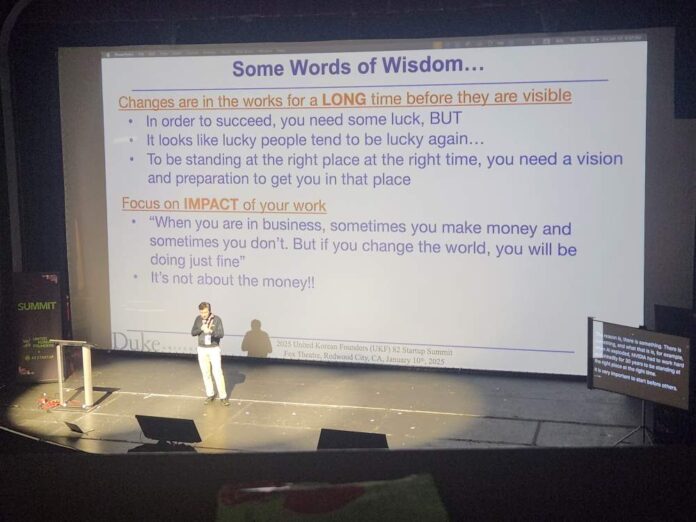
His interpretation of 'luck' was also unique. "The reason lucky people continue to look lucky is because they are prepared. Nvidia became a winner in the AI era because of 30 years of steady technological development."
In front of an audience of about 2,000, he gave his final advice to junior entrepreneurs.
“Focus on impact, not money. This is what Chairman Kim Jong-hoon of Unisys said. In business, there are times when you make money and times when you don’t. But if what you do changes the world, you will eventually succeed.”
After finishing his lecture, Professor Kim emphasized, “The future is uncertain, but there are opportunities in that uncertainty,” and “Don’t be afraid of challenges.” As soon as he finished speaking, cheers erupted from the audience.
You must be logged in to post a comment.