



“Thinking AI is Coming”… The AI Landscape Changed by Agent Workflow
[Silicon Valley, USA] “Just as electricity led to the industrial revolution, AI will become a general-purpose technology that permeates all industries.”
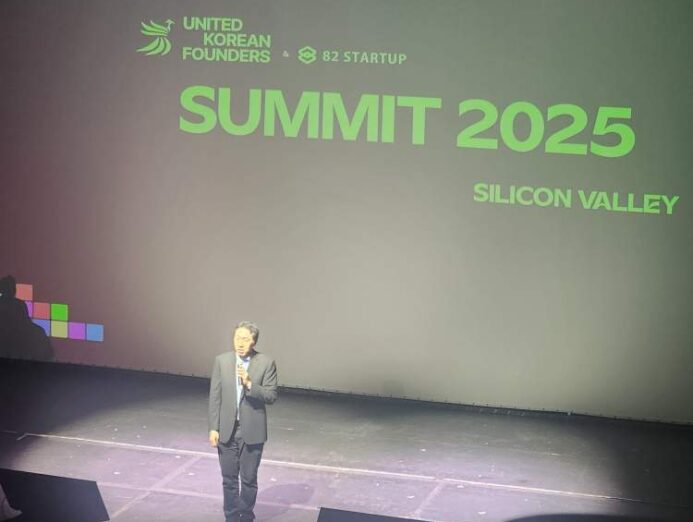
Stanford University professor Andrew Ng, a world-renowned AI expert, presented a vision for the future of AI innovation at the UKF 2025 Startup Summit. Professor Ng, known as the co-founder of Google Brain and the founder of AI education platform Coursera, explained the future direction of AI development after ChatGPT, saying, “The majority still underestimate the diversity of AI applications.”
Professor Eung cited 'agent workflow' as a notable AI trend. While existing AI was limited to simple question-and-answer, agent workflow performs repetitive tasks in which AI thinks, researches, and modifies results. "Just as humans go through the process of outlining, finding materials, writing a draft, and then modifying it when writing, AI is now capable of more systematic and in-depth work," he explained.
Professor Eung also suggested a new change in the AI technology stack. A new ‘agent orchestration’ layer has appeared on top of the semiconductor layer, cloud layer, and basic model layer. This refers to a software layer that effectively combines multiple AI models to perform more complex tasks.
He also highly evaluated the potential of the Korean startup ecosystem. “Korea has global competitiveness in the semiconductor sector, which is essential for AI innovation,” he said, emphasizing that “collaboration between Silicon Valley and Korean startups will become more important.”
It also heralded a revolutionary change in the AI development process. With the advancement of generative AI, the cost and time required to create prototypes have been greatly reduced, allowing companies to attempt more experiments and innovations. “AI system development that used to take 6 to 12 months is now possible in just 10 days,” he explained, adding, “A responsible approach is important along with rapid innovation.”
He presented the following as the core directions of future AI innovation: ▲a revolution in image processing beyond text processing ▲creation of new opportunities due to the reduction in data gravity ▲increased importance of unstructured data processing. He predicted, “Just as text analysis has created great economic value, image analysis will create a new wave of innovation in the future.”
He also shared his experience in fostering startups through AI funds. “We are working with corporate partners to create innovative AI startups,” he said. “In particular, we hope to see the creation of startups that will lead the global market through collaboration with Korean companies.”
Finally, Professor Eung emphasized the need for AI education. “The fastest-growing course on Coursera in 2023 was ‘Generative AI for Everyone,’” he said, adding, “It is most important to understand and utilize the business opportunities that AI will bring, even if you do not have technical knowledge.”
You must be logged in to post a comment.