



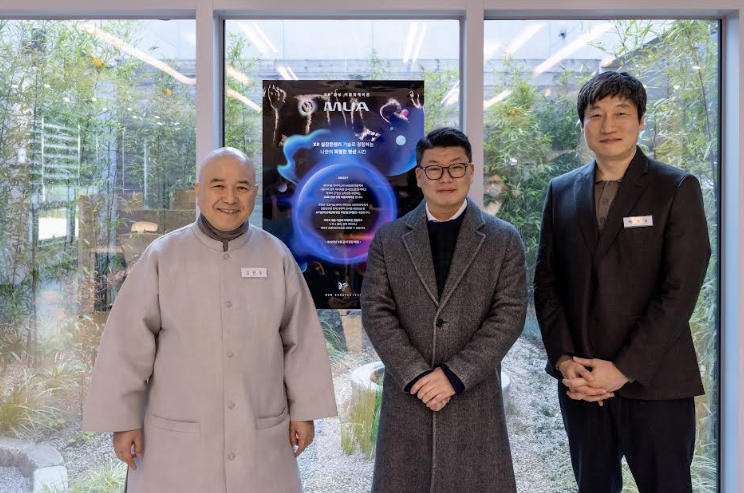
NP, a company specializing in XR (extended reality) content, announced on the 10th that it is developing an "XR Meditation App" through joint research with KAIST's Department of Brain and Cognitive Sciences. The app is designed to allow anyone to experience the positive effects of meditation in their daily lives, and is aiming for a release in the first half of 2025.
NP plans to combine its proprietary XR content production technology with KAIST's neuroscience and engineering expertise to present personalized XR meditation content that differentiates itself from existing meditation content. This app is optimized for XR devices such as VR headsets and XR smart glasses, and is designed to allow users to experience meditation. Specifically, it provides a personalized meditation experience in a space isolated from the outside world through XR devices, and through linking with wearable devices, it analyzes an individual's physical condition in real time and presents customized meditation content.
Professor Park Hyung-dong's research team at KAIST's Department of Brain and Cognitive Sciences is developing a hyper-personalized AI algorithm that recommends optimal meditation content for each user based on biometric data and emotional state measurements collected from wearable devices. KAIST's Department of Brain and Cognitive Sciences, in collaboration with Professor Jeong Jae-seung, established the Meditation Science Research Institute to study the scientific validation and effectiveness of meditation. In this research, they are collaborating with meditation expert and Director of the KAIST Meditation Science Research Institute, Kim Wan-doo, to enhance the scientific credibility and expertise of the content.
NP CEO Baek Seung-eop said, “The ‘XR Meditation App’ currently under development through joint research with KAIST will go beyond simple entertainment content and become XR killer content that will bring about real changes to users’ daily lives,” adding, “We expect it to be innovative meditation content suitable for the modern generation that is accustomed to videos.”
Professor Jaeseung Jeong, head of the Department of Brain and Cognitive Sciences at KAIST, said, “We hope that through this study, many users will be able to experience the scientifically proven positive effects of meditation.”
You must be logged in to post a comment.