



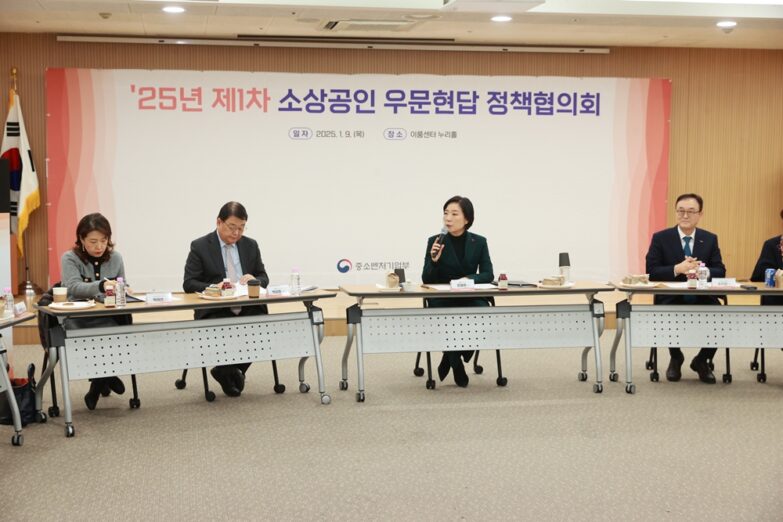
The Ministry of SMEs and Startups (Minister Oh Young-joo, hereinafter referred to as the Ministry of SMEs and Startups) announced on the 9th that it held the first 'Small Business Owners' Q&A Policy Council' (hereinafter referred to as the Policy Council) in 2025 at the Irum Center in Yeouido, Seoul.
This policy council meeting marked the first of the new year since Minister Oh Young-joo announced at the December meeting last year that he would "continue to pursue the policy council meeting in 2025." The event was attended by the president and vice president of the Korea Federation of Micro Enterprise, regional branch heads of the Korea Federation of Micro Enterprise, regional headquarters directors of the Korea Small Business Corporation, and relevant experts.
On this day, the Ministry of SMEs and Startups held an explanation session for the ‘Small and Medium Business Owners’ Q&A Policy Council’ as the first agenda item for the policy council.
First, I explained policies related to the early implementation of the livelihood budget and stimulating domestic demand. The selection process for small business support projects will begin promptly in early January, with implementation planned as early as possible in the first half of the year. Meanwhile, the KRW 3.77 trillion in small business policy funds will also be implemented promptly, starting in mid-January.
Additionally, the discount rate for Digital Onnuri Gift Certificates will be increased from 10% to 15% during the Lunar New Year holiday period, and the use of Onnuri Gift Certificates will be promoted. This includes offering cashbacks when using Digital Onnuri Gift Certificates at participating stores. Furthermore, the company plans to spur domestic demand by hosting the Donghaeng Festival at least three times a year.
Second, we introduced policies to ease the financial burden on small business owners. We will strengthen the three-part package of financial support for small business owners, including relaxing the eligibility requirements for the SME policy loan repayment extension program and expanding the scope of conversion guarantees. Furthermore, we plan to strengthen financial support for small business owners by establishing a KRW 100 billion "Mutual Growth Support Fund" to support the symbiotic relationship between small business owners and e-commerce platforms.
Third, we outlined policies to support the management stability and recovery of small businesses. This year, approximately 680,000 small business owners will receive new support of up to 300,000 won for delivery and courier fees, while preferential commission rates for small and medium-sized card merchants will be reduced by 0.05 to 0.1 percentage points. Furthermore, to support small business owners' recovery, we will expand support for store demolition costs from 2.5 million won to 4 million won. We will also provide in-depth mentoring and funding from dedicated project managers (PMs) for those ready to start a new business.
Finally, we announced new policies to support the growth of small businesses. To facilitate the growth of small businesses, SMEs, and then mid-sized enterprises, KRW 780 billion in growth-ladder policy financing will be provided. Furthermore, we will intensively foster export-oriented small businesses by establishing an export package program in collaboration with global companies like Amazon and utilizing professional sellers to support the entire process from store opening to sales and delivery.
After the Ministry of SMEs and Startups' policy explanation, time was spent discussing the current status and difficulties of the local small business industry, as well as policies desired for this year, with the heads of local branches of the Federation of Small Businesses and the regional headquarters of the Small Business Market Promotion Agency.
The event proceeded in the order that the regional headquarters directors of each Small Business Corporation explained the characteristics of the small business sector in their respective regions, management conditions, and other relevant current situations, while branch heads in each region suggested issues and policy suggestions related to small business owners in their respective regions.
The heads of local branches of the Korea Federation of Micro Enterprise, who attended the meeting, delivered a lively and unvarnished presentation of recommendations from the field, including easing policy funding requirements, expanding support for digital transformation, and revitalizing consumer incentives. Regional challenges and suggestions will be actively reflected in the policy implementation process, following internal review and consultation with relevant ministries.
Song Chi-young, president of the Korea Federation of Micro Enterprise, said, "Last year, through the Q&A session, we significantly strengthened and reflected on-site communication, addressing issues such as the burden of small business management costs and business-related regulations. I hope that this year, too, policies will be developed through the hands-on experience of small business owners, and that they will be able to experience these changes on the ground."
He continued, "Amidst the recent political instability and challenging economic conditions, I appreciate the Ministry of SMEs and Startups' unwavering support for the people's economy, including the early execution of this year's budget for small businesses. Considering the difficult livelihood conditions, I urge all ministries to make efforts to restore the warmth of small businesses during the upcoming Lunar New Year holiday."
Meanwhile, Minister Oh Young-joo, who presided over the meeting that day, said, “This year’s Q&A session will delve deeper into the small business field, so we invited small business owners from all over the country, including branch heads of the federation, to the first meeting of the new year.” He added, “This year, we will do our best to meet small business owners from more diverse fields, industries, and regions so that the various small business policies contained in the new year’s economic policy direction can take root in the field.”
- See more related articles
You must be logged in to post a comment.