



[Business Parallel Theory Through Historical Stories]
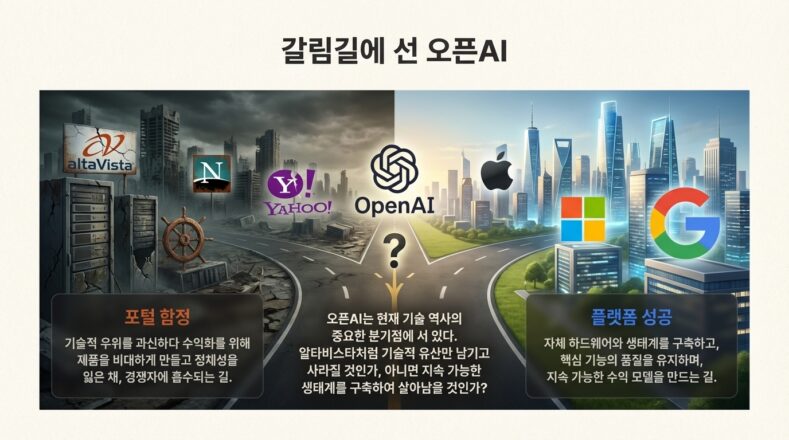
A similar trajectory is observed between AltaVista, which burst onto the scene in 1995 and set the standard for internet search, and OpenAI, which spearheaded the generative AI revolution in 2022. Both companies dominated the market with overwhelming technological superiority, but faced the common challenges of identity confusion, pressure to monetize, and the pursuit of a giant competitor like Google. Retracing AltaVista's demise provides a valuable perspective for examining the structural risks OpenAI currently faces.
Both AltaVista and OpenAI started out as "success, not a business." AltaVista was developed as a technology demo to showcase the capabilities of Digital Equipment Corporation (DEC)'s high-performance servers and Alpha chips. OpenAI, too, began with the non-profit goal of safe AI research for humanity. Both companies share a common goal: not being designed for commercial success. However, the market response exceeded expectations. The explosive traffic and user influx propelled both organizations to the forefront of their industries.
The problem was the next step. AltaVista's strategy faltered as ownership changed from DEC to Compaq and then to CMGI, opting instead for expansion into portals and a core value of search. OpenAI, too, is struggling to balance its nonprofit mission with its for-profit business under a complex governance structure with Microsoft. The generative AI market is expanding across all industries at an average annual growth rate of over 40%, but the technological gap is rapidly narrowing, eroding the early-mover advantage.
The most direct lesson from the AltaVista case is the shelf life of technological superiority. Initially, AltaVista's search performance was difficult for competitors to match, but the emergence of Google's PageRank algorithm dramatically changed the situation. Currently, OpenAI is locked in a fierce performance race with Google's Gemini 3 and Anthropic's Claude. GPT, once known for its ability to "answer anything," is now approaching the industry standard. This means that performance alone is no longer sufficient to build a long-term moat.

Another common risk is expansion strategies. AltaVista attempted to transform itself into a portal encompassing news, shopping, and email, rather than maintaining its core search functionality, leading to a fragmented user experience. OpenAI is also showing signs of functional bloat by integrating search, image generation, code writing, and voice conversation capabilities into ChatGPT. Similar concerns arise, as services become more complex under the guise of platform expansion, potentially blurring the clarity of the core experience.
An industry analyst report stated, "History doesn't repeat itself, but it does rhyme. AltaVista's trajectory of glory and demise mirrors the existential crisis OpenAI now faces." A former DEC executive's statement, "We're not a search engine company," symbolizes the identity crisis AltaVista faced. In contrast, OpenAI's founding mission was to "ensure digital superintelligence benefits humanity." Its current expansion is being tested to see how it aligns with this initial ideal.
OpenAI stands at a crossroads. It must choose between securing infrastructure leadership through proprietary chip development and device ecosystem development, or increasing platform retention through service expansion. The development of ASICs to reduce dependence on NVIDIA and the ability to clearly define ChatGPT's core role as an "intelligent assistant" rather than a "multi-functional tool" are key variables that will determine its future success or failure. The AltaVista precedent demonstrates that even technology leaders can quickly become marginalized if they lose their strategic focus. 2026 will likely be a turning point that determines whether OpenAI can avoid this trend.
You must be logged in to post a comment.