



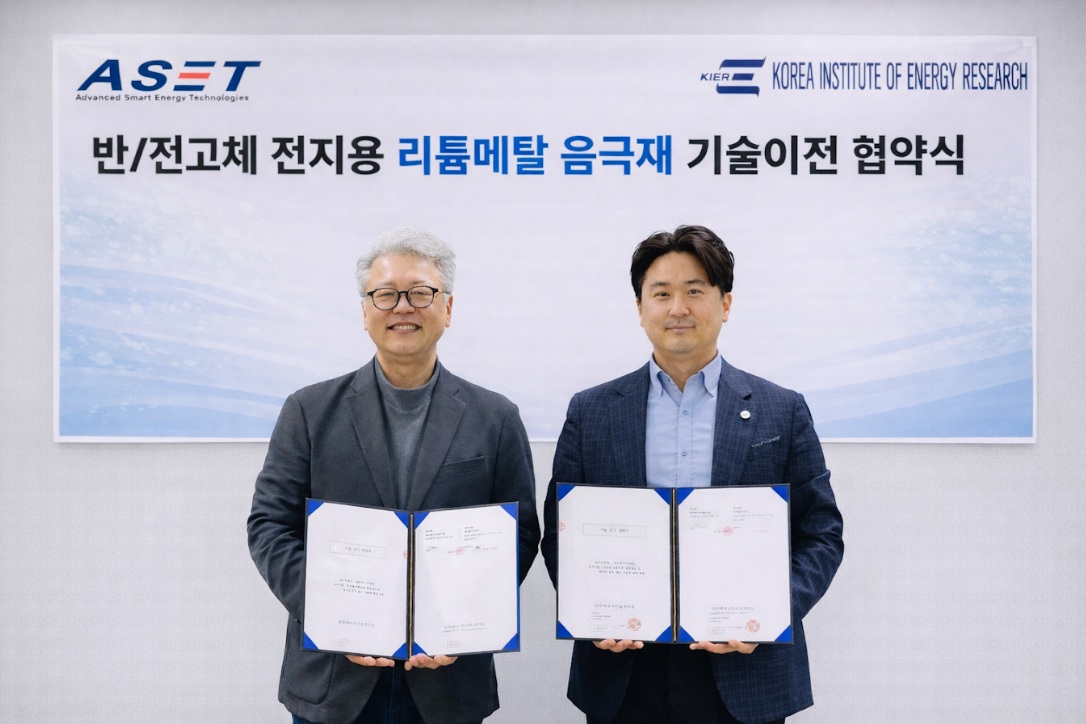
ASET (CEO Park Seok-jeong), a next-generation secondary battery materials specialist, announced on the 6th that it has signed a second technology transfer agreement with the Korea Institute of Energy Research for core technologies related to lithium metal batteries for next-generation secondary batteries.
This contract, signed on the 5th, includes lithium metal anode stabilization technology, interface control technology, and next-generation electrode structure design technology developed by the Korea Institute of Energy Research. These technologies are considered core elements in semi- and all-solid-state battery structures and are considered next-generation battery technologies capable of simultaneously achieving high energy density and high safety.
Previously, ASAT signed a first-stage technology transfer agreement with the Korea Institute of Energy Research (KIER) in 2023 for core technology in all-solid-state electrolytes for next-generation secondary batteries. Building on this agreement, ASAT is currently pursuing technological advancement and commercialization of all-solid-state electrolyte membranes for semi-solid-state and all-solid-state batteries.
This second technology transfer agreement is interpreted as a strategic move to gradually internalize key components of semi- and all-solid-state batteries by combining existing solid-state electrolyte technology with lithium metal cathode and next-generation electrode technology.
Based on the technology acquired through two technology transfer agreements, ASAT has established a mid- to long-term roadmap to commercialize semi- and all-solid-state batteries that incorporate both solid-state electrolytes and lithium metal cathodes by 2030. Beginning this year with prototype development and performance verification, the company plans to move into the commercialization phase through gradual technological advancement and verification.
CEO Park Seok-jeong stated that this technology transfer agreement will serve as an opportunity to complete the core technology portfolio for commercializing semi- and all-solid-state batteries, and that the company will secure competitiveness in the high-safety, high-energy next-generation battery market.
AST plans to continuously expand cooperation with domestic and international research institutes and global partners under the strategy of becoming a next-generation battery core materials and systems company that integrates all-solid-state electrolyte membrane and lithium metal technology, focusing on semi-solid-state and all-solid-state batteries.
- See more related articles
You must be logged in to post a comment.