



Kangsters, building a wheelchair-based physical esports ecosystem
A data-driven exercise platform born from rehabilitation experience and empathy.
-Expansion toward K-Parallel eSports standards through CES
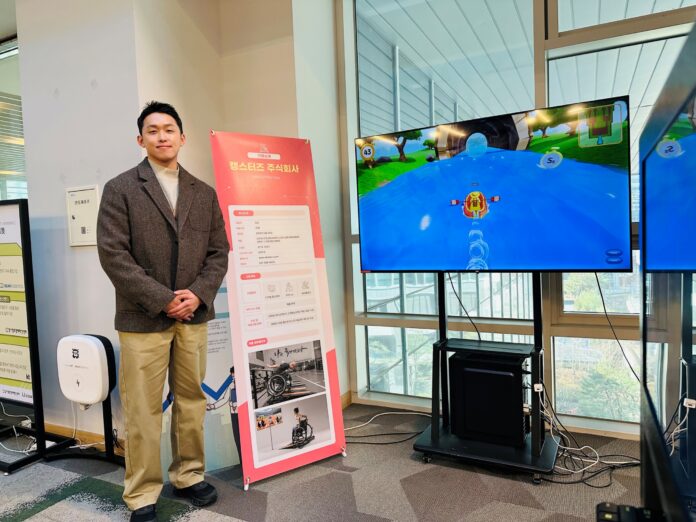
For wheelchair users, exercise isn't a choice; it's a matter of survival. Outdoor aerobic exercise presents significant physical limitations, and indoor exercise offers few options. This problem has become even more acute during the COVID-19 pandemic, when people were restricted from going outside. Kangsters, an AbleTech startup, emerged from this structural void.
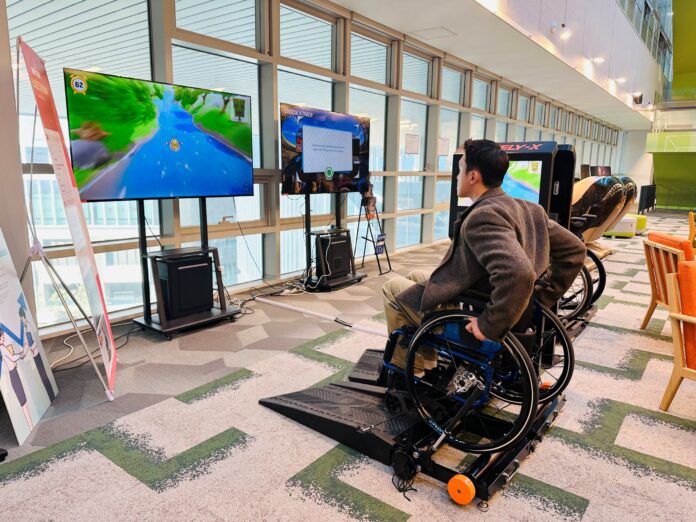
The future Kangsters is envisioning isn't simply a "company selling exercise equipment." It's a new way of life where exercise, gaming, and jobs all work simultaneously from the comfort of a wheelchair—an ecosystem that reimagines the daily lives and possibilities of people with disabilities. At the heart of this solution is Wheely-X, a treadmill-based exercise platform specifically for wheelchairs. It allows users to lift their wheelchairs into the air for indoor aerobic exercise, and by incorporating XR gaming content, it has opened up a new genre: "exercise esports," or Physical Esports.
“Rehabilitation is not an option, but a condition of recovery.”
Kim's deep empathy for disability sports and rehabilitation stems from personal experience. While working as a Taekwondo instructor in the United States, teaching athletes and the general public at a local gym, he suffered a serious injury in a fall during an outdoor demonstration. After this sudden accident and the lengthy rehabilitation process, he realized that "the ability to exercise" isn't a matter of individual willpower, but rather a matter of environment and equipment.
While staying at the rehabilitation hospital, CEO Kim's perspective naturally expanded to encompass his surroundings. He began to see the realities of those spending even longer in the hospital than he did, and of people with disabilities who had to juggle long periods of rehabilitation with their daily lives. The fact that his mother was wheelchair-bound made this issue even more personal.
The reality of not being able to move freely even in the confines of one's home and having few options for exercise wasn't simply an inconvenience; it was a structural constraint. This experience prompted CEO Kim to consider not just "assisted devices," but tools that could help people regain control of their bodies, recover, and connect with society. This is why Kangsters began not simply with product development, but with a critical awareness of the need to reimagine the possibilities of exercise, rehabilitation, and life.
“Trust must be built first.”
This awareness of the problem was first realized with the launch of "Wheelster Mini," a portable wheelchair wheel cleaning solution in 2021. At the time, CEO Kim didn't have a clear business roadmap. However, one hypothesis was clear.
“For these people to get back out there, trust and empathy must be built before technology.”
The Wheelster Mini was developed based on the feedback of hundreds of wheelchair users and garnered market acclaim as a solution to everyday inconveniences. However, as the company gained experience in the field, its limitations became clear. It was difficult to fundamentally expand the scope of life by simply providing convenience of mobility. This led Kangsters to make a strategic pivot, shifting its focus from manufacturing "assisted devices" to becoming a platform for accumulating exercise and health data. The Wheelster Mini was developed based on the feedback of hundreds of wheelchair users and garnered market acclaim as a solution to everyday inconveniences.
Creating the first 'exercise data' for people with disabilities
The WheelieX is a dedicated exercise device designed to allow wheelchair users to engage in steady aerobic exercise for over 30 minutes. However, what Kangsters has created isn't simply hardware. At its core is a platform structure organically connecting sensor modules, a mobile app, a server, and game content.
“For people with disabilities, exercise data itself is almost non-existent.”
Even basic health data such as heart rate, exercise frequency, and performance changes have never been systematically collected. Kangsters began accumulating rare exercise and health data for people with disabilities, such as age, disability type, physical level, exercise frequency, and content usage patterns, through the WheelieX. This will become an important infrastructure that can be expanded into the medical, insurance, and rehabilitation fields in the future. In particular, the WheelieX has implemented a universal design that covers over 1,600 physical conditions with a single model. The core of Kangsters' technology is that it is designed to ensure stability and mobility on the same device regardless of disability type and physical level.
Exercise becomes a 'culture'
The turning point was the game content. Kangsters was developed not simply for fun, but as a functional game that yields actual exercise results. From wheelchair control sensitivity and physical level adjustments to treadmill sensing integration—the game was thoroughly designed as an "exercise tool."
“More important than graphics is how accurately the physical responses and technology mesh.”
As games became integrated, change occurred rapidly. Online and offline communities formed, and competitions were established. Kangsters has hosted domestic disabled e-sports competitions annually for the past three years, developing over 300 players. This trend ultimately led to its adoption as an official event by the Korea Disabled e-Sports Federation. Wheelchair racing became an official event in the XR category, and Kangsters owns both the equipment and the game IP. This has secured a sustainable business structure that new entrants cannot easily replicate.
From CES to Expo
Kangsters' technology and vision were recognized internationally before they were recognized domestically. Since first unveiling the WheelieX on the global stage at CES, it has been recognized for both its technological prowess and social impact, winning TIME's "Best Inventions of 2024," a CES Innovation Award, and an Edison Award in succession. Kangsters' experiments have since been embraced as a "future you can experience" at disability, rehabilitation, and healthcare expos, including the Abilities Expo in the U.S. Over 500 people participated in each event, and all products sold on-site have sold out.
Currently, approximately 25% of Kangsters' sales come from overseas consumers, universities, hospitals, and research institutions. In particular, Virginia Tech, California State University, and Mount Sinai Hospital are using the WheelieX for research purposes to verify the effectiveness of game-based aerobic exercise. In fact, one study found that the game-based exercise group saw an average of 15% improvement in energy expenditure and brain activity compared to the non-game group.

Setting the standard for K-Parallel eSports
Kangsters is currently raising Series A funding. CEO Kim outlined specific goals for next year: establishing 10 domestic physical esports teams, training 100 players, and increasing overseas sales to 40%. More important than mere external growth is whether this structure functions as a sustainable ecosystem. He emphasizes that physical esports should not be limited to one-off events or welfare programs.
The ultimate goal is clear: to establish physical esports as a formal global culture and industry, culminating in the 2028 LA Paralympic Games. To achieve this, Kangsters is working to standardize equipment, games, game operation regulations, and athlete training systems. This is why CEO Kim says, "The period after it becomes a sport is even more important." He believes that once it becomes a sport, it becomes a culture, and once it becomes a culture, it becomes an industry.
“It's a sport and culture that everyone can enjoy.”
CEO Kim's words capture the vision Kangsters envisions. While the WheelieX began as a device exclusively for people with disabilities, non-disabled visitors were more active in overseas exhibitions and experience centers. When combined with gaming, the wheelchair became a new way of playing, rather than a symbol of limitation. The physical esports Kangsters envisions are the most intuitive interface, blurring the lines between disabled and able-bodied.
What began as a small experiment in a wheelchair has now expanded beyond the realm of exercise to encompass gaming, jobs, and social connections. This structure, which allows for home training, health recovery, and competitions that lead to income and jobs, represents a new form of exercise that is difficult to explain through existing sports or welfare models. Kangsters is elevating this structure through technology, data, and culture, setting a global standard.
Imbuing a field with rules and a language that didn't even have a name yet. Kangsters' challenge isn't simply about opening a new market. It's also about questioning who can become the subject of sports, who can stand at the center of the industry. And now, one answer to that question is being created in a wheelchair.
You must be logged in to post a comment.